European Plans for ‘Vaccine Passports’ Were in Place 20 Months Prior to the Pandemic. Coincidence?


European Plans for ‘Vaccine Passports’ Were in Place 20 Months Prior to the Pandemic. Coincidence?

 689
 1029  69
 
 1940

All Global Research articles can be read in 51 languages by activating the “Translate Website” drop down menu on the top banner of our home page (Desktop version).

***

With the world being told that so-called ‘vaccine passports’ will be required for all international travel in future, and in many countries even to enter shops, restaurants, bars, gyms, hotels, theatres, concerts and sports events, the impression we are being given is that the measure is a direct result of the coronavirus pandemic. In Europe, however, which hosts 8 of the top 10 pharmaceutical exporting countries, planning for vaccine passports began at least 20 months prior to the start of the COVID-19 outbreak. Apparently, the pandemic conveniently provided European politicians with the ‘excuse’ they needed to introduce the idea.

The ‘European Commission’ – the executive body of Europe – first published a proposal for vaccine passports on 26 April 2018. Buried deep in a document dealing with ‘Strengthened Cooperation against Vaccine Preventable Diseases’, the proposal was essentially ignored by the mainstream media.

A roadmap document issued in early 2019 subsequently set out specific plans for implementing the European Commission’s proposal. The primary action listed in the roadmap was to “examine the feasibility of developing a common vaccination card/passport” for European citizens that is “compatible with electronic immunization information systems and recognized for use across borders.” The plan aimed for a legislative proposal to be issued in Europe by 2022.

Interestingly, the roadmap uses several terms that, while relatively uncommon in most countries prior to the pandemic, have since become heard on a daily basis in the mainstream media. Perhaps the most notable of these is ‘vaccine hesitancy’. Supporting European countries in “countering vaccine hesitancy” is listed in the document as one of the key action points.

The possibility of pandemics and “unexpected outbreaks” occurring is also referred to in the roadmap. Revealingly, specific reference is made to supporting the authorization of “innovative vaccines, including for emerging health threats.” Stating that the “vaccine manufacturing industry” has a “key role” in meeting the aims described in the document, the roadmap lists “improving EU manufacturing capacity” and stockpiling vaccines as further action points to be considered. Towards strengthening “existing partnerships” and “collaboration with international actors and initiatives,” the roadmap also refers to a global vaccination summit meeting that took place in September 2019. A close examination of the attendees and subject matter for this meeting is revealing.

The 2019 Global Vaccination Summit

Unreported by most mainstream media outlets, a ‘Global Vaccination Summit’ was hosted in Brussels, Belgium, on 12 September 2019. Organized by the European Commission in cooperation with the World Health Organization, the meeting took place just 3 months before the coronavirus outbreak began. Significantly, this was also only 36 days before the now infamous coronavirus outbreak simulation exercise, supported by the Bill & Melinda Gates Foundation, the World Economic Forum, and Johns Hopkins Bloomberg School of Public Health, which took place on 18 October 2019.

An invitation-only event, the vaccination summit participants included political leaders, high-level representatives from the United Nations and other international organizations, health ministries, leading academics, scientists and health professionals, the private sector, and non-governmental organizations.

The summit was structured around three round tables entitled ‘In Vaccines We Trust’, ‘The Magic Of Science’, and ‘Vaccines Protecting Everyone, Everywhere’. Notable panel members for these round tables included Nanette Cocero, Global President of Pfizer Vaccines; Dr. Seth Berkley, CEO of GAVI, the Global Vaccine Alliance – an organization that has received vast amounts of funding from the Bill & Melinda Gates Foundation; and Joe Cerrell, the Bill & Melinda Gates Foundation’s Managing Director for Global Policy and Advocacy.

Pandemic planning was clearly in evidence at this summit meeting. Key documents distributed to the participants included reports on ‘Pandemic influenza preparedness planning’, ‘A pandemic influenza exercise for the European Union’, ‘Avian Influenza and Influenza Pandemic Preparedness Planning’, ‘Pandemic influenza preparedness and response planning’, ‘Towards sufficiency of Pandemic Influenza Vaccines in the EU’, and ‘A “Public Private Partnership” on European Pandemic influenza vaccines’. Across all these documents, the goal of strengthening collaboration with the pharmaceutical industry is repeatedly stressed, as also is the message that a global pandemic was now inevitable.

Vaccine passports: who really benefits?

Who really benefits from vaccine passports? Certainly not ordinary people, for whom sharing their health records and other personal data could soon become mandatory merely for participation in society. Instead, the chief beneficiary will be the multinational pharmaceutical industry. With global drug and vaccine sales already forecast to reach $1.5 trillion this year, pharmaceutical companies and their investors are salivating at the prospect of vaccine passports becoming mandatory worldwide.

The total market for COVID-19 vaccines is predicted to be worth $100 billion in sales and $40 billion in post-tax profits. Annual vaccinations against mutations of the coronavirus could raise these numbers still further. Unless we resist vaccine passports and instead ‘vote for reason’, drug and vaccine makers could force the world into long-term economic and political dependency. Our urgent goal must therefore be to replace the greed-driven pharmaceutical ‘business with disease’ with a healthcare system based on truly preventive approaches. Accepting the pharmaceutical industry’s alternative to this is simply unthinkable.

*

Note to readers: please click the share buttons above or below. Forward this article to your email lists. Crosspost on your blog site, internet forums. etc.

This article was originally published on Dr. Rath Health Foundation.

Executive Director of the Dr. Rath Health Foundation and one of the coauthors of our explosive book, “The Nazi Roots of the ‘Brussels EU’”, Paul is also our expert on the Codex Alimentarius Commission and has had eye-witness experience, as an official observer delegate, at its meetings.

Featured image is from Dr. Rath Health Foundation

Why Are We Vaccinating People on the Brink of Death?


Why Are We Vaccinating People on the Brink of Death?

Region:
 18
 21  7
 
 46

All Global Research articles can be read in 51 languages by activating the “Translate Website” drop down menu on the top banner of our home page (Desktop version).

***

In mid-January 2021, Bloomberg published an article titled Norway Warns of Vaccination Risks for Sick Patients Over 80. According to the article, Norway warned that Covid vaccines may be too risky for the very old and terminally ill. Norwegian officials said 23 people had died in their country a short time after receiving the first dose of the Covid vaccine. Of those deaths, 13 have been autopsied, with the results suggesting that common side effects may have contributed to severe reactions in frail, elderly people, said the Norwegian Medicines Agency.
“For those with the most severe frailty, even relatively mild vaccine side effects can have serious consequences… For those who have a very short remaining life span anyway, the benefit of the vaccine may be marginal or irrelevant.” – Norwegian Institute of Public Health

In clinical studies of Pfizer’s Covid vaccine, adverse reactions in participants included: pain at the injection site (84%); fatigue (63%); headache (55%); muscle pain (38%); chills (32%); joint pain (24%); fever (14%); and injection site swelling (11%).[1]

Clinical studies of Moderna’s Covid vaccine revealed an even higher frequency of adverse reactions in participants including: pain at the injection site (92%); fatigue (70%); headache (65%); muscle pain (62%); joint pain (46%); chills (45%); nausea/vomiting (23%); fever (16%); and swelling at the injection site (15%).[2]

Given the high frequency of adverse reactions from Covid vaccines, why are we vaccinating people on hospice who are near the end of their life? Hospice and comfort care are for people who are in the final stages of an incurable illness. The aim is to ensure they are comfortable. When someone enters hospice care they generally have fewer than six months to live and have decided to stop treatments to prolong their life.

“We have now repeated our existing advice not to give the vaccine to terminally ill patients” – Norwegian Medicines Agency[3]

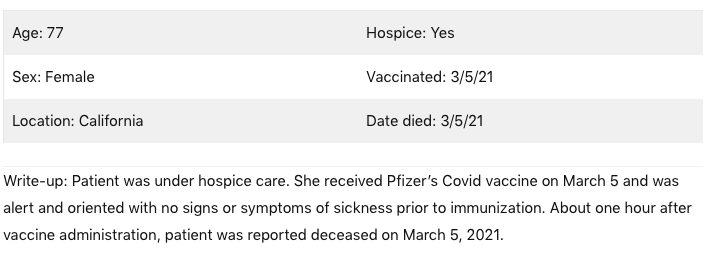
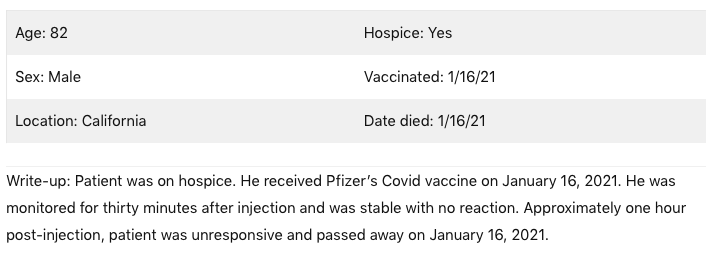
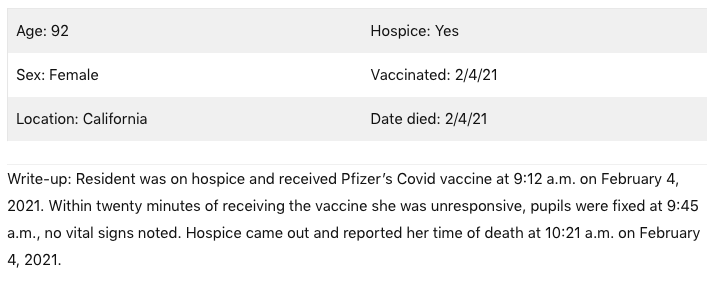
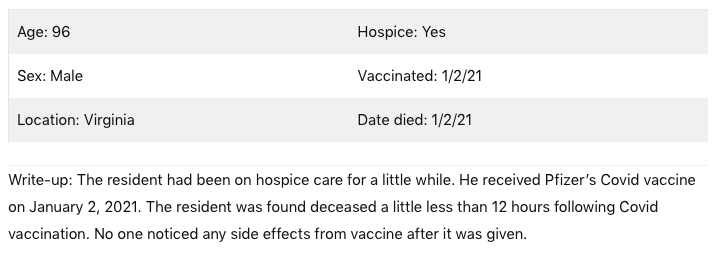
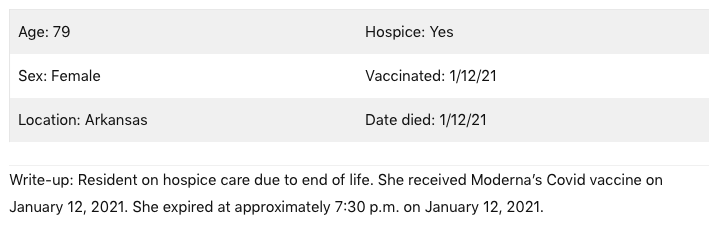
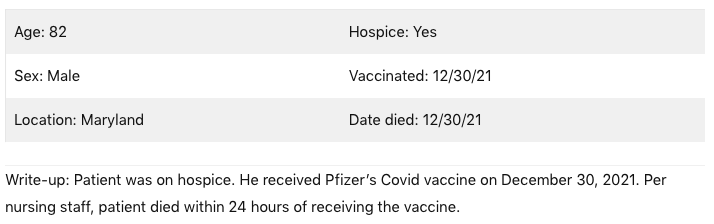
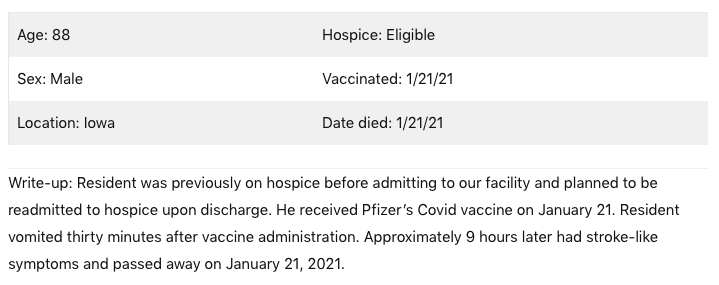
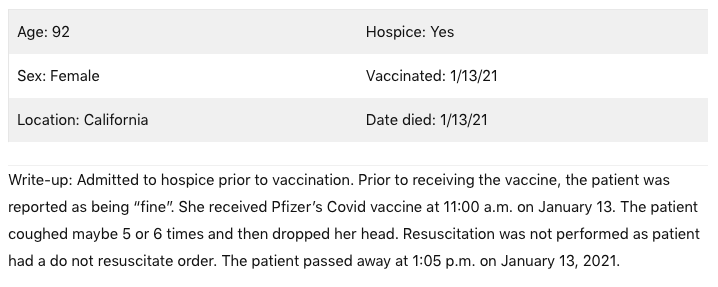
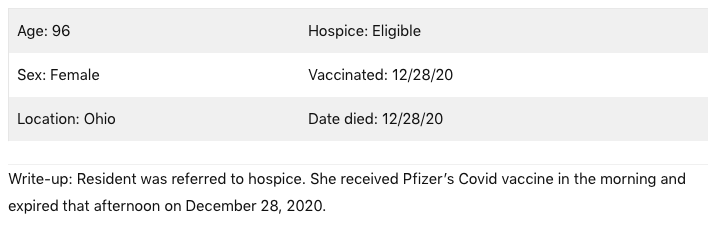
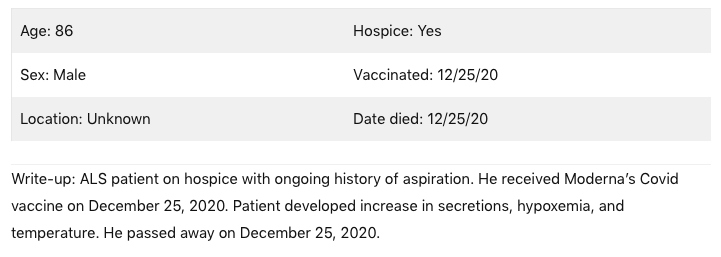
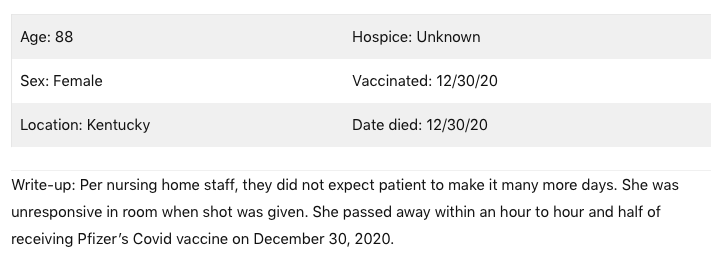
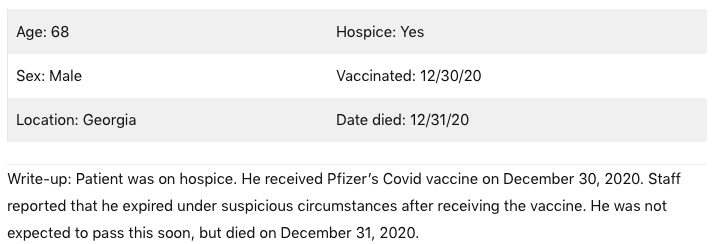
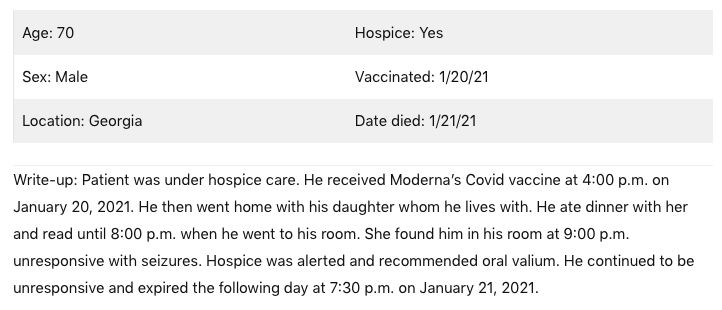
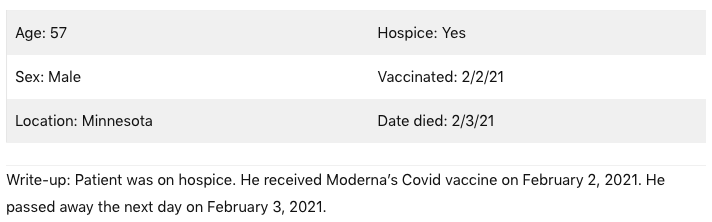
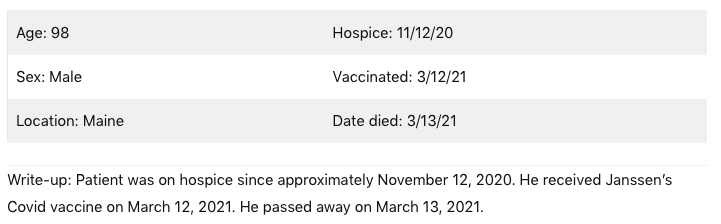
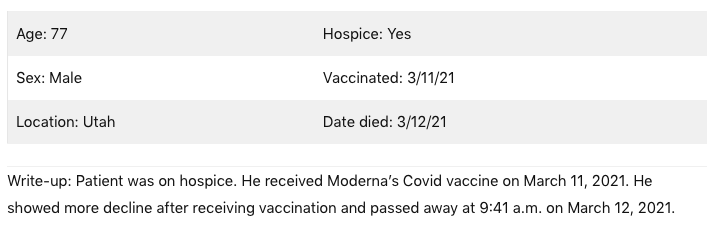
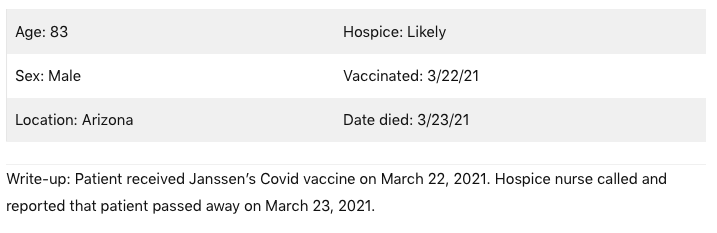
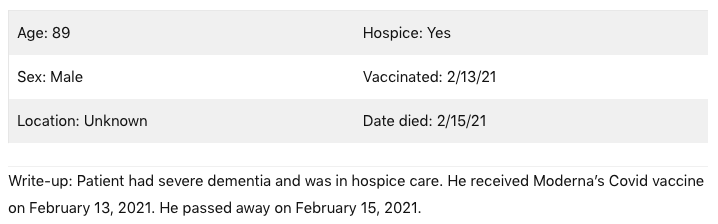
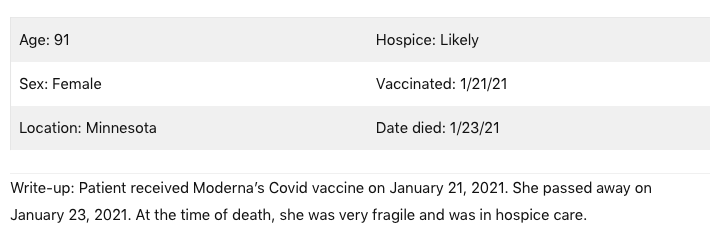
For some reason, this advice does not seem to be standard of care in the United States of America. According to reports submitted to the Vaccine Adverse Events Reporting System (VAERS) many people on hospice have been given a Covid vaccine, only to die very soon thereafter. What follows is a compilation of VAERS reports in which terminally ill patients received a Covid vaccine, and then died within seven days of vaccination.

Deaths Same Day as Vaccination

VAERS ID: 1077079

VAERS ID: 956225

VAERS ID: 960552

VAERS ID: 1003106

VAERS ID: 921880

VAERS ID: 940855

VAERS ID: 959729

VAERS ID: 971736

VAERS ID: 993998

VAERS ID: 915920

VAERS ID: 956966

VAERS ID: 914961

Deaths One Day After Vaccination

VAERS ID: 943442

VAERS ID: 977426

VAERS ID: 941607

VAERS ID: 996105

VAERS ID: 1052738

VAERS ID: 1074599

VAERS ID: 1104430

VAERS ID: 1112123

VAERS ID: 1139186

Deaths Two Days After Vaccination

VAERS ID: 1038442

VAERS ID: 929359

VAERS ID: 1057363

VAERS ID: 1004206

Read the full article here.

*

Note to readers: please click the share buttons above or below. Forward this article to your email lists. Crosspost on your blog site, internet forums. etc.

Luke is a health educator and wellness consultant dedicated to creating greater well-being in our world through education and empowerment. He is a functional nutritionist and the founder of GutResolution.com

Featured image is from The Dark Side of Vaccines

Can War with Russia be Avoided?


Can War with Russia be Avoided?

 13
 1  0
 
 14

All Global Research articles can be read in 51 languages by activating the “Translate Website” drop down menu on the top banner of our home page (Desktop version).

***

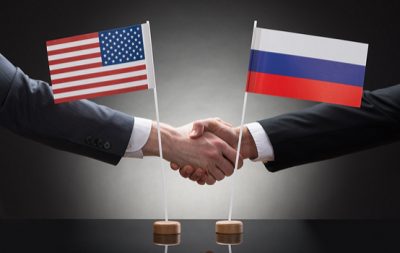
Considering the level of tension between the nuclear powers, the topic deserves far more attention that it receives.  In the US it is a difficult topic to address.  The President of Russia can call for better relations with the US without being demonized by the Russian media as an American agent, but when President Trump called for better relations with Russia, the US presstitutes denounced Trump as a Russian agent and launched the Russiagate hoax.  Knowledgable American commentators who supported Trump’s call for better relations were labeled “Russian agents/dupes.”

The Russian Free Press (svpressa) interviewed me on the Topic of Avoiding Conflict Between the Russian Federation and the United States. 

The interview in English can be viewed below.

 The film date of the interview is April 23, 2021.

The interview in Russian is here and here. 

My concern is that Washington’s hegemonic attitude prevents US acceptance of Russian sovereignty and that Putin’s low-key responses to insults and provocations result in his warnings not being taken sufficiently seriously and encourages more insults and provocations. Washington could go too far and provoke a major confrontation that Putin cannot overlook. 

The dangerous ingredient that could produce a conflict is Washington’s hegemonic arrogance.  Conflict seems certain if Washington cannot escape from its unilateral attitude.  The uni-polar era is over.  Washington must accept this fact if war is to be avoided.

*

Note to readers: please click the share buttons above or below. Forward this article to your email lists. Crosspost on your blog site, internet forums. etc.

Dr. Paul Craig Roberts writes on his blog site, PCR Institute for Political Economy, where this article was originally published. He is a frequent contributor to Global Research.

Featured image is from Andrey Popov/Shutterstock

‘May Day’ Militancy Needed to Create the Economy We Need


‘May Day’ Militancy Needed to Create the Economy We Need

 13
 6  1
 
 20

First published on April 30, 2018

To the memory of  late Kevin Zeese. His legacy will live.

Seventy years of attacks on the right to unionize have left the union movement representing only 10 percent of workers. The investor class has concentrated its power and uses its power in an abusive way, not only against unions but also to create economic insecurity for workers.

At the same time, workers, both union and nonunion, are mobilizing more aggressively and protesting a wide range of economic, racial and environmental issues.

On this May Day, we reflect on the history of worker power and present lessons from our past to build power for the future.

May Day Workers of the World Unite, Melbourne, Australia, in 2012. By Johan Fantenberg, Flickr.

History 

In most of the world, May Day is a day for workers to unite, but May Day is not recognized in the United States even though it originated here. On May 1, 1886, more than 300,000 workers in 13,000 businesses across the US walked off their jobs for the first May Day in history. It began in 1884, when the Federation of Organized Trades and Labor Unions proclaimed at their convention that workers themselves would institute the 8-hour day on May 1, 1886. In 1885 they called for protests and strikes to create the 8-hour work day. May Day was part of a revolt against abusive working conditions that caused deaths of workers, poverty wages, poor working conditions and long hours.

May Day gained permanence because of the Haymarket rally which followed. On May 3,  Chicago police and workers clashed at the McCormick Reaper Works during a strike where locked-out steelworkers were beaten as they picketed and two unarmed workers were killed. The next day a rally was held at Haymarket Square to protest the killing and wounding of workers by police. The rally was peaceful, attended by families with children and the mayor himself. As the crowd dispersed, police attacked. A bomb was thrown—no one to this day knows who threw it—and police fired indiscriminately into the crowd, killing several civilians and wounding forty. One officer was killed by the bomb and several more died from their own gunfire. A corrupt trial followed in August concluding with a biased jury convicting eight men, though only three of them were present at Haymarket and those three were in full view of all when the bombing occurred. Seven received a death sentence, the eighth was sentenced to 15 years, and in the end, four were hanged, one committed suicide and the remaining three were pardoned six years later. The trial shocked workers of the world and led to annual protests on May Day.

The unity of workers on May Day was feared by big business and government. That unity is shown by one of the founders of May Day, Lucy Parsons, who was of Mexican American, African American, and Native American Descent. Parsons, who was born into slavery, never ceased her work for racial, gender, and labor justice. Her partner was Albert Parsons, one of those convicted for Haymarket and hanged.

Solidarity across races and issues frightens the power structure. In 1894 President Grover Cleveland severed May Day from its roots by establishing Labor Day on the first Monday in September, after pressure to create a holiday for workers following the Pullman strike. Labor Day was recognized by unions before May Day. The US tried to further wipe May Day from the public’s memory by President Dwight Eisenhower proclaiming “Law and Order Day” on May 1, 1958.

Long Shoreman march in San Francisco on May Day 2008 in the first-ever strike action by U.S. workers against U.S. imperialist war. Source: The Internationalist

Escalation of Worker Protests Continues to Grow

Today, workers are in revolt, unions are under attack and the connections between workers’ rights and other issues are evident once again. Nicole Colson reports that activists on a range of issues, including racial and economic justice, immigrant rights, women’s rights, a new economy of worker-owners, transitioning to a clean energy economy with environmental and climate justice, and a world without war, are linking their struggles on May Day.

There has been a rising tide of worker militancy for years. The ongoing Fight for $15 protests, helped raise the wages of 20 million workers and promoted their fight for a union. There are 64 million people working for less than $15 an hour. Last year there was also a massive 36-state strike involving 21,000 mobility workers.

Worker strikes continued into 2018 with teacher strikes over salaries, healthcare, pensions and school funding. Teachers rejected a union order to return to work. Even though it included a 5 percent raise, it was not until the cost of healthcare was dealt with that the teachers declared success. Teachers showed they could fight and win and taught others some lessons on striking against a hostile government. The West Virginia strike inspired others, and is followed by strikes in Oklahoma, Kentucky, Colorado, and Arizona. These strikes may expand to other states, evidence of unrest has been seen in statesincluding New Jersey and Pennsylvania as well as Puerto Rico because courage is contagious.

Graduate students have gone on strike, as have transit and UPS workers and low-wage workers. The causes include stagnant wages, spiraling healthcare costs, and inadequate pensions. They are engaged in a fight for basic necessities. In 2016, there wasn’t a single county or state in which someone earning the federal minimum wage could afford to rent a two-bedroom apartment at market rate.

Workers are also highlighting that women’s rights are worker’s rights. Even before the #MeToo movement took off, workers protested sexual harassment in the workplace. Worker’s in thirty states walked off the job at McDonald’s to protest, holding signs that said “McDonald’s Hands off my Buns” and “Put Some Respect in My Check.”

Last year on May Day, a mass mobilization of more than 100,000 immigrant workers walked off their jobs. This followed a February mobilization, a Day Without Immigrants. The Cosecha Movement has a long-term plan to build toward larger strikes and boycotts. There will be many worker revolts leading up to that day.

The Poor People’s Campaign has taken on the issues of the movement for economic, racial, environmental justice and peace. Among their demands are federal and state living wage laws, a guaranteed annual income for all people, full employment, and the right to unionize. It will launch 40 days of actions beginning on Mother’s Day. Workers announced a massive wave of civil disobedience actions this spring on the 50th anniversary of the sanitation strike in Memphis, at a protest where they teamed up with the Poor People’s Campaign and the Movement for Black Lives.  Thousands of workers walk off their jobs in cities across the country.

Unrealized Worker Power Potential Can Be Achieved

The contradictions in the US economy have become severe. The wealth divide is extreme, three people have the wealth of half the population and one in five people have zero wealth or are in debt. The U.S. is ranked 35th out of 37 developed nations in poverty and inequality.  According to a UN report, 19 million people live in deep poverty including one-quarter of all youth. Thirty years of economic growth have been stagnant for most people in the US. A racial prism shows the last 50 years have made racial inequality even wider, with current policies worsening the situation.

May 5 is the 200th anniversary of the birth of economic philosopher, Karl Marx, the failure of US capitalism has become evident. Over the last fifty years, in order for the few to exploit the many, labor laws have been put in place the weaken workers’ rights and unions. Andrew Stewart summarizes some of the key points:

“First, the National Labor Relations Act, signed by FDR, that legalized unionization. Or more precisely, it domesticated unions. When combined with the Taft-Hartley Act, the Railway Labor Act, and Norris-La Guardia Act, the union movements of America were forced into a set of confines that reduced its arsenal of tactics so significantly that they became a shell of their pre-NLRA days. And this, of course, leaves to the side the impact of the McCarthy witch hunts on the ranks of good organizers.”

In addition, 28 states have passed so-called “right to work” laws that undermine the ability of workers to organize. And, the Supreme Court in the Janus case, which is likely to be ruled on this June, is likely to undermine public unions. On top of domestic laws, capitalist globalization led by US transnational corporations has undermined workers, caused de-industrialization and destroyed the environment. Trade must be remade to serve the people and planet, not profits of the few.

While this attack is happening, so is an increase in mobilizations, protests, and strikes. The total number of union members grew by 262,000 in 2017 and three-fourths of those were among workers aged 35 and under and 23% of new jobs for workers under 35 are unionized. With only 10 percent of workers in a union, there is massive room for growth at this time of economic insecurity.

Chris Hedges describes the new gig economy as the new serfdom. Uber drivers make $13.77 an hour, and in Detroit that drops to $8.77. He reports on drivers committing suicide. One man, who drove a cab over 100 hours a week to compete in the new gig driving economy, wrote,

“I will not be a slave working for chump change. I would rather be dead.”

Drivers compete for tiny hourly wages while the former CEO of Uber, one of the founders, Travis Kalanick, has a net worth of $4.8 billion. The US has returned to pre-20th Century non-union working conditions. Hedges writes that workers now must “regain the militancy and rebuild the popular organizations that seized power from the capitalists.”

Solidarity across racial and economic divides is growing as all workers suffer from abuses of the all-powerful capitalist class. As those in power abuse their privilege, people are becoming more militant. We are seeing the blueprint for a new worker movement in the teacher strikes and Fight for $15. A movement of movements including labor, environmentalist, anti-corporate advocates, food reformers, healthcare advocates and more stopped the Trans-Pacific Partnership. This shows the potential of unified power.

In recent strikes, workers have rejected proposals urged by their union and have pushed for more. Told to go back to work, they continued to strike. The future is not unions who serve to calm labor disputes, but unions who escalate a conflict.

The future is more than re-legalizing unions and raising wages and benefits, it is building wealth in the population and creating structural changes to the economy. This requires a new economy where workers are owners, in worker cooperatives, so their labor builds power and wealth. Economic justice also requires a rewoven safety net that ensures the essentials of healthcare and housing, as well as non-corporatized public education, free college education, a federal job guarantee and a basic income for all.

The escalation of militancy should not demand the solutions of the past but demand the new economy of the future. By building community wealth through democratized institutions, we will reduce the wealth divide and the influence of economic inequality over our lives.

*

Correction: In describing Chris Hedges column on the gig economy we mis-identified a suicide victim as an Uber driver when he was a cab driver competing with Uber drivers.

Margaret Flowers and Kevin Zeese are co-directors of Popular Resistance where this article was originally published.

Lettori fissi