

 https://tirarelacqua.blogspot.com/2024/07/google-inculata-sangue-dal-piu-piccolo.html
https://www.google.com/url?sa=t&rct=j&q=&esrc=s&source=web&cd=&cad=rja&uact=8&ved=2ahUKEwjxuo-v8_fvAhUk-2EKHRuRAO8QFjAAegQIBhAD&url=https%3A%2F%2Fwww.coe.int%2Ft%2Fdg4%2Fmajorhazards%2Fressources%2Fvirtuallibrary%2Fmaterials%2FOthers%2FNATO_Guidance_Psychosocial_Care_for_People_Affected_by_Disasters_and_Major_Incidents.pdf&usg=AOvVaw08uENfBfyQA-3PY_rf5jVR
-----
NATO/EAPC UNCLASSIFIED
1-2 Non-binding Guidance
AA
MMOODDEELL
FFOORR
DDEESSIIGGNNIINNGG,, DDEELLIIVVEERRIINNGG
AANNDD
MMAANNAAGGIINNGG
PPSSYYCCHHOOSSOOCCIIAALL
SSEERRVVIICCEESS
FFOORR
PPEEOOPPLLEE
IINNVVOOLLVVEEDD
IINN
MMAAJJOORR
IINNCCIIDDEENNTTSS,, CCOONNFFLLIICCTT,,
DDIISSAASSTTEERRSS
AANNDD
TTEERRRROORRIISSMM
.
https://tirarelacqua.blogspot.com/2024/07/google-inculata-sangue-dal-piu-piccolo.html


In another escalation of the crisis in eastern Ukraine, the country’s president said that only his admission into the western military alliance could end the war that has killed 13,000 people since 2014.
At the same time, the Russian Defense Minister, a country whose troop movements on the Ukrainian border have raised the current alarm in the West, ordered a combat readiness inspection by the armed forces of Vladimir Putin.
These are drums of war that are usually beaten when these crises occur, but they give an indication of the degree of tension it has experienced since the situation deteriorated again in the Donbass region.
Ukrainian President Volodimir Zelenski called NATO Secretary General Jens Stoltenberg on Tuesday.
After the call, he posted on Twitter that Ukraine hoped to be invited this year to join the NATO Affiliation Action Plan. “NATO is the only way to end the war in Donbass. The plan for Ukraine would be a real signal for Russia,” he wrote.
In recent years, the Western Alliance has said the armed forces and the Ukrainian state need reform before joining the club. “Reforms alone will not stop Russia,” Zelensky wrote.
In fact, the West has not brought Ukraine into NATO or the European Union, because it knows that would elicit a stronger reaction from Russia.
The bar was raised by Putin in 2014, when he responded to the overthrow of a pro-Kremlin government in Kiev with the annexation of Crimea and support for the separatists who started the war in the Donbass – today still frozen, the conflict gave rise to two autonomous republics. in the cities of Donetsk and Lugansk.
In his rhetoric, Stoltenberg said in a statement that “NATO strongly supports the territorial integrity and sovereignty of Ukraine”. “We remain committed to our close partnership,” he said.
The silence of the White House, questioned by journalists on the idea, is more eloquent.
President Joe Biden has been known for his harsh rhetoric against the Russians and demanded an explanation for sending soldiers, tanks and tanks to the border and also to Crimea. But from there, accelerating the absorption of Ukraine is a long way off.
Zelenski, an unlikely comedian who came to power in 2019, was trying to negotiate a deal with Putin. As he has lost popularity (a recent poll says only 22% would vote for him again), he gave in to pressure from the local establishment and embraced the confrontational discourse.
The inspection determined by Minister Serguei Choigu, meanwhile, also goes in the direction of the demonstration of teeth. The Kremlin has already said there is nothing unusual about the movement of troops and has denied wanting to attack Ukraine.
On the other hand, he signaled that he wanted the West’s commitment to the Minsk accords, which, in their latest version of 2015, established the conditions under which the rebel republics remain with Kiev, but with a great autonomy.
The agreements have been co-sponsored by Russia and the West, but Ukrainian leaders do not accept them because they consider that they make the country’s territorial integrity unachievable.
“We strongly doubt that this [entrar na Otan] go and help Ukraine solve its internal problem. From our point of view, this will only make the situation worse. Joining NATO is unacceptable to those who live in republics, ”said Dmitry Peskov, Kremlin spokesman.
After relative calm since 2015, the conflict has heated up again this year. Skirmishes took place on the 500 km border between Ukrainians and rebels, killing 23 Kiev soldiers and an uncertain number of separatists. Last year around 50 people died in clashes.
An estimated 3.8 million people live in the region, the majority of Russian origin, out of 44.3 million residents across Ukraine.
In Putin’s geopolitical primer, the West betrayed Russia after the end of the Cold War in 1991, expanding its structures to the east instead of helping to rebuild the country that ruled the Soviet Union.
Indeed, 11 ex-communist countries have been absorbed by the European Union since then, and 14 by NATO.
Since the war in Georgia (2008), Putin has made it clear that the movement should end. In 2014, he stunned the West by annexing Crimea and inciting revolt in Donbass.
In common with these three places is the existence of predominantly Russian ethnic areas. When Putin said the end of the Soviet Union was the greatest geopolitical disaster of the 20th century, he spoke of the loss of a defense belt on its periphery and, nominally, he cited the Russians who remained in the new free countries.
This creates credible mistrust of Russian intentions. So few analysts believe in a war, it’s good to remember that whenever Putin was questioned, he was betting on external actions, like in Crimea itself or in Syria (2015).
And the Russian leader, who has just regulated the possibility of trying to stay in power until 2036, is at the worst popularity level in his two decades in power (albeit at a comfortable 60%).
Ukraine and Belarus, the dictatorship it supports, are the main shields between its borders and hostile NATO countries in Eastern Europe. “Putin represents what the Russian elite think. They want to be Westerners, but with the right distance,” said Konstantin Frolov, an independent Russian analyst.
Annexation of the Donbass is not desired by the Kremlin because of the high economic cost embedded – in Crimea, there has been more than 5 billion dollars of work since 2014. What interests Putin is to leave the ‘Ukraine outside of Europe.
There are still other issues that can trigger a conflict. The Ukrainians have cut off the water supply to Crimea, which receives 85% of what it consumes from its former country. On Tuesday, Zelensky ordered special training for reservists in the border region of the two territories.
https://tirarelacqua.blogspot.com/2024/07/google-inculata-sangue-dal-piu-piccolo.html
A specialist inspects a Canadian Air Task Force jet CF-188 after it landed at the Siauliai air base in Lithuania on August 26, 2014.
Ints Kalnins/Reuters
This week's NATO summit will seek to deliver a strong message to Russian President Vladimir Putin of the alliance's willingness to defend its members – including the vulnerable Baltic States – against aggression. But the subtext of that statement will disappoint a Ukrainian government desperately appealing for help: NATO isn't coming to Kiev's rescue, no matter what Mr. Putin's armies and surrogates do in that country.
In an agenda-setting speech ahead of the crucial summit that begins Thursday in Wales, NATO deputy secretary general Alexander Vershbow said Russia's military moves in Ukraine had created a new solidarity and resolve to defend the alliance's borders. That new sense of purpose, he said, was reflected in a "Readiness Action Plan" that NATO leaders would announce this week, including the creation of a small "spearhead" force of several thousand troops that will be stationed in Eastern Europe and able to deploy to a crisis within 48 hours.
But, he made clear, that solidarity didn't extend to non-member Ukraine, where NATO says Russian troops and tanks are now directly aiding rebels in the east of the country. Asked if there was any "red line" Mr. Putin could cross that would prompt NATO involvement in the country, Mr. Vershbow left no doubt that Ukraine would have to fight alone.
"I don't see any red line that, if crossed, would lead to military engagement" in Ukraine, he told a "NATO after the Wales Summit" seminar hosted by Cardiff University. Ukrainian President Petro Poroshenko will attend this week's NATO meeting as a non-member observer.
"Ukraine understands that they're not a beneficiary of an Article 5 [NATO collective defence] guarantee," Mr. Vershbow told The Globe and Mail afterwards. "But I think we will show solidarity with Ukraine, meeting with Poroshenko. We'll roll out some of the assistance that we've been working on for Ukraine… it may not be everything that everybody wants, but again NATO is not the only responder. The broad international message from NATO, from the EU, from other actors, hopefully will make a difference."
Mr. Poroshenko asked last week that Ukraine be considered for full membership in NATO, but the request has been met with stony silence from the alliance, which is still seeking to avoid a direct military confrontation with Russia.
The EU, Canada and the United States have collectively imposed escalating sanctions on Russia in response to its actions in Ukraine. But while those measures are taking an economic toll – the Russian economy contracted in both June and July – they have not demonstrably affected the Kremlin's behaviour.
NATO believes that 100 battle tanks, accompanied by at least 1,000 infantry, entered eastern Ukraine last week. The column has reportedly pushed towards the Azov Sea port of Mariupol, creating a new front in the conflict and relieving the pressure on pro-Russian rebels who had been surrounded and facing defeat in Donetsk and Lugansk.
Russia also annexed the Crimean Peninsula from Ukraine in March, following a controversial referendum there. Moscow was infuriated by the February ousting of the Kremlin-friendly government of Viktor Yanukovych, and accuses Western governments of supporting an illegal "coup" in Kiev.
Mr. Vershbow spoke hours after it became public that Mr. Putin had told European Commission President Jose Manuel Barroso that Russia "could take Kiev in two weeks" if it wanted. The Kremlin said Tuesday that Mr. Putin's remarks had been "misinterpreted," but didn't deny the quote.
Separately, a senior Kremlin official said Tuesday that Russia would soon adjust its military doctrine in response to the increased NATO presence in Eastern Europe.
"[NATO plans to] stir up its military activities, take measures on providing long-term presence of NATO military units in Eastern Europe," Mikhail Popov, deputy chairman of the Russian Security Council, told the official RIA Novosti news service. "It's clear to everyone against whom these measures are directed."
Mr. Vershbow – who was U.S. ambassador to Moscow during Mr. Putin's early years in power – said the best outcome for Ukraine might now be a "fair" negotiated solution that took Russia's interests into account without violating Ukraine's sovereignty.
The other keynote speaker at the Cardiff University seminar warned that NATO needed to accept that it cannot achieve its aims in Ukraine, and avoid making empty promises to Mr. Poroshenko.
Stephen Krasner, a former top U.S. State Department official, said the alliance should focus on providing the Baltic States of Estonia, Latvia and Lithuania, tiny former republics of the Soviet Union that joined NATO in 2004, with credible deterrent against any aggression. Mr. Putin has claimed the right to "defend" Russian-speakers abroad, and Estonia and Latvia have significant Russian-speaking populations.
"We can't pretend we're going to defend Ukraine, when we can't do that," said Prof. Krasner, who now teaches at Stanford University. But, he said, "there are real reasons for us to fight in the Baltic States."
He called for NATO troops to be deployed along Estonia's and Latvia's borders with Russia in much larger numbers than the 4,000-soldier rapid deployment force apparently under consideration at this week's summit, which he said would be too small to counter the massive military might Russia has deployed along its western frontier. At one point during the crisis, Russia brought 150,000 troops to its border with Ukraine for snap "exercises."
Stephen Harper is heading to a crucial summit of NATO leaders where the Western military alliance will give itself the power to respond to threats more quickly in the face of Russia's continued effort to destabilize and break up Ukraine. However, the Harper government is balking at a push for NATO countries to boost military spending to at least 2 per cent of gross domestic product. Here is a look at how Canada's defence spending compares to other NATO countries.
Chart shows defence expenditures as a percentage of GDP for 2013 (Current Prices)
https://tirarelacqua.blogspot.com/2024/07/google-inculata-sangue-dal-piu-piccolo.html
A police officer talks to a woman outside a hotel that has been set up to treat non-critical coronavirus patients during the coronavirus disease (COVID-19) health emergency in Madrid, Spain, March 19, 2020.
Susana Vera/Reuters
“We are at war.”
So say world leaders as countries struggle to cope with the coronavirus pandemic. The unprecedented outbreak has pushed governments to take extraordinary measures unheard of in peacetime — including closing borders and instituting nationwide lockdowns. People all over the globe are increasingly required to carry permits or face fines for leaving their homes.
"This crisis could ultimately have an impact as serious as a world war in terms of the number of people affected, in terms of the impact on the economy and on people's way of life,” former US Ambassador to NATO Nicholas Burns told The World.
Governments have gotten the message.
French President Emmanuel Macron said Monday the invisible spread of the virus “requires a call to arms,” as he locked down the country.
United States President Donald Trump echoed the sentiment, tweeting, “The world is at war with a hidden enemy. WE WILL WIN!” He also referred to himself as a “wartime president” in a Wednesday press briefing, a statement that is without legal significance.
COVID-19 — which poses inordinate risk to the elderly and immunocompromised — has required extensive government measures across the globe to slow the spread of the highly contagious virus. Vulnerable health infrastructure systems unprepared for massive patient influxes also need support.
Related: Is South Korea’s approach to containing coronavirus a model for the rest of the world?
Under such circumstances, history has shown there is a very fine line between protecting citizens and eroding their civil rights — and that line can be exploited in times of great uncertainty.
"... once governments develop new capacities, they find it hard to let them lapse.”
“Even without any malevolent intent, major economic crises and wars usually lead to an expansion of the state and greater intrusions into people's lives,” said Scott Radnitz, associate professor of international studies at the University of Washington. “This can be for the better ... But sometimes once governments develop new capacities, they find it hard to let them lapse.”
China was the leader of lockdowns after COVID-19 was discovered in the city of Wuhan. At the time, such measures seemed extreme and draconian.
But “it would be foolish to believe that China’s decisions have been mainly based on crude authoritarianism,” wrote Ian Johnson for The Washington Post. “Some of its policies were motivated by serious concern for the public good and executed by a highly competent civil service.”
But political context matters when governments move to limit civil liberties, especially for countries that have a history of authoritarian leadership. China's efforts — though successful in leveling the virus’ spread — also included stifling information about COVID-19, and spreading conspiracy theories.
Related: Russia is spreading disinformation about coronavirus
In the Philippines — a partly free country where public movement has been limited to essential needs, like food and medicine — strongman Rodrigo Duterte has deployed the police and military to enforce quarantine measures. While it's not unlike steps taken elsewhere it has sparked fear of potential human rights abuses in light of Duterte’s authoritarian enterprises, like his “war on drugs.” Under that policy, characterized as a "large-scale murdering enterprise," thousands have been killed by state authorities.
In Spain, Prime Minister Pedro Sánchez said he is convinced that most Spaniards will comply with the country’s lockdown, but the limits on freedom of movement have also sparked debate in the nation, which has only been democratic since the late 1970s following the death of dictator Gen. Francisco Franco.
Related: In the shadow of Franco’s legacy, Spain faces its fascist history
Even in well-established democracies, there have been concerns about the lasting consequences of pandemic responses. In Israel, Prime Minister Benjamin Netanyahu ordered security services to use cellphone data to identify citizens who should be quarantined and has shuttered the courts — just as he was about to go on trial for corruption. Both initiativeswere announced in the dead of night.
"We cannot surrender transparency and oversight.”
“These are exceptional times that, unfortunately, call for exceptional measures in order to save lives,” Benny Gantz, Netanyahu’s political rival, said Tuesday. “That said, we cannot surrender transparency and oversight.”
In a public health pandemic, firm restrictions are warranted, particularly when individuals demonstratively make choices that affect the greater good. Dr. Anthony Fauci, the top infectious disease expert in the US, has not discounted the possible need for a “national shutdown.”
“Many of us were too selfish to follow suggestions to change our behavior,” wrote Italian writer Mattia Ferraresi of the casual attitudes toward initial restrictions put in place when the outbreak reached Italy. The country is now the worst affected after China. “It took weeks after the virus first appeared here to realize that severe measures were absolutely necessary.”
And in the United States, where individualism is a key element of the national ethos, the fine line between freedom and safety is increasingly clear.
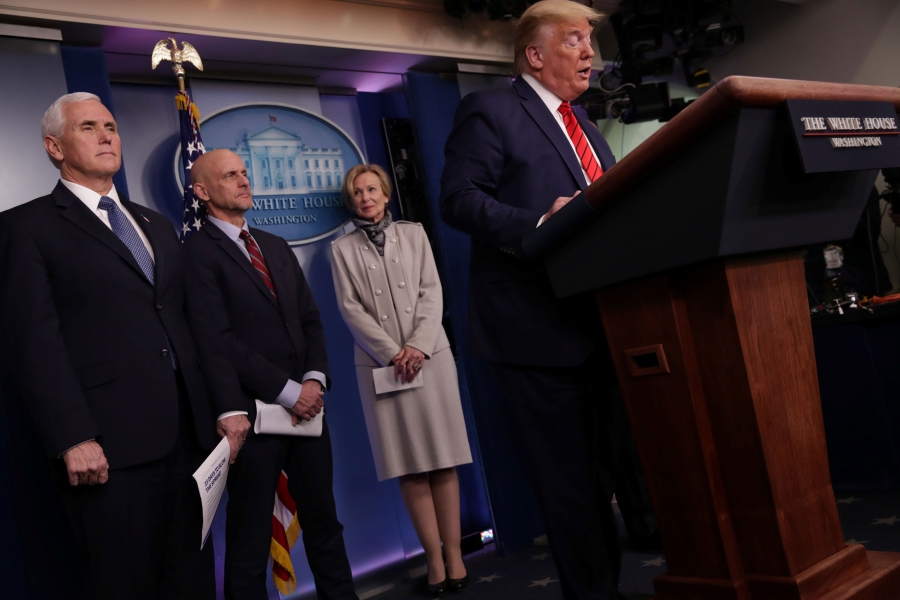
US Vice President Mike Pence, FDA Commissioner Dr. Stephen Hahn and Ambassador Debbie Birx, the White House Coronavirus Response Coordinator, listen as President Donald Trump addresses the coronavirus response daily briefing at the White House in Washington, DC, March 19, 2020.
Jonathan Ernst/Reuters
In the US, Trump has slowly come around to recognizing the serious nature of this pandemic. He has called for massive economic stimulus legislation, and last Friday, he announced a national emergency under the Stafford Act, a public health and disaster relief law, which allows states to tap into more than $42 billion to respond to growing needs of the coronavirus outbreak.
"[Trump] is so worried about the economy and his reelection, he had to be pressured into declaring a national emergency ..."
"What has struck me initially in the current crisis is how reluctant Trump has been to use the prerogatives of the presidency. A year ago, Democrats might imagine he would have soldiers in the streets by this point," Radnitz said. "But in fact, he is so worried about the economy and his reelection, he had to be pressured into declaring a national emergency and invoking the Defense Production Act."
Democratic Senate Minority Leader Chuck Schumer tweeted, “We've been calling for President Trump to do this for days. Americans will support an emergency declaration to extend assistance to Americans who need it. But he must not overstep his authority or indulge his autocratic tendencies for purposes not truly related to this crisis.”
For years, Congress has been concerned that emergency declarations invoked by the executive “may be used as political tools — especially during election years,” according to the Congressional Research Service.
“It’s often the case that governmental power expands in time of emergency and doesn’t revert fully back to the status quo ante after the emergency has passed,” Richard Primus, a constitutional law scholar at the University of Michigan wrote in an email. “Historically, the years of the Civil War, World War I, and World War II all saw important expansions of the federal government’s authority, and those expansions in important parts remained after the wars were over.”
More recently, following the 9/11 terrorist attacks in the US, federal responses invoked under ostensibly temporary measures have continued to affect lives two decades later. The USA Patriot Act — which expanded the government's ability to invade privacy, override due process, and punish dissent — remains largely in effect, despite the initial inclusion of sunset provisions.
The wars in Iraq and Afghanistan were also subsequently authorized with little opposition, though now both military actions have come under heightened scrutiny.
Related: Amb Lute on the war in Afghanistan: The US is 'taking a very hard look at itself'
And the impact of the post-9/11 war authorizations have extended to new conflicts, including Trump's ordered assasination of Iranian top general, Qasem Soleimani, early this year. Since 9/11, Congress has done little to stop the executive branch — Presidents George W. Bush, Barack Obama and Donald Trump — from using authorizations far beyond their original scope.
“Congress over many years has passed statutes that give the president extensive powers to act in situations of emergency,” Primus said. “Those statutes were passed on the assumption that presidents would be basically responsible people, and that assumption has turned out to be less than 100% accurate.”
Related: Human rights report accuses CIA-trained Afghan paramilitaries of atrocities
Legislation following the 2001 attacks could also impact the US response to the coronavirus. The Model State Emergency Health Powers Act, written in 2001 out of concern of a biological attack and taken up in some fashion by at least 33 states, expands government authority in times of emergency, including the power to quarantine. The ACLU and legal scholars have warned that such legislation has ethical and civil liberties issues.
For months, Trump toned down the seriousness of the coronavirus, and muddied the waters with misinformation. That pattern of lies and denial are concerning in the context of a presidency that routinely ignores facts and the law. Particularly since his impeachment trial acquittal, Trump has acted in increasing defiance of constitutional checks and balances on his authority.
Related: Trump's hypocrisy on corruption is just what Putin wants
"Given President Trump’s disregard for basic rule-of-law norms, the constitutional Republic was already at serious risk before the pandemic. The pandemic heightens that risk."
“Given President Trump’s disregard for basic rule-of-law norms, the constitutional Republic was already at serious risk before the pandemic,” Primus said. “The pandemic heightens that risk. A country going through a crisis like this could really use some responsible leadership.”
Even as the US and world is struggling to deal with the current pandemic, it is worth remembering the lessons of the past.
“History shows that politicians who are willing to bend rules will find ways to benefit from the crisis,” said Radnitz. “On the other hand, maybe we'll come out of this with a better public health system.”
If
measures grow increasingly restrictive — and they may — continued
vigilance and checks on power will help ensure democracy does not fall
victim to the pandemic.
https://tirarelacqua.blogspot.com/2024/07/google-inculata-sangue-dal-piu-piccolo.html
French president Emmanuel Macron has warned modern capitalism “can no longer work,” urging global leaders to focus on tackling inequality and climate change.
“We will get out of this pandemic only with an economy that thinks more about fighting inequalities,” he said on Tuesday.
Macron made the comments in a Q&A session at the virtual Davos Agenda 2021 summit of global leaders.
Macron is often seen as a pro-business liberal abroad, but struck a more leftist tone in criticising capitalism and market economies over the past few decades.
He acknowledged they had lifted millions of people out of poverty, and given consumers goods and services previously unavailable to them.
But he said there had been a “deep moral and economic crisis” in which many workers lost their jobs through economic shocks. “Hundreds and thousands of people throughout the world had this feeling of losing their usefulness,” he said.
He said previously there had been opportunities for “progression” for the middle class, but the system had “broken.”
READ MORE: DAVOS 2021: Santander CEO says vaccines are the most effective economic policy
Meanwhile a disconnect was allowed to grow between “value creation and profit,” according to Macron. He said the financialisation of capitalism had positives, but had led to “profits that are not linked to innovation or work.” This in turn had fuelled inequality, he added.
Macron said there were “two kings in this system—shareholders and consumers,” with workers and the planet paying a price.
The French president highlighted the need to “move beyond” de-regulation and hostility to state intervention, as well as reforms to ensure companies take into account the social, environmental and democratic impact of their. He stopped short of any more detailed prescriptions, however.
“The capitalist model together with this open economy can no longer work in this environment,” he said.
He highlighted efforts to build “what we immodestly called the Paris consensus” at the Paris Peace Forum for global leaders last year. “The idea was basically that we needed to move beyond the Washington consensus,” he added.
READ MORE: DAVOS 2021: Merkel criticises China's COVID 'transparency'
The ‘Washington consensus’ refers to a set of free-market ideas and policies promoted around the world by the International Monetary Fund (IMF), World Bank and US government in the late 20th century.
Macron has previously dubbed such ideas, from privatisation and small government to liberalising trade, a “dogma” that have shaped political and intellectual life in recent decades.
He has previously linked his reform agenda to measures such as EU rules penalising investment in fossil fuels and incentivising green investment.
The comments may raise eyebrows given he was addressing a virtual Davos Agenda summit, a warm-up event for the World Economic Forum’s (WEF) annual, in-person Davos event scheduled in May.
Many critics see the gathering as a talking shop big on lofty rhetoric, and a symbol of capitalism and the global elite.
But organisers say it offers a unique opportunity for discussion and collaboration at one of the biggest meetings of political, business and civil society leaders in the world.
The summit usually takes place in the Swiss ski resort of Davos, though it has been moved to Singapore this year.
Watch: Vaccine concerns divide nations at Davos
https://tirarelacqua.blogspot.com/2024/07/google-inculata-sangue-dal-piu-piccolo.html

 Post
Tutti i commenti
Post
Tutti i commenti

/arc-anglerfish-tgam-prod-tgam.s3.amazonaws.com/public/252U6QJFUFDNTIB35L3M372RQ4)

