(1st UPDATE) After accompanying longtime aide Senator Bong Go in filing his candidacy for vice president, Duterte announces 'my retirement from politics'
ADVERTISEMENT
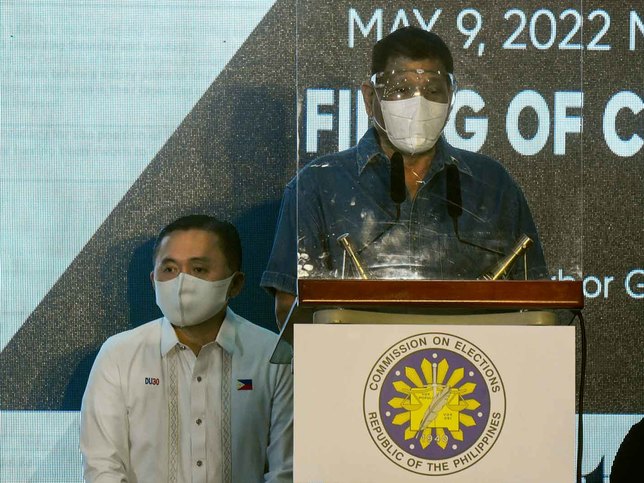
President Rodrigo Duterte is done with politics, he announced on Saturday, October 2, after accompanying his longtime aide, Senator Bong Go, who filed his candidacy for vice president.
It was Duterte who was expected to run for vice president given his previous announcements and a big push from his divided party, PDP-Laban. But the President said he took note of the "overwhelming sentiment" of Filipinos that running for vice president would "circumvent" the law.
"And today, I announce my retirement from politics," the 76-year-old President said.
ADVERTISEMENT
Duterte was apparently referring to a recent survey by the Social Weather Stations that showed six in 10 Filipinos believe that Duterte's contemplated vice presidential run is unconstitutional.
Taking the podium after Go's brief speech at the Sofitel Hotel where the filing of certificates of candidacy for the May 2022 elections is being held, Duterte mentioned the "different surveys, forums, caucuses, and meetings" about his planned vice presidential bid.
"The overwhelming sentiment of the Filipino is that I am not qualified and it would be a violation of the Constitution to circumvent the law, the spirit of the Constitution," said Duterte.
"In obedience to the will of the people, who after all placed me in the presidency many years ago, I now say, samga kababayan ko, sundin ko ang gusto ninyo. (To my countrymen, I will follow what you want). And today, I announce my retirement from politics," the President added.
ADVERTISEMENT
But it's not his first time to talk about retirement.
In 2015, when asked if he would consider running for president, Duterte said that he "will retire from public life for good." He ran for president the following year, in May 2016.
Who is standard-bearer?
Duterte had been nominated by the divided PDP-Laban as its vice presidential bet, which he subsequently accepted. The party nominated Go as its standard-bearer, which Go rejected.
On Saturday, Go filed for vice president instead – leaving the ruling party without a standard-bearer. The leader of a PDP-Laban faction, Senator Manny Pacquiao, filed his candidacy for president under a different party, Promdi.
While he remains popular, Duterte's ratings dipped in May and June to 75% and his administration is under fire for the questionable contracts it awarded to a company that is associated with his Chinese friend and former adviser, Michael Yang.
In a Pulse Asia poll, Duterte also fell far behind vice presidential aspirant and Senate President Tito Sotto. Duterte ranked second with a score of 14, which is just a little over half of Sotto's numbers.
Prior to this, Duterte had hinted several times that he was tempted to run for vice president to be "immune from suit" – an assumption that experts have dismissed.
End of US ban poised to lead to ‘tsunami’ of evictions
Some 750,000 US households could be evicted across the United States before the end of the year, global investment firm Goldman Sachs estimates.
After the United States Supreme Court ended the federal moratorium on evictions, global investment firm Goldman Sachs estimates that about 750,000 households could be evicted across the country before the end of the year [File: Mary Altaffer/AP Photo]
As Hurricane Ida barrelled towards the southeast coast of the United States in late August, 23-year-old Vashante Gray, her two children aged two and six, and her mother, Kristi Brown, 45, found themselves with no place to live.
After their building was sold to a new landlord who wanted everyone out to renovate, Gray and dozens of other renters were told they had to get out of their Starkville, Mississippi apartment complex. Some were given just days to do so.
Thanks to funding from a local community group, Gray and her two children have been in a hotel since. Her mother is being housed in a hotel as well, but in a different one across town, leaving Gray without childcare and struggling to get herself to work and her children to school as a result.
“They’re putting multiple families on the street,” Gray told Al Jazeera. “A lot of them have disabled babies and don’t have the funds to move and they’re not getting money back from rent that was paid.”
With the US Supreme Court ending the country’s national moratorium on evictions on August 26, hundreds of thousands of renters could soon find themselves in the same position as Gray and her family – with nowhere to live.
While Congress could still revive the national eviction ban legislatively and a handful of states still have individual eviction moratoria in place, the global investment firm Goldman Sachs estimates that roughly 750,000 households could be evicted across the country before the end of the year.
Roughly 3.5 million people in the United States said they faced eviction in the next two months, according to US Census Bureau data from early August [File: Brittainy Newman/AP Photo]
According to Jasmine Rangel, a research specialist at Princeton University’s Eviction Lab that studies the affordable housing crisis, the ban has been an effective means of keeping people housed during the COVID-19 public health crisis.
“Throughout the pandemic, states that have been abiding by the law and following the guidelines saw a significant drop in evictions, or at least a smaller proportion of eviction filings compared to any other normal year in that state,” she told Al Jazeera.
Now that the nationwide eviction moratorium is over, she expects that the forthcoming evictions will not be spread evenly across the states.
“Certain states make it easier, cheaper and faster to evict, especially if [landlords] can quickly file in bulk,” she said.
The number and speed of evictions are also often related to the size of a landlord’s holdings as well.
“We know that a particular set of landlords in large cities are responsible for a larger share of evictions,” Rangel said. “It’s not unlikely that a landlord that owns a lot of units can be a single person, but very often they’re large corporations.”
Conversely, she noted that smaller “mom-and-pop landlords” are typically more inclined to find ways to help by setting up payment plans and the like.
Ripple effects
Beyond potentially putting people on the streets during a global pandemic, Rangel sees the end of the federal ban as antithetical to the country’s efforts to bounce back economically from the pandemic.
Just like Gray, who is struggling to get to work from a new location without a car or childcare, “those who face eviction are more often than not likely going to lose their jobs, too,” Rangel explained, pointing to Eviction Lab research (PDF) that links evictions to declines in economic opportunities for certain families.
In light of such declining economic opportunities, many people rely on affordable housing to have a place to live. But there are just 37 affordable and available units in existence for every 100 extremely low-income households (those making less than 30 percent of their area’s median income), research by the nonprofit National Low Income Housing Coalition shows.
With affordable housing already scarce, mass evictions have the potential to make a difficult situation worse. An eviction remains on a tenant’s credit report for years, affecting their future housing prospects as well.
“This coming tsunami of evictions is going to have some really negative effects on housing because it becomes very difficult with an eviction on your record to get subsequent housing,” Ed Goetz, a professor and housing expert at the University of Minnesota’s Hubert H Humphrey School of Public Affairs, told Al Jazeera.
“I think it may be enough to shove some people into the shadow market” of informal housing, he added.
Higher housing costs
The end of the moratorium also brings a fresh opportunity for landlords across the country to raise rents after evicting tenants who are behind on their payments, potentially driving up housing costs in some regions.
“In some markets, you may see landlords be able to shift to higher rents. That may be possible where there is a real shortage of housing and where there is unmet demand at incomes that are higher than those that are going to be most affected by the evictions that are coming,” Goetz said. “That’s probably true of a lot of markets, but not all markets.”
While landlords who see themselves as the aggrieved parties behind on income might take to raising rents once tenants have been evicted, Goetz expects affordable housing providers like non-profit organisations and government housing programmes will be more inclined to help meet tenants where they are. But not everyone who is evicted will be able to find housing in such places.
The US Treasury Department said just $5.1bn of the estimated $46.5bn in federal rental assistance, or only 11 percent, has been distributed by states and localities [File: Michael Dwyer/AP Phorto]
The government aid already allocated to struggling tenants has also been slow to be distributed, data released by the US Treasury Department on August 25 found. States and local programmes have spent just $5.1bn of the $46.5bn in federal rental assistance that has been allocated, leading Treasury officials to conclude that “too many grantees have yet to demonstrate sufficient progress in getting assistance to struggling tenants and landlords”.
While Rangel agrees that short-term rental assistance is essential, she argues that it’s just a temporary bandage on a gaping wound.
“We have to wrestle with thinking short term and thinking long term,” she said. “In the long term, we should start to wrap our minds around the fact that evictions should be a last solution or a non-solution, just because of the terrible side effects it has on people’s lives.”
Gray and her family are living some of those effects now. After running out of funds for the hotel she had been staying in on Sunday, Gray is left staying with her sister, wondering where she and her kids will finally find a home, if anywhere at all.
Visitors may love the vibrant street markets and countless cheeses, but something is badly wrong with France’s food system. In the absence of joined-up policy, could urban farming point the way forward?
A member of an ‘association for the maintenance of peasant agriculture’ (AMAP) buys vegetables, Campbon, France, April 2020
Loic Venance · AFP · Getty
France may have none of the hunger found in developing countries, the kind that distends children’s bellies and attracts western television crews. Here, it’s different, diffuse, discreet, and it operates ‘surreptitiously, almost without visible sign’, as Josué de Castro, the 20th-century Brazilian doctor and author of The Geopolitics of Hunger, put it. But it is visible: in food aid queues and welfare programmes in schools, when a manufacturer gives out free samples, or even in how a security guard checks customers’ bags as they leave the supermarket.
According to a recent Senate report, food insecurity affects eight million people in France; one in five according to the Ipsos-Secours Populaire survey. Food is often the first item on the household budget to come under pressure: 19% of French households struggle to pay for their children’s school lunches; 27% can rarely afford fresh fruit, vegetables, meat and fish; and many regularly skip meals. In a 2014 Médecins du Monde survey, two thirds of French people said they spent less than €3.50 a day on food (€2 in the case of the homeless, and people in squats or makeshift accommodation). Tight budgets force tough trade-offs, leading to nutritional deficiencies, a growing toll of obesity and chronic diseases, and anxiety about the future. Five and a half million people in France now rely on food aid, and that figure more than doubled between 2009 and 2017.
In 2013 Findus, ever keen to drive down supplier prices, discovered horse meat in its ‘pure beef' lasagne. The problem was Europe-wide: four and a half million meals on the market and the entire supply chain was implicated
Food is recognised as a fundamental right in international treaties, including the Universal Declaration of Human Rights (1948), the International Covenant on Economic, Social and Cultural Rights (which came into force in 1976) and the Rome Declaration on World Food Security (1996). But unlike (...)
Declaration issued after global summit of health experts in Rome
More than 4,000 scientists and physicians from around the world have signed a declaration condemning public policy makers of “crimes against humanity” for restricting life-saving treatments and quashing debate and scientific inquiry.
[UPDATE: as of 7pm ET on 9/27 over 5,200 doctors & scientists have signed the Rome Declaration. Please join us by reading and signing below.]
We the physicians of the world, united and loyal to the Hippocratic Oath, recognizing the profession of medicine as we know it is at a crossroad, are compelled to declare the following;
WHEREAS, it is our utmost responsibility and duty to uphold and restore the dignity, integrity, art and science of medicine;
WHEREAS, there is an unprecedented assault on our ability to care for our patients;
WHEREAS, public policy makers have chosen to force a “one size fits all” treatment strategy, resulting in needless illness and death, rather than upholding fundamental concepts of the individualized, personalized approach to patient care which is proven to be safe and more effective;
WHEREAS, physicians and other health care providers working on the front lines, utilizing their knowledge of epidemiology, pathophysiology and pharmacology, are often first to identify new, potentially life saving treatments;
WHEREAS, physicians are increasingly being discouraged from engaging in open professional discourse and the exchange of ideas about new and emerging diseases, not only endangering the essence of the medical profession, but more importantly, more tragically, the lives of our patients;
WHEREAS, thousands of physicians are being prevented from providing treatment to their patients, as a result of barriers put up by pharmacies, hospitals, and public health agencies, rendering the vast majority of healthcare providers helpless to protect their patients in the face of disease. Physicians are now advising their patients to simply go home (allowing the virus to replicate) and return when their disease worsens, resulting in hundreds of thousands of unnecessary patient deaths, due to failure-to-treat;
WHEREAS, this is not medicine. This is not care. These policies may actually constitute crimes against humanity.
NOW THEREFORE, IT IS:
RESOLVED, that the physician-patient relationship must be restored. The very heart of medicine is this relationship, which allows physicians to best understand their patients and their illnesses, to formulate treatments that give the best chance for success, while the patient is an active participant in their care.
RESOLVED, that the political intrusion into the practice of medicine and the physician/patient relationship must end. Physicians, and all health care providers, must be free to practice the art and science of medicine without fear of retribution, censorship, slander, or disciplinary action, including possible loss of licensure and hospital privileges, loss of insurance contracts and interference from government entities and organizations – which further prevent us from caring for patients in need. More than ever, the right and ability to exchange objective scientific findings, which further our understanding of disease, must be protected.
RESOLVED, that physicians must defend their right to prescribe treatment, observing the tenet FIRST, DO NO HARM. Physicians shall not be restricted from prescribing safe and effective treatments. These restrictions continue to cause unnecessary sickness and death. The rights of patients, after being fully informed about the risks and benefits of each option, must be restored to receive those treatments.
RESOLVED, that we invite physicians of the world and all health care providers to join us in this noble cause as we endeavor to restore trust, integrity and professionalism to the practice of medicine.
RESOLVED, that we invite the scientists of the world, who are skilled in biomedical research and uphold the highest ethical and moral standards, to insist on their ability to conduct and publish objective, empirical research without fear of reprisal upon their careers, reputations and livelihoods.
RESOLVED, that we invite patients, who believe in the importance of the physician-patient relationship and the ability to be active participants in their care, to demand access to science-based medical care.
IN WITNESS WHEREOF, the undersigned has signed this Declaration as of the date first written.
Since the onset of the ‘global pandemic,’ government and mainstream media in western nations have been adamant that the public must trust ‘The Science,’ because it was backed by an unanimous ‘consensus.’
We were told by our leaders to ignore and disregard any information, analysis or opinion which goes against their consensus. These same governments then partnered Silicon Valley giants like Facebook, YouTube and Twitter to enforce their consensus globally.
In addition, mainstream media have gone out of their way to silence and ignore any contrarian views on the subject.
The result of this collusion between government, Big Tech and the legacy media is the false depiction of a ‘unified consensus’ on Covid and intervention policies.
However, after 18 months of this regime, it’s clear that there was never any universal consensus on the science behind Covid, and even less so regarding all of the brutal mitigation policies imposed by governments like lockdowns, masks, mass PCR testing, social distancing, school closures, business closures, the rushed approval of experimental vaccines, vaccine mandates, vaccine passports and the persecution of the unvaccinated by government, corporations and media institutions.
A recent summit of scientists and medical professionals has further driven this point home.
A“Physicians’ Declaration” produced by an international alliance of physicians and medical scientists strongly condemns the global strategy to treat COVID, accusing policy-makers of potential “crimes against humanity” for preventing physicians from providing life-saving treatments for their patients and suppressing open scientific discussion.
The document states that “one size fits all” treatment recommendations have resulted in needless illness and death.
As of 1pm Friday afternoon, the declaration had garnered over 3,100 signatures from doctors and scientists around the world. (See below for updated number).
A group of physicians and scientists met in Rome, Italy earlier this month for a three day Global Covid Summit to speak “truth to power about Covid pandemic research and treatment.”
The summit, which was held from September 12 to September 14, gave the medical professionals an opportunity to compare studies, and assess the efficacy of the various treatments that have been developed in hospitals, doctors offices and research labs throughout the world.
The Physicians’ Declaration was first read at the Rome Covid Summit, catalyzing an explosion of active support from medical scientists and physicians around the globe. These professionals were not expecting career threats, character assassination, papers and research censored, social accounts blocked, search results manipulated, clinical trials and patient observations banned, and their professional history and accomplishments altered or omitted in academic and mainstream media.
Dr. Robert Malone, architect of the mRNA vaccine platform, read the Rome Declaration at the summit.
TEXT:
Thousands have died from Covid as a result of being denied life-saving early treatment. The Declaration is a battle cry from physicians who are daily fighting for the right to treat their patients, and the right of patients to receive those treatments – without fear of interference, retribution or censorship by government, pharmacies, pharmaceutical corporations, and big tech. We demand that these groups step aside and honor the sanctity and integrity of the patient-physician relationship, the fundamental maxim “First Do No Harm”, and the freedom of patients and physicians to make informed medical decisions. Lives depend on it.
We the physicians of the world, united and loyal to the Hippocratic Oath, recognizing the profession of medicine as we know it is at a crossroad, are compelled to declare the following;
WHEREAS, it is our utmost responsibility and duty to uphold and restore the dignity, integrity, art and science of medicine;
WHEREAS, there is an unprecedented assault on our ability to care for our patients;
WHEREAS, public policy makers have chosen to force a “one size fits all” treatment strategy, resulting in needless illness and death, rather than upholding fundamental concepts of the individualized, personalized approach to patient care which is proven to be safe and more effective;
WHEREAS, physicians and other health care providers working on the front lines, utilizing their knowledge of epidemiology, pathophysiology and pharmacology, are often first to identify new, potentially life saving treatments;
WHEREAS, physicians are increasingly being discouraged from engaging in open professional discourse and the exchange of ideas about new and emerging diseases, not only endangering the essence of the medical profession, but more importantly, more tragically, the lives of our patients;
WHEREAS, thousands of physicians are being prevented from providing treatment to their patients, as a result of barriers put up by pharmacies, hospitals, and public health agencies, rendering the vast majority of healthcare providers helpless to protect their patients in the face of disease. Physicians are now advising their patients to simply go home (allowing the virus to replicate) and return when their disease worsens, resulting in hundreds of thousands of unnecessary patient deaths, due to failure-to-treat;
WHEREAS, this is not medicine. This is not care. These policies may actually constitute crimes against humanity.
NOW THEREFORE, IT IS:
RESOLVED, that the physician-patient relationship must be restored. The very heart of medicine is this relationship, which allows physicians to best understand their patients and their illnesses, to formulate treatments that give the best chance for success, while the patient is an active participant in their care.
RESOLVED, that the political intrusion into the practice of medicine and the physician/patient relationship must end. Physicians, and all health care providers, must be free to practice the art and science of medicine without fear of retribution, censorship, slander, or disciplinary action, including possible loss of licensure and hospital privileges, loss of insurance contracts and interference from government entities and organizations – which further prevent us from caring for patients in need. More than ever, the right and ability to exchange objective scientific findings, which further our understanding of disease, must be protected.
RESOLVED, that physicians must defend their right to prescribe treatment, observing the tenet FIRST, DO NO HARM. Physicians shall not be restricted from prescribing safe and effective treatments. These restrictions continue to cause unnecessary sickness and death. The rights of patients, after being fully informed about the risks and benefits of each option, must be restored to receive those treatments.
RESOLVED, that we invite physicians of the world and all health care providers to join us in this noble cause as we endeavor to restore trust, integrity and professionalism to the practice of medicine.
RESOLVED, that we invite the scientists of the world, who are skilled in biomedical research and uphold the highest ethical and moral standards, to insist on their ability to conduct and publish objective, empirical research without fear of reprisal upon their careers, reputations and livelihoods.
RESOLVED, that we invite patients, who believe in the importance of the physician-patient relationship and the ability to be active participants in their care, to demand access to science-based medical care.
Update:
As of Monday afternoon, Sept. 28, over 4,600 physicians and medical scientists worldwide had signed the Rome Declaration.
As of 10:30am ET on Sept. 29, over 7,200 doctors and scientists had signed the Rome Declaration.


 Roughly 3.5 million people in the United States said they faced eviction in the next two months, according to US Census Bureau data from early August [File: Brittainy Newman/AP Photo]
 The US Treasury Department said just $5.1bn of the estimated $46.5bn in federal rental assistance, or only 11 percent, has been distributed by states and localities [File: Michael Dwyer/AP Phorto]

 Declaration issued after global summit of health experts in Rome

 Post
Post

