UPDATE: After CityNews contacted Instagram and
following the publication of this story, Sarah Taylor’s Instagram
account has been reinstated as of April 15.
A Facebook company spokesperson provided the following statement:
“We want our policies to be inclusive and reflect all
identities, and we are constantly iterating to see how we can improve.
We remove content that violates our policies, and we train artificial
intelligence to proactively find potential violations. This technology
is not trained to remove content based on a person’s size, it is trained
to look for violating elements – such as visible genitalia or text
containing hate speech. The technology is not perfect and sometimes
makes mistakes, as it did in this case – we apologize for any harm
caused.”
What started out as an exciting Instagram post about a pregnancy
announcement for one Toronto woman, ended with her account being
deactivated due to what she fears is a biased algorithm that is facing
increased scrutiny.
Sarah Taylor, a plus-size model and personal trainer, posted a photo
of three running shoes beside a onesie and her baby’s sonogram. Soon
after, she said she received an alert from Instagram, telling her that
there was suspicious activity on her account and would therefore need to
go through a verification process to authenticate her page. Despite
doing so, she was told her account was being disabled for 24 hours.
“My page was gone, there was nothing there and it looked like I
didn’t exist,” said Taylor. “I wasn’t given a reason, I had never had
any community violations. To be shutdown with no warning at all and no
previous faults against my account, made no sense at all.”

The soon-to-be mom lost over 8,000 followers, over 90 per cent of
whom were women. She depends on her social media page for her
livelihood, keeping her Toronto business – a fitness studio that was
forced to shut down during the pandemic – running virtually.
After taking numerous steps to get her page back and following up
with the social media app to appeal the removal of her account, she was
told via email that her account was deactivated due to community
guidelines being violated. An allegation she disputes.
“I had no hate speech, no bullying, I am not nude on my photos and
mostly in fitness gear,” said Taylor. “All of my posts are all about
empowering women, it’s my life’s work to help women advocate for
themselves.”
More than two weeks later, Taylor still doesn’t know why her account
was deactivated, adding that she is unaware of whether or not she was
reported by someone else and if Instagram investigated prior to removing
her page.
“The fact that no one got back to me with details is really
disheartening as an influencer, as a business owner, and somebody who
owns a small business and is trying to survive during COVID,” Taylor
said. “I want them to give me actual reasons as to why it was shut down
in the first place because there was no cause for it. I want to see
change in the long run in algorithms. Stop filtering different groups if
they aren’t the typical beauty standard.”
CityNews reached out to Instagram last week to ask why Taylor’s account was removed but a response has not yet been provided.
The algorithm dilemma
Taylor took to her other Instagram page to bring attention to her
experiences and found that her story was just one of many that
highlighted issues surrounding Instagram’s algorithm, a set of
computerized rules and instructions used by the social media site.
“I discovered there were a couple other accounts that I know off who
talk about very similar topics as me that have been shut down, or have
had community violations, and have been shadow banned,” said Taylor.
“There are so many other things that have happened when it comes to
silencing the voices who are in marginalized bodies.”
For years now, a community of social media users have criticized
Instagram’s algorithms for being biased towards plus-size account
holders, and especially those from racialized communities.
Yuan Stevens, Policy Lead on Technology, Cybersecurity &
Democracy at Ryerson University, said a computer’s system rule, in this
case algorithms, can discriminate against persons.
One of the issues identified by Stevens is that algorithms are
assumed to be neutral and math-based, but the technology isn’t
impartial, and it’s made with “biases of their creators”. The biases
built into algorithms and automated technology are also reflective of
their databases and can therefore favour people who hold similar values
as the creators.
Stevens said that has significant implications for plus-sized people on social media.
“I’m not surprised that plus-sized models could be targeted on social
media apps like Instagram,” she said. “We know that automated decision
making algorithms like face recognition technologies can be extremely
inaccurate.”
Just recently, over 50 content creators who are plus-size signed up to participate in the ‘Don’t Delete My Body’ project,
calling on Instagram to ‘stop censoring fat bodies’ and that Queer and
BIPOC account holders are targeted at higher rates. The influencers, who
are from diverse backgrounds, posted photos with the caption “Why does
Instagram censor my body but not thin bodies?”
“There’s a bot in the algorithm and it measures the amount of
clothing to skin ratio and if there’s anything above 60 per cent, it’s
considered sexually explicit,” said Kayla Logan,
one of the creators of the project. “So if you’re fat and you’re in a
bathing suit, compared to your thin counterpart, that’s going to be
sexually explicit. It’s inherently fat phobic and discriminatory towards
fat people.”
Logan, who is a body positive and mental health content creator, adds
that this issue has persisted for years. That’s why dozens participated
in the project, taking photos of themselves in swimwear, lingerie, and
some posed semi-nude while covering parts of their bodies. Logan said
the photos taken for this project, are similar to what Instagram has
allowed other account holders to post without penalty.
“Instagram is doing everything they possibly can to silence you. They
will delete posts, they will flag your stories and remove them,” Logan
said. “Everyone shared their experience of censorship, especially on
Instagram. It’s not an isolated incident being fat and being silenced on
Instagram or losing your platform.”
Logan describes herself as a body-positive fat liberation activist
who has posted photos in lingerie posing next to iconic places around
the world. These algorithms have also impacted her account, locking her
out without any notice numerous times for posting content that’s similar
to non plus-sized accounts.
“I’m all about showing your body in very
artistic, beautiful, non sexualized ways. But on Instagram, fat bodies
are considered sexualized.”
Logan, claims she’s also been shadow-banned for years now, which is
the practice of restricting content and limiting an account’s reach
where photos and videos don’t appear on the explorer page. For social
media users who depend on these apps for business, that may mean losing
customers and opportunities. Logan also adds that her story views have
decreased by half and her branded content feature was removed, which
impacts her ability to do business with companies.
“I did have that confirmed by one of the largest companies in Canada,
when their IT department looked into it for me,” said Logan. “A company
wanted to put money in to a sponsored post we were doing and I didn’t
have that feature. I felt really embarrassed and ashamed and I had to
tell them that I believe I’m shadow-banned.”
“It’s like this hush thing in the community where us plus-size
influencers talk about it a lot but Instagram denies that it exists,”
Logan added.
Both Taylor and Logan have said that contacting Instagram has been
one of the biggest challenges, and there’s been a lack of transparency
and accountability, especially when they’re accused of violating
community rules and their content is repeatedly removed.
“There’s no human entity to speak with so we’re shouting into this
void,” said Logan. “They’re losing their community and their livelihood,
and even they can’t get a hold of Instagram. These are people that have
half-a-million viewership and they can’t have this conversation with
Instagram.”
“Start hiring people to actually look at things,” Taylor added. “If I
submit an appeal to my account, someone should be looking at it and
give me an actual answer rather than just a link with no details. It’s
unfair and something has to change. That’s my hope in speaking up.”
Criticism over Instagram’s algorithms started long before Taylor’s account was removed.
Last June, when the world saw mass protests, highlighting the death
of Black people by police officers and calling on governments and
institutions to address systemic racism, the head of Instagram made a
post standing in solidarity with the Black community.
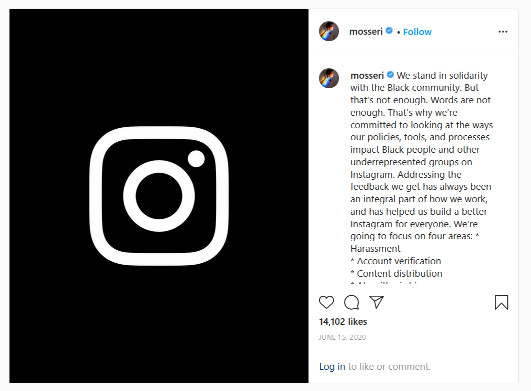
Instagram CEO Adam Mosseri wrote then that the company will be doing a
better job at serving underrepresented groups on four areas, including
addressing algorithmic bias.
CityNews reached out to Facebook, which owns Instagram, to ask about
the issue of algorithm biases, shadow-banning, and how the company
investigates flagged accounts prior to removing them. A response has not
been yet been provided.
“This is a greater conversation, it’s not just about you shutting my
business page with no reason,” Taylor said. “I’m wondering if it’s a
bigger conversation about censorship. If that’s the case, I will
continue to be loud because that’s not okay.”
The algorithm debate
Algorithms used by social media sites have sparked big debates on not
only censorship, but the responsibility companies have in addressing
issues such as online hate, white supremacy, harassment and misogyny.
“It is worse for those who are Black, Indigenous and Asian because
they do get targeted even more and that’s not okay,” Taylor said. “It’s
very frustrating.”
Stevens said technology works in favour of some people and against
others because of its bias and potential for discrimination, adding that
Instagram’s algorithms aren’t perfect.
“Automated decision making technology is important because it speeds
up human decision making processes and allows decisions to be made at a
significant scale,” she explained. “Whereas Facebook is removing
content, historically it would have relied on a person to make that
decisions, automation would speed that process up and allow content to
be removed at an incredible scale and speed.”
Stevens is part of a team at Ryerson Labs, looking at face
recognition technology and how algorithms work. She cites the work of
Shoshana Zuboff, a scholar and leader in the field of “surveillance
capitalism,” saying algorithms play a role for social media companies
who are collecting data.
“These companies are in the business of understanding how we think
and work and nudging us in certain directions, and that’s really
significant,” said Stevens. “We expect to know how technology works but
algorithmic technology sometimes, it teaches itself because we feed it
data.”
Stevens and her team are hoping to highlight the work of Joy
Buolamwini, a computer scientist and digital activist who founded the
Algorithmic Justice League, focusing on creating equitable and
accountable technology.
As explained by Stevens, the organization has identified how face
recognition algorithms, which are being used by social media companies,
can often be inaccurate. Recently AGL analyzed 189 face algorithms
submitted by developers around the world and found concerning results.
“What they found was that the algorithms were 10
to 100 times more likely to inaccurately identify a photograph of a
Black or East Asian person compared to a white person,” said Stevens.
“What this means is that if you are in a data base and you are being
chosen for something or if they wanted to remove content or for some
reason target you in some way, the chances of you being misidentified
are so much greater if you’re East Asian or Black.”
Stevens adds that there needs to be more research in Canada that
looks at the use of algorithms and how decisions are made, not only on
social media, but also when it comes to policing.
Most of the research cited comes from the U.S., where there have been
instances of people being wrongly accused of committing a crime as
police services have also been known to use facial recognition
technology.
“There needs to be solutions,” argued Stevens. “Social media
companies are increasingly using algorithms and AI to make decisions.
Our work uncovered that in 2020 Facebook’s Community Standards
Enforcement report demonstrated that they’re continuously expanding
their use of algorithms to make content removal decisions.”
Attention has also turned to Canada’s privacy laws when it comes to
facial recognition technology. Stevens said it’s important that our
government’s laws advance to prevent what she calls “wrongful takedowns”
and instead, require social media companies to be more transparent
about how they make their decisions.
“People should understand how decisions are made. Right now companies
aren’t required to make these decisions transparent,” Stevens said.
“It’s incredibly important that companies are required by the Canadian
government to be open about how they decide how content is removed.
Right now, we don’t have that transparency.”
Unfairly targeted
Not having access to her account has resulted in a loss of business for Taylor, who was crowned Miss Plus Canada 2014.
Since the pandemic closed down her physical gym, she’s moved her
operations online and Instagram has become a key component to growing
her community.
The expectant mother also depends on social media as she works with
big brands like Nike, Lululemon and Penningtons. She’s created a
community with people from all around the world, which is why she’s
hoping Instagram will give her her page back.
“It wasn’t just a page, it was a community,” she said. “To lose that
makes me really sad, and it’s also disheartening that it happened after
announcing my pregnancy. I’ve definitely lost opportunities. It’s
basically slowed to a halt.”
Logan, who has nearly 38,000 followers on Instagram, adds that she
and others who have been unfairly targeted by algorithms have had to
create backup accounts just in case their pages are removed.
“I don’t know any thin bloggers who have a backup account in case
they lose their page,” Logan said. “Almost all of my friends I know, we
have backup accounts because we are terrified every single day that our
accounts will be gone. So just in case, we have that second platform.”
It’s been said for decades now, that society needs to do a better job
of being representative and inclusive of communities who haven’t always
had a platform for representation. The same can be said about social
media. Centering empowerment of other women who haven’t always seen
themselves reflected has been central for both Taylor and Logan.
“I grew up as a big kid, I was a size 12 and I was bullied heavily,
not just verbally. I was beat up by the guys in grade school,” Taylor
said. “It became my infernal dialogue and I grew up hating myself. It
affected all the decisions I made and led me to marry a man who was
abusive.”


















 Post
Post


