C'era una volta l'America: Four signs America is a ‘failing state’ – warning about the future of the US


Four signs America is a ‘failing state’ – warning about the future of the US

Considered the greatest country on earth for generations, America is far from dominant these days – and could be on the verge of becoming a failing state.


Current Time 0:05
Duration 1:14
The move follows weeks of violent clashes between Black Lives Matter protesters and police in the United

For generations, the United States has been viewed by much of the world as an infallible beacon of strength and power, thanks to its economic, military and social prowess.

These days, the country is far from dominant.

Instead, America is exhibiting all of the key indicators that political experts use to characterise a failing state – the kind of nation on the brink you might’ve found in the post-Soviet era or in war-torn regions of Africa and the Middle East.

The notion that the world’s oldest functioning democracy could ever fail was, until recently, “unthinkable to all but the most radical critics”, says George Rennie, an expert on US politics and international relations at the University of Melbourne.

But based on the most common metrics available to political scientists, there are clear signs that the superpower is in trouble, he said.

“The US is increasingly performing poorly on key predictors of state failure – ethnic and class conflict, democratic and institutional backsliding, and other socio-economic indicators including healthcare and inequality,” Mr Rennie wrote in an article for The Conversation.

“It is in crisis – convulsed by riots and protest, driven by a virus that has galloped away from those charged with overseeing it, and heading into a presidential election led by a man that has possibly divided the nation like no other before him.”

A PERFECT STORM

If you head to Google and type in “America is failing”, you’ll receive a plethora of analysis pieces dating back to the birth of the search engine.

“We’ve been here before,” says Dr Gorana Grgic from the United States Studies Centre at the University of Sydney.

“Over the past half a century, there have been these waves of debate about the decline of the US, after the Vietnam War, during the economic turmoil of the late 1980s and early 1990s, after September 11, during the Global Financial Crisis, so this isn’t a new conversation.”

RELATED: Donald Trump accused of leading US to civil war

America seems more divided than ever – on a multitude of issues. Picture: AP

America seems more divided than ever – on a multitude of issues. Picture: APSource:AP

It’s true that America has been confronted with serious issues relating to those indicators of a failing state – but perhaps not all at the same time.

“We are now in the middle of all of these things happening at once,” Dr Grgic said.

But decades of inaction on addressing systemic failures, particularly surrounding social inequality, has come home to roost.

And that growing inequality among much of the American population adds a different dynamic to the challenges the country is facing.

“It’s hugely worrying,” Dr Grgic said.

“Inequality has been worsening for a while. There’s a growing discrepancy between those who have and those who don’t have. Those who have are amassing wealth at a much greater rate. There hasn’t been any positive movement on those fronts.”

DOWNTRODDEN AND DIVIDED

Ethnic and class conflict is one of the biggest challenges to the “‘united’ part of the United States”, Mr Rennie said.

Black Lives Matter protests saw hundreds of thousands of people take to the streets, angry over police brutality against African-Americans.

While the demonstrations were in response to current events, they’re more likely a sign of a long-building tipping point borne from worsening inequality and poverty exacerbating racial tensions.

“The experience of many black Americans is telling,” Mr Rennie said.

“They feel ‘criminalised at birth’, and when this perception reaches a critical mass among a large enough population, states fail.”

Timeline

Trump's Covid-19 Crisis

Jan, 2020

First warning

US vaccine chief warns Trump administration about severe shortages of personal protective equipment in the national stockpile.

Timeline

Trump's Covid-19 Crisis

Jan 21, 2020

Covid-19 arrives

America's first case of Covid-19.

Timeline

Trump's Covid-19 Crisis

Jan 22, 2020

"We have it totally under control"

Trump is asked if he is worried about a possible pandemic. He replies: “No, not at all. We have it totally under control. It’s one person coming in from China, and we have it under control. It’s going to be just fine.”

Timeline

Trump's Covid-19 Crisis

Feb 6, 2020

First death

American records it's first death from Covid-19. On the same day Trump speaks about his impeachment trial at the White House.

Timeline

Trump's Covid-19 Crisis

Feb 26, 2020

Zero chance

Trump plays down threats of Covid-19, stating that “within a couple of days [it] is going to be down close to zero.”

Timeline

Trump's Covid-19 Crisis

Mar 6, 2020

"Anybody that needs a test gets a test"

Trump states "anybody that needs a test gets a test". Two months later less than 3% of the population has been tested

Timeline

Trump's Covid-19 Crisis

Mar 17, 2020

Trump "always knew"

When Covid-19 cases rise above 6,000 in mid-March, Trump claims that he always knew the coronavirus would be a pandemic.

Timeline

Trump's Covid-19 Crisis

Mar 24, 2020

Open it up

Trump says that he wants the nation “opened up and just raring to go by Easter.”, while a task force warns deaths could surge over 100,000 if lockdown is ended.

Timeline

Trump's Covid-19 Crisis

Mar 29, 2020

Project Airbridge

Trump promotes taxpayer-funded flights of personal protective equipment from Asia to the US organized by his son-in-law Jared Kushner, dubbed Project Airbridge.

Timeline

Trump's Covid-19 Crisis

Apr 5, 2020

Hydroxychloroquine

Trump publicly promotes anti-malarial drug hydroxychloroquine as a treatment, despite warnings that it can cause serious side effects.

Timeline

Trump's Covid-19 Crisis

Apr 14, 2020

Withdrawal of funding

Trump announces the withdrawal of American funding to WHO

Timeline

Trump's Covid-19 Crisis

Apr 23, 2020

Injecting disinfectant

In press conferences Trump suggests injecting people with disinfectant and exposing people’s bodies to ultraviolet light will help treat the disease.

Timeline

Trump's Covid-19 Crisis

May 5, 2020

Cubic Model

Trump’s economic advisor Kevin Hassett devises a “cubic model” that shows Covid-19 deaths falling to zero by mid-May.

Timeline

Trump's Covid-19 Crisis

May 7, 2020

Project Airbridge shut

Project Airbridge closed amid allegations of profiteering by private companies.

Timeline

Trump's Covid-19 Crisis

May 14, 2020

Obama's fault

Trump blames the Obama administration for lack of face masks and other personal protective equipment.

Timeline

Trump's Covid-19 Crisis

May 18, 2020

Trump announces he is taking hydroxychloroquine.

Timeline

Trump's Covid-19 Crisis

May 27, 2020

Grim milestone

The United States reaches more than 100,000 virus-related deaths.

Timeline

Trump's Covid-19 Crisis

May 29, 2020

Trump leaves WHO

Trump announces that the United States will terminate its membership of WHO

Jan, 2020

Jan 21, 2020

Jan 22, 2020

Feb 6, 2020

Feb 26, 2020

Mar 6, 2020

Mar 17, 2020

Mar 24, 2020

Mar 29, 2020

Apr 5, 2020

Apr 14, 2020

Apr 23, 2020

May 5, 2020

May 7, 2020

May 14, 2020

May 18, 2020

May 27, 2020

May 29, 2020

20202020FebruaryMarchAprilMayJune
+

Similarly, the widespread push-back against coronavirus restrictions in southern states, some of which featured armed demonstrators storming government buildings, is also about more than immediate disadvantage.

It’s a sign that the low- and middle-class populations, still recovering from the economic devastation of the Global Financial Crisis, are beyond breaking point.

Before the coronavirus crisis took hold, America had achieved record-low unemployment and its economy was continuing to grow at a rapid pace.

But as Mr Rennie points out, much of that wealth and prosperity has been absorbed mostly by those at the very top of the mountain.

The gap between rich and poor is widening, the American middle class is shrinking and the top 1 per cent are carving out a larger piece of the pie.

“For example, CEOs’ pay went from 20 times the average workers’ salary in 1965 to 278 times their salary in 2018,” he said.

“In real terms, only college graduates have seen their pay increase as a group since 1979, and this occurs while 21 per cent of American children live in poverty.

“Moreover, health outcomes for Americans are very poor compared to other OECD countries, despite having the highest per capita healthcare costs in the world.”

RELATED: The thing that divides us could be our downfall

Americans in San Diego protest against coronavirus lockdown measures. Picture: AFP

Americans in San Diego protest against coronavirus lockdown measures. Picture: AFPSource:AFP

While all poorer Americans are “getting relatively poorer”, it’s an issue that disproportionately affects black Americans, he pointed out.

And when anger reaches a critical mass and disenfranchised people of colour push back, as they have in recent weeks, it ironically sows further racial division.

Poor white Americans seem “increasingly likely to fight against the perceived injustices of other ethnic groups”, Mr Rennie said.

“They do this by pitting themselves against similarly politically and economically disenfranchised groups, rather than the power system that keeps them dispossessed.”

INSTITUTIONS BREAKING DOWN

If America was a car dashboard, there would be flashing lights to warn about the erosion of critical democratic institutions.

That’s the view of Mr Rennie, who believes the “wealth disconnect” is contributing to politics being less representative.

Analysis conducted last year found the average net worth of both senators and members of the House of Representatives was $500,000. That’s five times the median household worth in the US.

There are 76 federal politicians with a net worth greater than $3 million.

The wealthiest, Greg Gianforte, a Republican congressman from Montana, is worth $135 million, while Senator Mark Warner, a Democrat representing Virginia, is worth $90 million.

According to the news outlet RollCall, the collective wealth of politicians increased by one-fifth in two years to $2.4 billion.

Mr Rennie said there is significant evidence that “the majority of citizens are not being represented” by democracy.

“The black and white, racial narrative of America’s woes misses an important, but even more consequential point,” he said.

“While there is no doubt black Americans are disproportionately suffering, an increasing majority is losing out, regardless of race.”

Economic inequality has risen sharply in America, widening the gap between rich and poor. Picture: Michael Nagle

Economic inequality has risen sharply in America, widening the gap between rich and poor. Picture: Michael NagleSource:Supplied

The ability for governments to get things done has also declined significantly.

In his book First-Class Passengers on a Sinking Ship, author Richard Lachmann, also a professor at the University of Albany-SUNY, wrote that failure across a number of areas has been evident for decades.

“Spending on infrastructure has stagnated as bridges collapse, water and sewer pipes and dams burst, air and road traffic become ever more snarled, and passenger trains on a shrinking network struggle to reach early 20th-century speeds,” Lachmann said.

“Student achievement at the primary, secondary, and university levels has fallen from the top ranks. US students, who attend ever more decrepit schools, are performing less well than their peers in countries with much lower levels of income or educational spending.

“The United States does spend lavishly in two sectors, health care and the military, but its relative standing in both realms has been falling for decades.”

Americans pay more for health care and medicine than elsewhere in the world, despite going to the doctor less and spending fewer days in hospital, he wrote.

The US ranks 34th among nations in life expectancy. The healthcare system spends more than twice on administrative costs than any other OECD nation.

When it comes to the success of the country’s other costliest pursuit – defence – Lachmann said America was unique among dominant powers in its “repeated failure to achieve military objectives” over the past several decades.

“The US military has become ever less able to win wars, even as its advantage in spending and in the amount and sophistication of its armaments has widened over its actual and potential rivals to a level unprecedented in world history.”

A homeless person covered in blankets for warmth sleeps at the entrance of a Metro station near the White House in Washington, DC. Picture: AFP

A homeless person covered in blankets for warmth sleeps at the entrance of a Metro station near the White House in Washington, DC. Picture: AFPSource:AFP

Political polarisation is also worse than ever, Dr Grgic said, although it’s been steadily worsening for some time.

In the “golden era of bipartisanship” in the mid-parts of the 20th century, it wasn’t uncommon to see politicians crossing party lines. Those days are virtually over.

“If you examine the voting records in the US Congress, you really see this party discipline and an inability to find a middle ground,” she said.

“This has now reached an almost tipping point. The two parties are very distant from one another because they largely speak to different constituents.

“It’s reached fever pitch. It doesn’t come with Donald Trump though. The causes were there for a very long time.”

EASY TO BLAME TRUMP

There’s probably a temptation among many to immediately level blame for the current woes of America on President Donald Trump.

But Dr Grgic said that “history didn’t begin in 2016” and the challenges gripping the nation are “symptoms of an illness that’s very deeply rooted”.

America’s complex challenges didn’t begin in 2016 with the election of Donald Trump. Picture: AFP

America’s complex challenges didn’t begin in 2016 with the election of Donald Trump. Picture: AFPSource:AFP

Income tax cuts, corporate tax reform and industry deregulation have all largely failed to improve the livelihoods of average Americans, Dr Grgic said.

“This is something that’s very structural and goes way back – long before Trump, long before Obama, before Bush … it’s not new but it’s getting worse.

“What we’re seeing now, I think, is indicative of decades and decades of huge problems that haven’t been addressed.”

Racial inequality is also worsened by systems that make breaking out of poverty and wealth accumulation difficult.

Mr Rennie agreed that successive governments have “proved unable to respond and listen to their citizens”.

“The domestic deterioration of the world’s biggest nuclear and military superpower would prove unprecedented and frightening beyond rational analysis,” he said.

“The challenge now is whether the world’s oldest continuous democracy can live up to its own ideals.”

THE END OF AMERICA?

The demise of the United States has been predicted countless times.

But there’s little doubt that the multitude of complex challenges facing the country are greater than they have been in a long time, and occurring simultaneously.

“The challenge now is also different because for some time, the distribution of global power has been shifting away from the US – other states are amassing power, whether economically or militarily,” Dr Grgic said.

“But power is also shifting away from nation states. We have various non-state actors amassing power … wealthy individuals and corporations, even militant organisations.”

But assuming that the next major player down the ladder – China – will take the mantle as the world’s great superpower is perhaps a premature conclusion, she said.

“Probably where we’re heading, and this is where it’s different from the 70s and 80s, is towards a world that’s increasingly fragmented.”.

The coronavirus crisis, which shows no signs of easing, has added to America’s many issues. Picture: AFP

The coronavirus crisis, which shows no signs of easing, has added to America’s many issues. Picture: AFPSource:AFP

When it comes to challenges at home, Dr Grgic sees the recent civil unrest as a positive sign for the future and not a negative one.

It points to a segment of the population that shows “no shortage of will and motivation to address some of the issues, whether it be income inequality or race relations, to drive real systemic change”.

She said America’s fate should be a discussion “about relative decline, not absolute decline”.

“When someone hears decline, they associate it with collapse – you know, ‘this is it’. But you have to be careful and distinguish between relative and absolute.”

At the end of the day, she said “no one has a crystal ball”.

“But the US has shown a number of times that it’s able to bounce back.”

C'era una volta l'America: COVID-19 blunders signal end of ‘American Century’


COVID-19 blunders signal end of ‘American Century’

By Wang Wen Source:Global Times Published: 2020/3/30 19:38:40
47

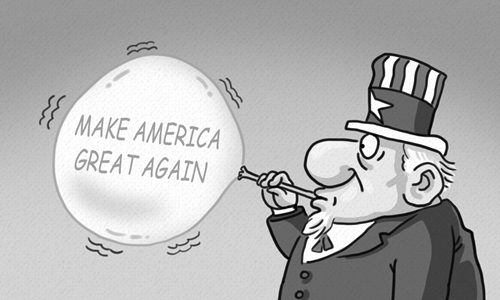
Illustration: Liu Rui/GT

For most people it's unfathomable that the fight against the COVID-19 pandemic is the first global event that hasn't been led by the US since 1941. In 1941, the US was a leader in the worldwide antifascist war. During this current global fight against an invisible enemy, the US is hardly able to protect itself. The US should have been much better prepared for the outbreak considering the coronavirus came to its shores after it had rampaged through China, Japan, South Korea, Iran, Italy, France, Germany and Britain. 

The Trump administration was ineptly over-confident. It lied about the pandemic, missed its best chance to contain the virus, and is now trying to blame other countries. Currently, the US leads the world in the number of infected cases, with a total death toll that is greater than that caused by the 9/11 attacks. According to Professor Stephen M. Walt, the pandemic may declare "the death of American competence."

The US is the self-proclaimed leader of the world, but it's sad to see that not one country has rushed to help the US out of its current virus plight. By contrast, when China was in its arduous battle against the virus two months ago, at least 53 countries donated personal protective equipment (PPE), and now as the threat in China abates it has helped more than 80 countries and international organizations, supplying ventilators and PPE. I wonder what Time magazine's founding publisher Henry Luce, who coined the term "American Century," would call on the US to do. Perhaps he would publish a similar cover story, but this time probably an obituary: "American Century (1941-2020)."

There have been debates on the decline of the US for many years. I believe that the US, which led the world's development after WWII, should never be underestimated. Yet it is probably indisputable that the COVID-19 pandemic has brought an end to the "American Century." 

The principal founder of peace and conflict studies, Johan Galtung, predicted in his 2009 book The Fall of the US Empire-And Then What? that the US empire will decline and fall by 2020. According to Galtung, the decline and fall of the US is due to its expanding hegemon that has driven the US to exploit and suppress other countries. 

The history of ancient China, which witnessed the rise and fall of numerous dynasties, provides a number of bitter lessons: Emperors who overindulged in sensual pleasures, wantonly engaged in military aggression, lacked experience in ruling a country, and were forsaken by allies eventually witnessed the death of their empire. Let's take a look at past four US presidents. The political sex scandal involving Bill Clinton exposed the ugly features of the White House. George W. Bush launched successive wars against Afghanistan and Iraq, which depleted the US treasury and played a role in the 2008 global financial crisis. Barack Obama strived to make changes but achieved little due to insufficient governing experience and a deeply divided congress that was stacked against him. Donald Trump's "America First" doctrine has led his administration to abruptly withdraw from international treaties that have almost cracked the traditional world order.

The fractured US society means that new domestic policy never receives the full support of the American people, giving room to populist and protectionist policies to be seen as acceptable within the country. This is leading the international image of the US to decline from one of a global empire to an inconsequential regional power.

The Chinese people do not take any pleasure in witnessing the end of the American century. Even as the US is ravaged by the pandemic, the Trump administration has not stopped attacking China. US Secretary of State Mike Pompeo used racist virus terms to smear China during several international events. Trump signed the so-called Taipei Act into law in direct interference in cross-Straits affairs. Obviously, China is seen as the "competitor" that concerns the declining US empire most.

Former US first lady Michelle Obama once said, "When they go low, we go high." China is unwilling to get entangled with the petty politics of the US. Instead, China is devoted to walking a fine line between controlling the epidemic and resuming economic activities. The country is also ready to provide any help within its capacity to those in need.

China will give the US a hand in fighting the virus if it is asked. The two countries cooperated to cope with the 2008 financial crisis, and they should be working together now. But things have changed. The COVID-19 pandemic will show an unprecedented change that had already begun: a move away from US-centric century.

The author is professor and executive dean of Chongyang Institute for Financial Studies at Renmin University of China, and executive director of China-US People-to-People Exchange Research Center. His latest book is Great Power's Long March Road. wangwen2013@ruc.edu.cn

C'era una volta l'America: Trump team is driving US to ‘failed state’ status


Trump team is driving US to ‘failed state’ status

By Wang Wen Source:Global Times Published: 2020/4/27 20:13:41
23

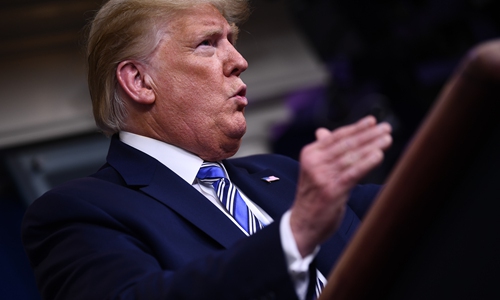
US President Donald Trump File Photo: AFP

It's unthinkable that US media outlets would call their own country a "failed state." The term was once used to describe US adversaries such as Iran and Iraq.

The US think tank Fund for Peace started its annual report called Failed States Index in 2005. It has been renamed the Fragile States Index and is produced jointly with Foreign Policy magazine. It didn't take long for the US to be included in the index.

US political scientist Francis Fukuyama, who once believed history would end with liberal democracy as the final form of government for all countries, has since changed his mind, writing in his 2016 article "America: the failed state" that the US should give up "entirely on global leadership." In another article titled "We Are Living in a Failed State" published by The Atlantic, staff writer George Packer said that the coronavirus has made the US "a beggar nation in utter chaos" and that "like France in 1940, America in 2020 has stunned itself with a collapse that's larger and deeper than one miserable leader."

Many people in China who once worshiped the US are not taking any pleasure in witnessing the decline of the US. China cares about Americans. 

"As of April 20, China had provided the US with over 2.46 billion masks, meaning seven masks for each [person] in the US, plus nearly 5,000 ventilators" and many other types of medical equipment, Chinese Foreign Ministry spokesperson Hua Chunying said on Twitter on Thursday. 

China does need to take a lesson from the US and examine why the once great country has failed to protect its people, fallen into political division, been stunned by corruption and unparalleled social divide?

China must continue to be wary of US radical policies, including making China a scapegoat for its failures. The news site Politico reported on Friday, that the National Republican Senatorial Committee "has sent [election] campaigns a detailed, 57-page memo authored by a top Republican strategist advising GOP candidates to address the coronavirus crisis by aggressively attacking China." According to Politico, "Republicans have indicated they plan to make China a centerpiece of the 2020 campaign."

Attempts to stigmatize China reflect the degradation of the US. The Trump administration's radical policies that at first seem to create an advantage actually damage the US.

Over the last three years, the Trump administration has nearly destroyed the foundation of international order that's been in place since the end of the Cold War. It has pulled out of the Trans-Pacific Partnership, the Paris Agreement, the United Nations Human Rights Council, the Intermediate-Range Nuclear Forces Treaty, and many other international treaties and organizations. 

Over the past three months, the Trump administration has doubled the Federal Reserve's balance sheet via measures including quantitative easing and strong stimulus policies, making US dollar the most unstable factor in the global monetary order. It has also severely shaken the international financial system. Global assets are now facing the risk of suddenly plunging or skyrocketing at any time.

Over the past three weeks, the Trump administration has escalated the international oil price war, causing oil prices to collapse. For the first time in history, crude oil was trading at negative prices on April 20, disturbing the global energy market, and making the US withdraw from the oil hegemony system that it has maintained for half a century.

Over the past three seconds, Trump might have made even more startling statements again. Numerous people are wondering how the US system can tolerate such a person as a president. The Washington Consensus is dead, the beacon of democracy, freedom and human rights that the US has long adhered to has collapsed. 

The current US government, which most US elites are dissatisfied with, is not only hurting itself, it also wants to harm China. The US scapegoating China makes the US look like some immoral person spitting at an innocent person. The signing of the TAIPEI Act and seeking compensation from China for coronavirus losses are without doubt equivalent to clenching its fists and getting ready to throw punches. 

It is like a bad kid who gets low marks, blames others and even undermines their chances of passing the exam. 

China will not get stuck in the blame game with the US, nor will it become a grave good of a declining US. Going its own way is still key for China. China is confident of doing a good job in not only containing the virus, but also resuming economic activities. 

It is a pity that the Trump administration seems to have opened this Pandora's box, allowing fighting, division, unpredictability and selfishness to spread around the world. The US is no longer the world's dominant force, but it is still powerful. If it continues its willful misbehavior, Washington will bring disaster not only to the US, but all of human kind. 

Nobel laureate in economics, Joseph E. Stiglitz, once wisely noted; "The only way forward, the only way to save our planet and our civilization, is a rebirth of history. We must revitalize the Enlightenment and recommit to honoring its values of freedom, respect for knowledge and democracy."

The author is professor and executive dean of Chongyang Institute for Financial Studies at Renmin University of China, and executive director of China-US People-to-People Exchange Research Center. His latest book is Great Power's Long March Road.wangwen2013@ruc.edu.cn

C'era una volta l'America: Everyone failed on Covid-19


Everyone failed on Covid-19

The US’s coronavirus epidemic is an American failure, not solely a Trump or Republican one.

President Donald Trump arrives at the White House on October 5 after his stay at Walter Reed National Military Medical Center, where he was treated for Covid-19.
Win McNamee/Getty Images

America’s Covid-19 epidemic is truly national. Every region has far too many coronavirus cases and deaths, with cases increasing in all 50 states and Washington, DC, for at least some time over the past couple of months.

In June, just three states reported daily new coronavirus cases higher than 12 per 100,000 people. Today, every state except Hawaii exceeds that threshold. Some of that is due to greater testing capacity, but the climbing toll of hospitalizations and deaths, which have reached record highs nationally in the last month, show this is not merely a “casedemic” of sick people who might have gone undetected earlier in the year, but a rising tide of Covid-19 across the US.

So how did America get here?

The primary answer lies in President Donald Trump and Republican leaders in Congress, who have collectively abdicated the federal government’s role in addressing the outbreak or even acknowledging its severity. From Trump’s borderline denialist messaging on Covid-19 to Congress’s inability to pass broader economic relief, the country has been left in a place where states, local governments, and the public have to fend for themselves — and none of them have the resources to deal with the coronavirus on their own.

Trump and his allies have also actively worked to sideline the Centers for Disease Control and Prevention, crippling the agency’s ability to provide guidance to states and others that have now been left out on their own.

At the same time, there are serious structural issues that hindered states’ and the public’s ability to act. Experts have long argued that the US’s public health infrastructure is underresourced and ill prepared for a serious crisis, and the pandemic has exposed this many times over: Nearly a year into the pandemic, no state has capacities for testing and contact tracing that most experts would consider adequate.

And the lack of economic relief has made it much harder for people to stay home and business owners to close down, faced with the decision of mitigating the coronavirus’s spread or failing to pay their mortgage and other bills.

“Throughout the whole pandemic, I have never accepted the argument that the problem of America is we have 50 failed governors,” Ashish Jha, dean of the Brown University School of Public Health, told me. “That can’t possibly be the right answer. The right answer is not we need better governors — the right answer is we need a different structure and a better federal government.”

Still, Jha acknowledged, “I don’t want to completely let the governors go.” They’ve been limited in what they can do, especially as a weakened economy shrank their budgets. But over time, as fatigue around the pandemic set in, governors became less proactive toward the coronavirus and more reactive — and they increasingly pushed short-term economic interests over public health concerns.

That was clear as the entire country, over the summer and fall, reopened schools, indoor dining, bars, and other risky indoor spaces, even as experts warned that the consequences could be dire. Now we’re seeing the effects.

That includes states led by Democrats and ones led by Republicans:

  • In California, Democratic Gov. Gavin Newsom earned praise in the spring for shutting down the state early, helping avoid the kind of surge that New York saw. But in recent months, he pushed to close down only after the state was reporting tens of thousands of Covid-19 cases a day.
  • In New York, Democratic Gov. Andrew Cuomo was praised for his response to an enormous spring surge as he locked down the state, built up testing, and vowed to leave things closed down as long as necessary. But in the summer and fall, he began to open up the state more aggressively — reopening indoor dining in New York City, despite experts’ warnings of the dangers involved. The failure is now apparent, as New York City closed down indoor dining again after cases skyrocketed.
  • In Ohio, Republican Gov. Mike DeWine originally stood out as one of the few in his political party taking aggressive steps against Covid-19 — only to respond to the ongoing surge with a curfew that’s widely seen as a joke to experts. (The coronavirus, it turns out, doesn’t keep nighttime hours for spreading from person to person.)

This is only a sampling of states’ mistakes. “There have been different versions of not doing this well across the states,” Kirsten Bibbins-Domingo, an epidemiologist at the University of California San Francisco, told me.

The public has eased up too. The US has generally gotten better at masking, based on public opinion surveys, but has also gotten much worse at social and physical distancing than in the spring. We’ve patronized the restaurants, bars, and other risky indoor areas that have reopened. We’ve gathered with friends and family over Labor Day, Halloween, and Thanksgiving, even as public health officials and experts have pleaded that we don’t.

As a result, the US is now among the worst performers on Covid-19 in the world. Despite recent surges in Europe and elsewhere — which were largely the result of similar failures — America remains within the top 20 percent for most coronavirus deaths per person among developed nations, with more than twice the death rate as the median developed country. If the US managed the same Covid-19 death rate as Canada, nearly 190,000 Americans would likely be alive today.

While the story behind those numbers lies mostly in what Trump and much of the federal government have wrought, it’s also on the rest of the US. From the president to governors to mayors to the public, America has failed on Covid-19 — and only by learning from those mistakes can we ensure they don’t happen again.

All states are doing very badly on Covid-19

Since early on in the pandemic, I’ve tracked a range of metrics for each state’s Covid-19 outbreak. Taken together, these metrics — daily new cases per capita, the infection rate, and the test positive rate — provide a sense of how well a state is controlling its epidemic.

As of now, no state is doing well. For the past few weeks, not a single state has met all three benchmarks in the state-by-state tracker. In fact, for most of the past several weeks, not one state has met even two of three benchmarks.

The map for cases per capita used to have a diversity of colors, but now it’s almost all purple. The coronavirus has overwhelmed every single state. Even Hawaii and Vermont, which are performing the best, have case levels that suggest the epidemic is spreading out of control.

A map of each state’s Covid-19 cases per capita.

Covid-19 hospitalizations and deaths have also steadily increased for more than a month nationwide now. The increase in cases isn’t just the result of more tests — more people are genuinely getting sick and dying as a result of the coronavirus. The US is quickly approaching a daily Covid-19 death toll that matches that of the 9/11 attacks, every day, with no sign of slowing.

This was preventable and predictable. Part of the problem is the US never truly suppressed the coronavirus. “We’ve never gotten cases down to a really low point — ever — even in the best states,” Bibbins-Domingo said. So there’s always been a lot of the virus out there, waiting to spread to new hosts the moment the public and governments eased up.

By contrast, the countries that have done better against Covid-19 — including Australia, Japan, South Korea, and Vietnam but also, to a lesser degree, Canada and Germany — suppressed the virus at one point. So when they did see a rise in cases, it was a rise that was much more manageable.

That’s why it was so dangerous for states to reopen as early and as quickly as all of them did at some point this year — before they and their neighbors had real control of the coronavirus through low cases, widespread masking, and scaled-up systems to test and contact trace. Reopening created an environment in which the coronavirus could quickly spread out of control as people went back to private gatherings, parties, restaurants, and bars.

Now states face another crisis: With holiday gatherings around Thanksgiving, Christmas, and New Year’s Eve, as well as the cold weather making outdoor activities much harder for much of the country, public health experts always expected that cases would rise in the fall and winter. But because states had already squandered any gains they made by the time Thanksgiving rolled around, the fall surges are surges on top of surges, shattering records set during the spring’s initial outbreaks.

This is truly national, with no state spared. The best thing one can say is that Hawaii, which could use its geographical advantage to take stronger steps to restrict travel from other states, is suffering less. But it still has far more than 8 cases per 100,000 a day on average, more than double the threshold of about 4 cases per 100,000 a day that experts rely on as a sign of having the coronavirus under control. The best in the US is still quite bad.

Trump and Congress’s failure is mostly to blame

When a failure in the US is nationwide, chances are the problem is rooted in a common variable: a systemic factor that’s influencing the behavior of leaders across the country.

Particularly with an infectious disease, a big failure in one part of the country is typically going to result in some level of spread to others. It’s just too difficult, if not impossible, to restrict travel among states, due to the social, legal, and political issues involved. That’s what made a federal strategy so important for every single state — but such a federal plan never came, and the Trump administration and Congress actually pulled back from offering aid to states, counties, and cities as the pandemic progressed.

At the top of the list of problems is the failure to pass a second economic relief bill until late December. Democrats pushed for a large bill in Congress, passing multiple versions of one in the House. But Trump made clear the bill was less of a priority than getting his Supreme Court nominee through the Senate. And Senate Majority Leader Mitch McConnell continually resisted a broad stimulus package on both fiscal grounds and to push for legal protections for employers so they’re not held legally liable for Covid-19 spread in their workplace.

Meanwhile, the economic relief measures Congress passed in the spring dwindled. Thanks to the US’s weak social safety net, this left people with little to no relief as they lose their jobs due to the weakened economy or are asked to, in effect, give up income as they stay home to avoid spreading the virus.

This obviously hurts people’s financial well-being. But it also makes it much harder to actually do what’s right for getting Covid-19 under control. If you’re a bar owner, you’re likely going to be much more resistant to closing down your business if it means you’ll lose your source of income without anything to make up for it. The same thing goes for any employee in that bar or any other business who’s being told to stay home and avoid the same risky indoor spaces where they work — many of them simply can’t afford to do it.

Congress has now passed a second relief bill. But it arguably comes too little and too late: The fall and winter Covid-19 surge is already in full effect, people have languished financially for months, and benefits could take weeks to roll out to people even after the measure is enacted. State aid is still almost nonexistent, and the size of the package is still too small.

Trump has also deliberately acted as a bullhorn for Covid-19 denialism over the past several months. The result is that a large segment of the country who believes in Trump has hung on to his every word, arguing that their local and state leaders should not take the coronavirus so seriously.

The problem isn’t limited to deep-red states. For one, more people voted for Trump in California than in Texas, Florida, or any other state, and those constituencies have been apparently vocal enough to get local officials to step back from stronger restrictions. In a particularly extreme case, Orange County’s chief health officer resigned after working on a mask-wearing order and facing public backlash, including death threats.

That’s on top of large segments of the public who are simply tired of dealing with Covid-19 and have eased up on precautions like social distancing as the pandemic has dragged on.

“We often think leaders decide things based on what they think is right,” Jha said, referring to his own discussions with governors. “But there is a political space they need to act.”

On top of his denialism, Trump muzzled those in the federal government who could have provided better guidance and leadership. That applies especially to the Centers for Disease Control and Prevention, which for months didn’t hold its own press conferences even as the epidemic rapidly worsened. When agencies like the CDC did try to provide cautionary guidance, Trump, Vice President Mike Pence, and other administration officials often got in the way — an effort to stop anything that could be read as suggesting that Covid-19 is a real problem and that the president isn’t doing enough to stop it.

Trump also pulled the federal government out of many Covid-19 efforts. In April, the White House put out a “blueprint” that effectively abdicated the federal government’s role in building up coronavirus testing — instead arguing that local, state, and private entities should be in charge as the feds act merely as a “supplier of last resort.” In practice, this left the states fighting for a limited number of supplies for tests while no one did anywhere near enough to fix the choke points along the supply chain that led to shortages in the first place. The approval process and strategy for testing was flawed from the start and continues to be less than ideal.

Other structural problems preceded Trump. In 2019, a ranking released by the Johns Hopkins Center for Health Security and Nuclear Threat Initiative put the US at the top for disease outbreak preparedness, but also concluded that “no country is fully prepared for epidemics or pandemics.” Public health infrastructure in the US, as well as every other country in the world, has long been insufficiently funded to handle a major crisis like the coronavirus.

Combined, all of these structural failures and barriers can help explain how every state now has Covid-19 outbreaks that are completely out of control.

But there have been genuine failures by local and state leaders

At the same time, experts cautioned that you can’t let local, state, and other non-federal leaders off the hook. There are obvious examples like 12 states still not mandating masks, but there are more controversial actions that local and state leaders could have taken.

Some experts argue states should have simply shut down much earlier this fall — if not entirely, at least close risky indoor spaces like restaurants, bars, casinos, and gyms. This would have involved short-term economic pain largely thanks to the lack of federal economic relief. But it would have saved a lot of lives and, based on the research and experience of other countries, could have actually helped the economy in the long term.

“Lives cannot be rebuilt; other things can be,” Daniel Goldberg, a medical historian and public health ethicist at the University of Colorado, told me. He acknowledged the short-term economic pain that closing down would bring, but said it was simply the better of a set of bad options.

“A lot of what I do in public health ethics is thinking about the fact that often there isn’t a good option,” he said. “So what we have to do is pick the least bad one. It’s not good. I’m not going to tell you it’s a good thing. It’s terrible. But it’s still the least bad thing we have to do.”

But just about everyone reopened too aggressively following spring and summer surges of Covid-19, and they have been far too slow to close down since — as the surges in previously proactive states like California and Ohio indicate.

There are some partisan differences. The states that haven’t enacted mask mandates, which the research increasingly supports, are all led by Republicans. Many Republican-led states resisted any sort of restrictions at all — with South Dakota, as one example, sticking to a “personal responsibility” strategy even as the state suffered one of the worst Covid-19 outbreaks in the world at the time.

But it’s not entirely a red-or-blue issue. Democratic leaders in California, New York, and elsewhere have also softened their approach to Covid-19, resisting stronger action until after their states reached or neared new highs in coronavirus cases or deaths this fall. According to the New York Times, businesses are mostly or largely open in 41 states, and none has a stay-at-home order statewide.

Governors will point to the structural problems. Jha told me that in his own conversations with governors, they’ve argued that they essentially have to choose between public health and the economy, thanks to the lack of federal aid. “They really don’t like those choices,” he said.

While that might make the problems local and state officials face more understandable, it doesn’t fully justify what followed. Before the fall, most experts warned of the growing risk of Covid-19 as the holidays arrived, temperatures dropped, and states reopened. Michael Osterholm, director of the Center for Infectious Disease Research and Policy, told me that “this fall is going to be the biggest spike of all” — a message echoed by others in the field, publicly and privately. It was genuinely hard to avoid the warnings that more cases and deaths were coming without proper action.

This created a clear choice for states: You can continue to reopen or keep places open, leading to thousands of deaths and, potentially, not avoiding any economic harm if a new surge leads the public to voluntarily lock down anyway. Or you can impose restrictions, save as many lives as possible through the fall and winter, and come out on the other side with the likely prospects of a vaccine reaching the general public, all with at worst a short-term hit to the economy.

Every state opted to roll the dice on a risky reopening, gambling on the possibility that things wouldn’t get too bad and the economy would remain afloat. Now things are bad, with record numbers of Americans getting sick and dying.

Meanwhile, the economy continues to struggle anyway, as much of the public keeps cutting back socializing and spending as the Covid-19 epidemic spirals. According to restaurant data from OpenTable, seated dining from online, phone, and walk-in reservations are now down 71 percent compared to the same time last year. By contrast, places that have controlled the coronavirus have stronger economies: In Australia, dining in is actually up 58 percent from last year. The problem US leaders sought to avoid by reopening and staying open hasn’t been avoided.

“It feels like we have the worst of both worlds,” Bibbins-Domingo said, speaking to her experience in California. “You can see that now with the backlash and fatigue and latest reaction” to new restrictions.

In response, leaders have called on individuals to take steps to mitigate the risk of spread — to cancel or reduce their holiday plans. It hasn’t worked, with cases, hospitalizations, and deaths still trending up, and much-feared Christmas and New Year’s surges looking more and more likely. The American public simply isn’t listening, leading to surges on surges.

Some government leaders have exemplified the failure of this approach. New York Gov. Andrew Cuomo has spent many of his press conferences warning people of the risks of holiday gatherings, advising people to simply not do them. Yet until a public backlash, Cuomo planned to hold a Thanksgiving dinner with his 89-year-old mother and two of his adult daughters. Leaders in California, Rhode Island, and elsewhere have made similar mistakes.

Such failures are part of why experts have called for more government action. While it’s true that holiday gatherings can lead to the spread of Covid-19, and individuals should reconsider any big winter plans, the reality is many people are going to do these kinds of things anyway. But if all levels of government had done a better job controlling the coronavirus before the US got to its holiday season, the risk wouldn’t have been as large as it is now — there may have been much less virus out there, waiting to spread over dinner on Christmas Eve.

That’s mostly Trump and his Republican allies’ fault, but not entirely. The Covid-19 epidemic is an American failure — and the whole country has to learn from that.

C'era una volta l'America: Is the United States a failing state?


Is the United States a failing state?

Is the United States a failing state?

President Donald J. Trump makes a stop at a pizza shop in Old Forge, PA, on August 20, 2020. Photo: White House

By Richard Falk

To ask whether the United States, the world’s dominant military power, is ‘a failing state’ should cause worldwide anxiety. Such a state, analogous to a wounded animal, is a global menace of unprecedented proportions in the nuclear age. Its political leadership is exhibiting a reckless tendency of combining incompetence with extremism. It is also crucial to ascertain at what point a failing state should be written off as ‘a failed state’ for which there is no longer a clear path to redemption. The November elections in the United States will send a strong signal as to whether the United States is failing or has failed.

Even raising these issues suggests how far the United States has fallen during the Trump years, despite already being in sharp decline internationally ever since the Vietnam War, and continuing, despite a few redemptive moves (now renounced), during the Obama presidency. The responses of the Trump presidency to the two great crises of 2020 were helpful in solidifying the image of the world’s #1 state as truly failing, and not just sour grapes taking the form of an expression of partisan frustration with an appalling leadership. It was appalling because it was affirming the most regressive features of the American past while unconvincingly claiming credit for the stock market rise and low unemployment. The COVID-19 pandemic and Black Lives Matter campaign against systemic racism gave Trump the opportunity to exhibit his lethally systemic incompetence as a crisis manager producing thousands of deaths among his own countrymen. He also seized the occasion to show the world his seemingly genuine racist solidarity with the Confederate spirit of the American South that tried to split the country and preserve its barbaric slave economy and supportive culture in the American Civil War 150 years ago, and has been a sore loser ever since.

With these clarifying developments, it no longer captures the full reality of this downward trend to be with content by calling attention to America’s ‘imperial decline.’ In the present setting, it seems more relevant to insist on describing America as ‘a failing state,’ and try to understand what that means for the country and the world. To make the contention more precise, it is instructive to realize that the United States is not only a failing state, but the first instance ever of a failing global state, which takes due account of its multi-dimensional hegemonic status as concretized by the planetary projection of its military might to air, land, and sea, to space and cyber space, as well as by its influence on the operation of the world economy and the character of popular culture whether expressed by music or cuisine.

There are several measures of a failing state that cast light on the American reality:

functional failures: inability to respond adequately to challenges threatening the security of the society and its population against threats posed by internal and external hostile political actors, as well as by ecological instabilities, by widespread extreme poverty and hunger, and by a deficient health and disaster response system;

normative failures: refusal to abide by systemic rules internationally as embedded in international law and the UN Charter, claiming impunity and acting on the basis of double standards to carry out its geopolitical encroachments on the wellbeing of others and its disregard of ecological dangers; patterns of normative failures include endorsements of policies and practices giving rise to genocide and ecocide, constituting the most basic violations of international criminal law and the sovereign rights of foreign countries; the wrongs are too numerous to delimit, including severe and systemic denials of human rights in domestic governance; economic and social structures that inevitably generate acute socio-economic inequalities on the basis of class, race, and gender.

Some additional considerations accentuate the failing state reality of the US due to the extensive extraterritorial dimensions that accompany the process of becoming ‘a failing global state.’ This new type of transnational political creature should be categorized as the first historical example of a ‘geopolitical superpower.’ Such a political actor is neither separate from nor entirely subject to the state-centric system of world order that evolved from the Peace of Westphalia in 1648, and became universalized in the decades following World War II. Although lacking a true antecedent, the role of European ‘great powers’ or ‘colonial empires’ give clues as to the evaluation of the US as a global state or geopolitical superpower;

effectiveness: the loss of effectiveness by a failing state is disclosed by its inability to maintain and exert control over challenges to its supremacy. Such an assessment if vindicated by failed military operations (regime-changing interventions) and the inability to learn from and overcome past mistakes, disclosures of vulnerability to homeland security (9/11 attacks) and overly costly and destructive responses (9/12 launching of ‘war on terror’; declining respect and trust by secondary political actors, including close allies, in the context of global policy forming arenas, including the United Nations; as a further reflection of this failing dynamic of lost control is the pattern of withdrawal from arenas that can no longer be controlled (Human Rights Council, WHO) and the rejection of agreements that appear beneficial to the world as a whole (Paris Climate Change Agreement and Iran Nuclear Program Agreement-JCPOA;

legitimacy: the legitimacy of a global state, which by its nature potentially compromises the political sovereignty and independence of all other states, reflects above all else, on its usefulness as a source of problem-solving authority, especially in war/peace and global economic recession settings; the degree of legitimacy also depends on perceptions by political elites and public opinion that the assertions of global leadership are in general beneficial for the system as a whole, and as particularly helpful to states that are vulnerable due to acute security and development challenges; in this regard, the US enjoyed a high degree of legitimacy after the end of World War II, as a source of security, and even guidance, for many governments in most regions of the world throughout the Cold War, and was also appreciated as the architect of a rule-governed liberal economic order operating with the framework of the Bretton Woods institutions charged with avoiding recurrences of the Great Depression that undermined stability and economic wellbeing during the 1930s, developments that then contributed to the rise of fascism and the outbreak of a systemic war costing upwards of 50 million lives. The American leadership role was also prominent in achieving global public order in such settings as the management of the oceans, avoiding conflict in Antarctica and Outer Space, establishing international human rights standards, and promoting liberal internationalism as a way to enhance global cooperative approaches to shared problems.

As suggested, the United States as a failing state has been graphically revealed as such by its response to the COVID-19 pandemic: refusal to heed early warnings; unacceptable shortages of equipment for health personnel and insufficient hospital capacity; premature economic openings of restaurants, bars, stores; contradictory standards of guidance from health experts and from political leaders, including falsehoods and fake news embraced by the American president in the midst of the health emergency. Beyond this, Trump adopted an inappropriate nationalist and commodifying approach to the search for a vaccine capable of conferring immunity from the disease, while at the same time immobilizing the UN, and especially the WHO, as an indispensable venue for dealing with epidemics of global scope, including its role in dispensing vital assistance to the most disadvantaged countries. These failings have shockingly resulted in the United States recording more infected persons than any country in the world, as well as having the highest incidence of fatalities attributable to the disease.

In contrast, has been the responses of several far less developed and affluent countries that effectively contained the disease without incurring much loss of life or severe economic damage by way of lost jobs and diminished economic performance. Judged from the perspective of health such societies are success stories, and instructively, their ideological identity spans the political spectrum, including state socialist Vietnam to market-driven countries such as Singapore, South Korea, and Taiwan. Such results parallel the finding of Deepak Nayyar who reports in his breakthrough book, The Asian Resurgence (2019), that the remarkable growth experience of the 14 Asian societies that he empirically assesses, supports the conclusion that ideological orientation is not an economistic indicator of success or failure. Such findings are relevant in refuting the triumphalist claims of the West that the Soviet collapse demonstrated the superiority of capitalism as compared to socialism. The crucial factor when it comes to economistic success is the skilled management of state/society relations whether in relation to investment of savings in prioritizing development projects or seeking to impose a lockdown to curtail the spread of a deadly infectious disease.

Yet, there is a normative side of response patterns as suggested above. China treats the desperate search for a workable vaccine as a sharable public good, while the United States under Trump maintains its standard transactional approach despite issues of affordability for many countries in the South, as well as the poor in the North. From a 21st-century perspective, the ethos of being all in this together is the only foundation for grappling with the increasingly challenging dilemmas of world order. It is a sign of a failing state, whatever its capabilities and status, to use its leverage to gain national and geopolitical advantages. Along this line, as well, is the normative disgrace of refusing to suspend unilateral sanctions imposed on countries such as Iran and Venezuala, already stressed, for at least the duration of the pandemic in response to widespread humanitarian appeals from civil society actors and international institutions.

A final observation as to whether the US vector points toward a failed or redemptive future. If Trump loses the election and gives up the White House to his opponent the prospects for reversing the failing trend improve, while if Trump is reelected in November or succeeds in cancelling the electoral outcome then the U.S, will have moved closer to being a failed state as the citizenry would have endorsed failure or the constitutional order shown to be enfeebled, insufficiently resilient to reject failure. Even if Trump is replaced and Trumpism subsides, the momentum behind predatory capitalism and global militarism will be difficult to curtail without a revolutionary push that rejects the bipartisan consensus on such matters and challenges the sufficiency of procedural democracy centered upon the role of political parties and elections. Only a progressive movement from below will shatter that consensus, ending laments about the US being in transition from failing to failed. Whether the BLM leadership of a movement alternative is robust and comprehensive enough to end American freefall will become clearer in coming months.


Richard Falk is an international law and international relations scholar who taught at Princeton University for forty years. This article originally appeared on his blog Global Justice in the 21st Century.

Lettori fissi