C'era una volta l'America: Is America descending into a failed state?


Is America descending into a failed state?

John Dobson
  • Published
  • :
  • June 13, 2020,
  • 7:15 pm
  • |
  • Updated
  • :
  • June 13, 2020,
  • 9:45 PM

A demonstrator uses a megaphone during a Black Lives Matter protest in Trafalgar Square, following the death of George Floyd who died in police custody in Minneapolis, London on Friday. (REUTERS Photo) (ANI)

Francis Fukuyama claimed, ‘America’s political rot is infecting the world order. This could be as big as the Soviet collapse.’


LONDON: Social media erupted last week in disbelief. “This is America. Arresting journalists for doing their job doesn’t happen here. Peaceful protesters don’t get tear-gassed.” Oh yes they do. “Presidents don’t threaten to unleash troops on those protesting against killing and oppression. This is America.” Oh yes he did.

As President Donald Trump morphs into a version of Benito Mussolini, according to former US ambassador Tony Garner last week, the latest NBC/Wall Street Journal poll reported that 80% of respondents agreed that their country was “out of control”. Friends of America are dismayed by the latest turn of events, a sign of terminal decline of a once proud nation.

Racism is a problem in many countries, not least in Britain, but in America it’s widespread and even subconscious in the southern “slave states”. The four-year American Civil War, which began almost 160 years ago, was primarily as a result of the long-standing controversy over the enslavement of black people. Remnants of the ultra-racist Ku Klux Klan (KKK) still exist today in America’s southern states. Even Donald Trump’s father is tainted. On Memorial Day in 1927 he was arrested as 1,000 white-robed Klansmen marched through the New York Borough of Queens. A contemporaneous news account reported that “Fred Trump was detained on charges of refusing to disperse from a parade, assembled by the KKK, when ordered to do so”. Donald Trump, born 19 years after the event, has always denied that his father was arrested or had anything to do with the KKK.

Police brutality, protected by qualified legal immunity, and racism have proved a lethal cocktail in America. White knees have been on black necks for years. For many Blacks, the “American Dream” is not to be murdered by white policemen. In the past year, 1,004 people were shot and killed by the police, the rate of black killings being more than twice that for white.

A country in such trouble requires a leader who has the ability to bring people together. Unfortunately, America has the exact opposite. President Trump’s strategy has always been to deny America’s black population the human rights it extends to its white one, and whenever it is caught doing so graphically, brutally, undeniably on camera, convinces itself that this is the exception and not the norm. Many are wondering what the verdict on George Floyd’s death might have been if the incident had not been caught on a mobile phone. Steve Jobs has done as much for the victims of racism as any law.

It’s not just racism, which is dividing America. American people are highly diverse along every conceivable axis; racially, ethnically, religiously, geographically, and culturally. With the correct leadership, this diversity could be a source of great strength. Instead, the divisive leadership of successive Republican Presidents, ameliorated partially by Democratic President Barack Obama, over the past 30 years and culminating in the Divider-in-Chief, Donald Trump, has created enormous fault lines in every direction of society. As the former Secretary of Defence, James Mattis, said on CNN last week: “Donald Trump is the first President in my lifetime who does not try to unite the American people.” Even President Nixon met with Vietnam protestors at the Lincoln Memorial in 1970.

The combination of Trump’s rhetoric, the bloodlust of the Republicans spoiling for a fight, the police with clear orders and appetite to stifle protest, and emboldened white supremacists, have heaped provocation on a nation that was already a tinderbox after three years of Trump-related polarisation. Even when Trump doesn’t openly embrace the white supremacists’ cause (although in Charlottesville he called them “very fine people”) he is often their ally due to the polarisation in which he revels.

By any measure, Congress is also currently polarised more than at any time in living memory. There have always been differences in the visions of the two main political parties in America. Republicans traditionally argue for a small state and lower taxes, Democrats preferring a more socially equal society. But there has usually existed a middle consensus, providing an overlap for a bipartisan agreement on the way forward. In the past 20 years, election results have created a polarised Congress where the most liberal Republican is considerably more conservative than the most conservative Democrat. The result is a huge gap between the 2 Parties, preventing any bipartisan agreement, a gap magnified by money and lobbyists.

America has seen the rise of a large number of wealthy and well-organised interest groups, corporate lobbyists and donors, who can on their own raise nearly as much money as either one of the two main parties. The amount of money in American politics, including untold amounts from abroad, has more than doubled since the late 1990s.This money gives lobbyists far greater access to legislators, buying influence which can potentially veto action by the legislature against the interests of the donors. This access was institutionalised by the US Supreme Court in 1976, when it ruled that political donations and spending on lobbying are a form of free speech and therefore constitutionally protected by the First Amendment. Money therefore can buy votes in America, a power denied to the vast majority of the population, thereby sustaining inequality.

Inequality in America has risen substantially over the past generation. The gap between the richest and poorest in American society more than doubled from 1989 to 2016, with deadly effects. The economist and former US Secretary of Labour, Robert Reich, has argued that income inequality is the defining issue for the United States. The top wealthiest 1% possess 40% of the nation’s wealth; the bottom 80% own 7%. Put another way, the average employee has to work more than a month to earn what the CEO earns in one hour.

There are 630 billionaires in America, whose wealth this year totalled $3.4 trillion. According to the Forbes rankings, the 400 richest Americans have as much combined wealth as the poorest 64% American households. While most Americans are poorer as a result of the coronavirus, US billionaires are $565 billion richer since 18 March. Amazon’s Jeff Bezos is $36 billion richer, while Facebook’s Mark Zukerburg’s net worth went up by $30 billion. All this while millions of impoverished Americans are queuing at food banks in order to survive.

Inequality in wealth leads to inequality in health. Trump’s attack on Obamacare, just because it was one of the great achievements of the Obama administration, has increased the cost of health provision for most citizens. When Americans need medical treatment, their bank balances are examined before they are. If you can afford it, or if it is provided by your employer, insurance will cover much if not all the costs, which can be considerable. The news outlet, Denver7, reported last week that a man in Colorado who spent two weeks in hospital fighting and beating the coronavirus, received his first itemized statement for the cost of his care: $840,386! The total final bill is expected to top one and a half million dollars. The median household wealth for a black family in America is $17,150, according to the Brookings Institute, so obtaining any healthcare is a challenge, even with Medicaid. Some 14.4% of black Americans lacked health care coverage in 2018, compared with only 8.6% of whites.

Historians have long debated the exact moment when great nations start their terminal decline. The Soviet Union was rotten for many years before it collapsed in 1991. Its leader in 1984, Yuri Andropov, sensed that the country was in a steep decline years earlier when he was head of the notorious KGB. At the time he ordered his agents, one of whom was Vladimir Putin, to funnel huge sums of “black cash” into untraceable accounts abroad in order to prepare for life after the anticipated collapse. A chunk of the “black cash” was spent in supporting Donald Trump’s failing property businesses, although the exact details will not be known until his financial returns are revealed, as promised in the run up to the 2016 presidential elections. In a curious twist of history, Trump now finds himself leading a failing state, though ending as the Soviet Union is unlikely, although not impossible.

America’s decline and potential collapse was forecast by the renowned American political scientist, Francis Fukuyama, in December 2016 following the shock victory of what he called “the buffoonish fringe candidate”, Donald Trump. “America’s political rot is infecting the world order. This could be as big as the Soviet collapse”, he claimed in Prospect Magazine. Recognising that the result had roots which ran deep in American society, Fukuyama analysed the prospect of “assertive and yet more insular politics, potentially creating the space for other powers to fill”, adding that “the world as a whole could soon have to grapple with the consequences of America’s retreat”.

Well, we all know how well that prophetic comment is working out. America has largely surrendered its manufacturing capacity to a rival growing power, China, which instead of reciprocating according to the calculations of the neoliberal theorists, practised a traditional and ruthless mercantilism in pursuit of its own interest. America’s white working class did not educate or train itself up the food chain and largely remained unemployed, only to be exploited by the empty promises of Donald Trump.

So, can a country so hugely polarised in politics, race, wealth and health, avoid descending into the realms of a failed state? Opinion is divided as the country approaches a critical election in November, which pits two gerontocrats of dubious mental acuity against each other, resembling the late Soviet era before the regime collapsed under its own absurdities. If Donald Trump wins, always a possibility due to the unfair method of Electoral College voting, where “winner takes all”, America will quickly become an autocratic state, increasingly resembling Russia. Trump has always envied Putin’s power. Already the Founding Fathers’ system of check and balances is malfunctioning, with a highly politicised Supreme Court, a Department of Justice in the pocket of the President and a supine Republican Party in Congress, whose members are terrified of being mocked by presidential tweets. Congress leader, Mitch McConnell and his Republican minions have essentially given the President carte blanche to ignore constitutional norms. If the impeached President Trump is awarded a further four years, the chasms in society will become unbridgeable, with dire consequences. America will be in a very dark place.

If Biden wins, although on Wednesday he said his biggest fear is that Trump will try to steal the election, there is the possibility of reversing the descent. But Donald Trump will not go quietly; he is pathologically incapable of admitting defeat. He even refused to accept that he had lost the popular vote in 2016, which he did by 3 million votes, claiming electoral fraud. For nearly 250 years, US Presidents have respected the law. Even when electoral defeat has been unexpected and ignominious, Presidents have passed the baton without acrimony.

Will Donald Trump? A frightening and plausible scenario would be if his defeat inspired extremist supporters to engage in violence. A defeated Donald Trump would almost certainly tweet that the election was rigged or contaminated by the chaos of the pandemic, a message which would be amplified by the right-wing media such as Fox News. This would inspire Trump extremists to carry out deadly acts of violence against the new administration, with disastrous consequences. If you consider this unlikely, take a look at the Trump-loving disinformation movement QAnon, or white supremacist Boogaloo, the new far-right slang for US civil war.

If Donald Trump should fail in his final duty as President to transfer power peacefully, the nation’s laws and institutions will be responsible for carrying out the will of the electorate. Should those fail, too, then the American experiment’s greatest achievement will come to a grinding halt, and with it the hope that a Republic can ever be kept.

Whatever the result of the November election, America will remain hopelessly divided and on course to become a failed state.

John Dobson is a former British diplomat and worked in UK Prime Minister John Major’s Office between 1995 and 1998.

C'era una volta l'America: We Are Living in a Failed State - The coronavirus didn’t break America. It revealed what was already broken.


We Are Living in a Failed State

The coronavirus didn’t break America. It revealed what was already broken.

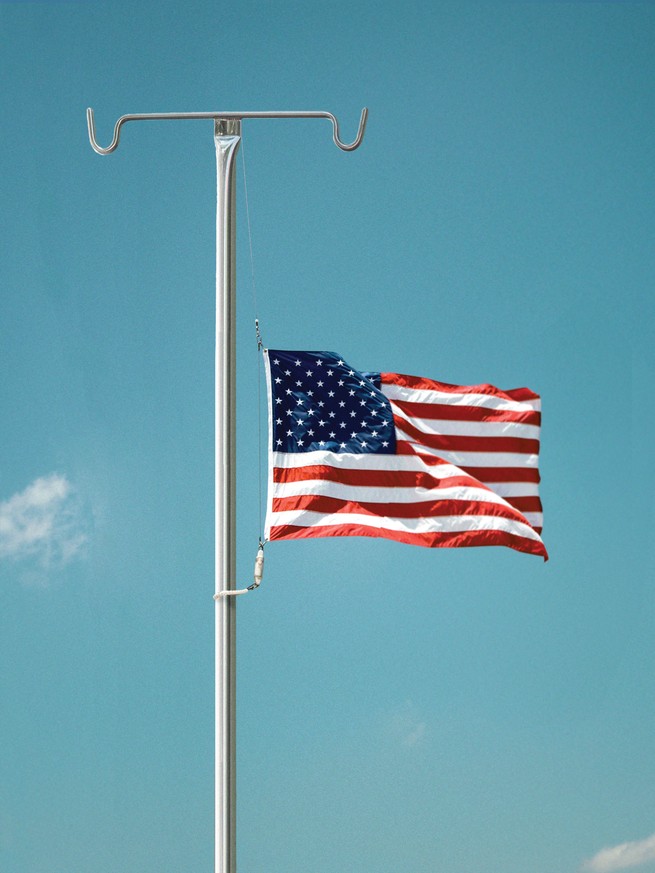
Illustration: American flag at half-mast on IV stand
Oliver Munday

When the virus came here, it found a country with serious underlying conditions, and it exploited them ruthlessly. Chronic ills—a corrupt political class, a sclerotic bureaucracy, a heartless economy, a divided and distracted public—had gone untreated for years. We had learned to live, uncomfortably, with the symptoms. It took the scale and intimacy of a pandemic to expose their severity—to shock Americans with the recognition that we are in the high-risk category.

The crisis demanded a response that was swift, rational, and collective. The United States reacted instead like Pakistan or Belarus—like a country with shoddy infrastructure and a dysfunctional government whose leaders were too corrupt or stupid to head off mass suffering. The administration squandered two irretrievable months to prepare. From the president came willful blindness, scapegoating, boasts, and lies. From his mouthpieces, conspiracy theories and miracle cures. A few senators and corporate executives acted quickly—not to prevent the coming disaster, but to profit from it. When a government doctor tried to warn the public of the danger, the White House took the mic and politicized the message.

Every morning in the endless month of March, Americans woke up to find themselves citizens of a failed state. With no national plan—no coherent instructions at all—families, schools, and offices were left to decide on their own whether to shut down and take shelter. When test kits, masks, gowns, and ventilators were found to be in desperately short supply, governors pleaded for them from the White House, which stalled, then called on private enterprise, which couldn’t deliver. States and cities were forced into bidding wars that left them prey to price gouging and corporate profiteering. Civilians took out their sewing machines to try to keep ill-equipped hospital workers healthy and their patients alive. Russia, Taiwan, and the United Nations sent humanitarian aid to the world’s richest power—a beggar nation in utter chaos.

Donald Trump saw the crisis almost entirely in personal and political terms. Fearing for his reelection, he declared the coronavirus pandemic a war, and himself a wartime president. But the leader he brings to mind is Marshal Philippe Pétain, the French general who, in 1940, signed an armistice with Germany after its rout of French defenses, then formed the pro-Nazi Vichy regime. Like Pétain, Trump collaborated with the invader and abandoned his country to a prolonged disaster. And, like France in 1940, America in 2020 has stunned itself with a collapse that’s larger and deeper than one miserable leader. Some future autopsy of the pandemic might be called Strange Defeat, after the historian and Resistance fighter Marc Bloch’s contemporaneous study of the fall of France. Despite countless examples around the U.S. of individual courage and sacrifice, the failure is national. And it should force a question that most Americans have never had to ask: Do we trust our leaders and one another enough to summon a collective response to a mortal threat? Are we still capable of self-government?

This is the third major crisis of the short 21st century. The first, on September 11, 2001, came when Americans were still living mentally in the previous century, and the memory of depression, world war, and cold war remained strong. On that day, people in the rural heartland did not see New York as an alien stew of immigrants and liberals that deserved its fate, but as a great American city that had taken a hit for the whole country. Firefighters from Indiana drove 800 miles to help the rescue effort at Ground Zero. Our civic reflex was to mourn and mobilize together.

Partisan politics and terrible policies, especially the Iraq War, erased the sense of national unity and fed a bitterness toward the political class that never really faded. The second crisis, in 2008, intensified it. At the top, the financial crash could almost be considered a success. Congress passed a bipartisan bailout bill that saved the financial system. Outgoing Bush-administration officials cooperated with incoming Obama administration officials. The experts at the Federal Reserve and the Treasury Department used monetary and fiscal policy to prevent a second Great Depression. Leading bankers were shamed but not prosecuted; most of them kept their fortunes and some their jobs. Before long they were back in business. A Wall Street trader told me that the financial crisis had been a “speed bump.”

All of the lasting pain was felt in the middle and at the bottom, by Americans who had taken on debt and lost their jobs, homes, and retirement savings. Many of them never recovered, and young people who came of age in the Great Recession are doomed to be poorer than their parents. Inequality—the fundamental, relentless force in American life since the late 1970s—grew worse.

This second crisis drove a profound wedge between Americans: between the upper and lower classes, Republicans and Democrats, metropolitan and rural people, the native-born and immigrants, ordinary Americans and their leaders. Social bonds had been under growing strain for several decades, and now they began to tear. The reforms of the Obama years, important as they were—in health care, financial regulation, green energy—had only palliative effects. The long recovery over the past decade enriched corporations and investors, lulled professionals, and left the working class further behind. The lasting effect of the slump was to increase polarization and to discredit authority, especially government’s.

Both parties were slow to grasp how much credibility they’d lost. The coming politics was populist. Its harbinger wasn’t Barack Obama but Sarah Palin, the absurdly unready vice-presidential candidate who scorned expertise and reveled in celebrity. She was Donald Trump’s John the Baptist.

Trump came to power as the repudiation of the Republican establishment. But the conservative political class and the new leader soon reached an understanding. Whatever their differences on issues like trade and immigration, they shared a basic goal: to strip-mine public assets for the benefit of private interests. Republican politicians and donors who wanted government to do as little as possible for the common good could live happily with a regime that barely knew how to govern at all, and they made themselves Trump’s footmen.

Like a wanton boy throwing matches in a parched field, Trump began to immolate what was left of national civic life. He never even pretended to be president of the whole country, but pitted us against one another along lines of race, sex, religion, citizenship, education, region, and—every day of his presidency—political party. His main tool of governance was to lie. A third of the country locked itself in a hall of mirrors that it believed to be reality; a third drove itself mad with the effort to hold on to the idea of knowable truth; and a third gave up even trying.

Trump acquired a federal government crippled by years of right-wing ideological assault, politicization by both parties, and steady defunding. He set about finishing off the job and destroying the professional civil service. He drove out some of the most talented and experienced career officials, left essential positions unfilled, and installed loyalists as commissars over the cowed survivors, with one purpose: to serve his own interests. His major legislative accomplishment, one of the largest tax cuts in history, sent hundreds of billions of dollars to corporations and the rich. The beneficiaries flocked to patronize his resorts and line his reelection pockets. If lying was his means for using power, corruption was his end.

This was the American landscape that lay open to the virus: in prosperous cities, a class of globally connected desk workers dependent on a class of precarious and invisible service workers; in the countryside, decaying communities in revolt against the modern world; on social media, mutual hatred and endless vituperation among different camps; in the economy, even with full employment, a large and growing gap between triumphant capital and beleaguered labor; in Washington, an empty government led by a con man and his intellectually bankrupt party; around the country, a mood of cynical exhaustion, with no vision of a shared identity or future.

If the pandemic really is a kind of war, it’s the first to be fought on this soil in a century and a half. Invasion and occupation expose a society’s fault lines, exaggerating what goes unnoticed or accepted in peacetime, clarifying essential truths, raising the smell of buried rot.

The virus should have united Americans against a common threat. With different leadership, it might have. Instead, even as it spread from blue to red areas, attitudes broke down along familiar partisan lines. The virus also should have been a great leveler. You don’t have to be in the military or in debt to be a target—you just have to be human. But from the start, its effects have been skewed by the inequality that we’ve tolerated for so long. When tests for the virus were almost impossible to find, the wealthy and connected—the model and reality-TV host Heidi Klum, the entire roster of the Brooklyn Nets, the president’s conservative allies—were somehow able to get tested, despite many showing no symptoms. The smattering of individual results did nothing to protect public health. Meanwhile, ordinary people with fevers and chills had to wait in long and possibly infectious lines, only to be turned away because they weren’t actually suffocating. An internet joke proposed that the only way to find out whether you had the virus was to sneeze in a rich person’s face.

When Trump was asked about this blatant unfairness, he expressed disapproval but added, “Perhaps that’s been the story of life.” Most Americans hardly register this kind of special privilege in normal times. But in the first weeks of the pandemic it sparked outrage, as if, during a general mobilization, the rich had been allowed to buy their way out of military service and hoard gas masks. As the contagion has spread, its victims have been likely to be poor, black, and brown people. The gross inequality of our health-care system is evident in the sight of refrigerated trucks lined up outside public hospitals.

We now have two categories of work: essential and nonessential. Who have the essential workers turned out to be? Mostly people in low-paying jobs that require their physical presence and put their health directly at risk: warehouse workers, shelf-stockers, Instacart shoppers, delivery drivers, municipal employees, hospital staffers, home health aides, long-haul truckers. Doctors and nurses are the pandemic’s combat heroes, but the supermarket cashier with her bottle of sanitizer and the UPS driver with his latex gloves are the supply and logistics troops who keep the frontline forces intact. In a smartphone economy that hides whole classes of human beings, we’re learning where our food and goods come from, who keeps us alive. An order of organic baby arugula on AmazonFresh is cheap and arrives overnight in part because the people who grow it, sort it, pack it, and deliver it have to keep working while sick. For most service workers, sick leave turns out to be an impossible luxury. It’s worth asking if we would accept a higher price and slower delivery so that they could stay home.

The pandemic has also clarified the meaning of nonessential workers. One example is Kelly Loeffler, the Republican junior senator from Georgia, whose sole qualification for the empty seat that she was given in January is her immense wealth. Less than three weeks into the job, after a dire private briefing about the virus, she got even richer from the selling-off of stocks, then she accused Democrats of exaggerating the danger and gave her constituents false assurances that may well have gotten them killed. Loeffler’s impulses in public service are those of a dangerous parasite. A body politic that would place someone like this in high office is well advanced in decay.

The purest embodiment of political nihilism is not Trump himself but his son-in-law and senior adviser, Jared Kushner. In his short lifetime, Kushner has been fraudulently promoted as both a meritocrat and a populist. He was born into a moneyed real-estate family the month Ronald Reagan entered the Oval Office, in 1981—a princeling of the second Gilded Age. Despite Jared’s mediocre academic record, he was admitted to Harvard after his father, Charles, pledged a $2.5 million donation to the university. Father helped son with $10 million in loans for a start in the family business, then Jared continued his elite education at the law and business schools of NYU, where his father had contributed $3 million. Jared repaid his father’s support with fierce loyalty when Charles was sentenced to two years in federal prison in 2005 for trying to resolve a family legal quarrel by entrapping his sister’s husband with a prostitute and videotaping the encounter.

Jared Kushner failed as a skyscraper owner and a newspaper publisher, but he always found someone to rescue him, and his self-confidence only grew. In American Oligarchs, Andrea Bernstein describes how he adopted the outlook of a risk-taking entrepreneur, a “disruptor” of the new economy. Under the influence of his mentor Rupert Murdoch, he found ways to fuse his financial, political, and journalistic pursuits. He made conflicts of interest his business model.

So when his father-in-law became president, Kushner quickly gained power in an administration that raised amateurism, nepotism, and corruption to governing principles. As long as he busied himself with Middle East peace, his feckless meddling didn’t matter to most Americans. But since he became an influential adviser to Trump on the coronavirus pandemic, the result has been mass death.

In his first week on the job, in mid-March, Kushner co-authored the worst Oval Office speech in memory, interrupted the vital work of other officials, may have compromised security protocols, flirted with conflicts of interest and violations of federal law, and made fatuous promises that quickly turned to dust. “The federal government is not designed to solve all our problems,” he said, explaining how he would tap his corporate connections to create drive-through testing sites. They never materialized. He was convinced by corporate leaders that Trump should not use presidential authority to compel industries to manufacture ventilators—then Kushner’s own attempt to negotiate a deal with General Motors fell through. With no loss of faith in himself, he blamed shortages of necessary equipment and gear on incompetent state governors.

To watch this pale, slim-suited dilettante breeze into the middle of a deadly crisis, dispensing business-school jargon to cloud the massive failure of his father-in-law’s administration, is to see the collapse of a whole approach to governing. It turns out that scientific experts and other civil servants are not traitorous members of a “deep state”—they’re essential workers, and marginalizing them in favor of ideologues and sycophants is a threat to the nation’s health. It turns out that “nimble” companies can’t prepare for a catastrophe or distribute lifesaving goods—only a competent federal government can do that. It turns out that everything has a cost, and years of attacking government, squeezing it dry and draining its morale, inflict a heavy cost that the public has to pay in lives. All the programs defunded, stockpiles depleted, and plans scrapped meant that we had become a second-rate nation. Then came the virus and this strange defeat.

The fight to overcome the pandemic must also be a fight to recover the health of our country, and build it anew, or the hardship and grief we’re now enduring will never be redeemed. Under our current leadership, nothing will change. If 9/11 and 2008 wore out trust in the old political establishment, 2020 should kill off the idea that anti-politics is our salvation. But putting an end to this regime, so necessary and deserved, is only the beginning.

We’re faced with a choice that the crisis makes inescapably clear. We can stay hunkered down in self-isolation, fearing and shunning one another, letting our common bond wear away to nothing. Or we can use this pause in our normal lives to pay attention to the hospital workers holding up cellphones so their patients can say goodbye to loved ones; the planeload of medical workers flying from Atlanta to help in New York; the aerospace workers in Massachusetts demanding that their factory be converted to ventilator production; the Floridians standing in long lines because they couldn’t get through by phone to the skeletal unemployment office; the residents of Milwaukee braving endless waits, hail, and contagion to vote in an election forced on them by partisan justices. We can learn from these dreadful days that stupidity and injustice are lethal; that, in a democracy, being a citizen is essential work; that the alternative to solidarity is death. After we’ve come out of hiding and taken off our masks, we should not forget what it was like to be alone.


This article appears in the June 2020 print edition with the headline “Underlying Conditions.”

C'era una volta l'America: The US Is a Failed State - In less than four years, Donald Trump has exacerbated nearly every issue plaguing this country, from income inequality to global warming. By Tom Engelhardt


The US Is a Failed State

In less than four years, Donald Trump has exacerbated nearly every issue plaguing this country, from income inequality to global warming.

facebook sharing button
twitter sharing button
flipboard sharing button
pocket sharing button
email sharing button

The year was 1991 and the United States was suddenly the globe’s lone superpower, its ultimate hyperpower, the last and greatest of its kind, the soon-to-be-indispensable nation. The only one left—alone, utterly alone and triumphant atop the world.

Who could have asked for more? Or better? It had been a Cold War fantasy of the first order—until that other superpower, the Soviet Union, imploded. In fact, even that doesn’t catch the true shock of the moment, since Washington’s leaders simply hadn’t imagined a world in which the Cold War could ever truly end.

Now, go ahead, blame me. In this pandemic moment that should perhaps be considered a sign of a burning, sickening future to come, I’m stoking your nostalgia for better times. Admittedly, even that past was, in truth, a fantasy of the first (or perhaps last) order. After all, in retrospect, that mighty, resplendent, lone superpower, victorious beyond the wildest dreams of its political elite, was already about to embark on its own path of decline. Enwreathed in triumph, it, too, would be heading for the exits, even if so much more slowly than the Soviet Union.

Climate Justice, for the First Time Ever, Is on the G7 Agenda

It’s clear enough now that, in 1991, with Ronald Reagan’s former vice president George H.W. Bush in the White House and his son, George W., waiting in the wings of history (while Iraqi autocrat and former US ally Saddam Hussein was still perched in his palace in Baghdad, Iraq), the United States was already launching itself on the path to Donald Trump’s America. No, he didn’t know it. How could he? Who could have possibly imagined him as the president of the United States? He was still a tabloid phenomenon then (masquerading that year as his own publicist “John Miller” in phone interviews with reporters to laud the attractions and sexual conquests of one “Donald Trump”). He was also on the road to bankruptcy court since his five Atlantic City casinos would soon go down in flames. Him as a future candidate to head an America where life for so many would be in decline and its very greatness in need of being “made” great again… well, who coulda dreamt it? Not me, that’s for sure.

Welcome to American Carnage

Let me apologize one more time. Yes, I was playing on your sense of nostalgia in this besieged American moment of ours. Mission accomplished, I assume.

So much, I’m afraid, for such “Auld Lang Syne” moments, since that one took place in a previous century, even if, remarkably enough, that wasn’t actually so long ago. Only 29 years passed from that singular moment of triumph in Washington (a period that would then be fancied as “the end of history”) to Donald Trump’s America-not-First-but-Last world—to, that is, genuine “American carnage” (and I’m not just thinking about the almost 190,000 Americans who have already died from Covid-19, with no end in sight). Less than a quarter of a century took us from the president who asked God to continue to “bless the United States of America” in the wake of a historic victory to the man who campaigned for president on the declinist slogan of making America great again.

And don’t think Donald Trump was wrong in that 2017 inaugural address of his. A certain level of American carnage (particularly in the form of staggering economic inequality, not to speak of the “forever wars” still being fought so brainlessly by a military on which this country was spending its money rather than on health, education, and infrastructure) had helped bring him to power and he knew it. He even promised to solve just such problems, including ending those forever wars, as he essentially did again in his recent White House acceptance speech, even as he promised to keep “rebuilding” that very military.

Here was the key passage from that long-gone inaugural address of his:

Mothers and children trapped in poverty in our inner cities; rusted-out factories scattered like tombstones across the landscape of our nation; an education system, flush with cash, but which leaves our young and beautiful students deprived of knowledge; and the crime and gangs and drugs that have stolen too many lives and robbed our country of so much unrealized potential. This American carnage stops right here and stops right now.

Of course, more than three and a half years later, in that seemingly eternal “now” of his, the carnage seemed eternal—whether in the form of those wars he swore he would get us out of; the spending on the military and the rest of what’s still known as the national security state, which only increased; the economic inequality, which just grew, thanks in part to a humongous 2017 tax cut, a bonanza for the wealthiest Americans (and no one else), leaving the government and so the rest of us owing far more money than previously imaginable; and above all, the urge of his administration, from top to bottom, not just to deny that climate change exists but to burn this planet down by “unleashing” a program of “American energy dominance” and taking every imaginable restraint off the exploitation of fossil fuels and opening up yet more areas for those industries to exploit. In other words, Donald J. Trump has given American carnage new meaning and, in his singular way, lent a remarkable hand to the transformation of this country.

A Simple Math Problem

When The Donald descended that Trump Tower escalator in June 2015 to declare himself a candidate for president, he made a promise to the disgruntled citizens of the American heartland. He would build what he hailed as a “great wall” (that the Mexican government would pay for) to seal us off from the lesser breeds on this planet (Mexican rapists!). Until that moment, of course, there had been just one “great” wall on planet Earth and it had been constructed by various Chinese dynasties over untold centuries to keep out nomadic invaders, the armed “caravans” of that moment.

As Americans would soon learn, however, being second-best to or only as good as just about anything wasn’t, to put it mildly, Donald Trump’s signature style. So in that first speech of his, he instantly doubled the “greats” in his wall. He would create nothing less than a “great, great” one.

In the years that followed, it’s also become clear that neither spelling, nor pronouncing words is among his special skills or, put another way, that he’s a great, great misspeller and mispronouncer. Given that he managed to produce only 300 miles of wall on the US-Mexico border in almost four years in office, almost all of it replacing already existing barriers (at the expense of the American taxpayer and a set of private donors cum suckers), we have to assume that the candidate on that first day either misspelled or mispronounced one word in that phrase of his.

Given what’s happened to this country since, it’s hard not to imagine that what he meant was not a great, great wall, but a great, great fall. And in this pandemic hell of a country, with its economy in the kind of tatters that no one has yet faintly come to grips with, its health (and mental health) in crisis mode, parts of it burnt to a crisp and others flooded and clobbered by intensifying storms, if that’s what he meant to say, his leadership of what remains the world’s lone superpower (despite a rising China) has indeed been a great, great success. For such a triumph, however, this country needs some new term, something to replace that old “indispensable nation” (and, for my money, “dispensable nation” doesn’t quite do the trick).

And I have a suggestion. Once upon a time when I was much, much younger, we spoke of three worlds on planet Earth. There was the first world (also known as “the free world”), which included the developed countries of North America, Europe, and Japan (and you could throw in South Korea and Australia, if you wanted); there was the second world, also known as the communist bloc, the Soviet Union and the People’s Republic of China; and, of course, there was the third world, which included all the other poor and underdeveloped countries, many former European colonies, scattered around the globe’s south and often in terrible shape.

So many years later, with the first billionaire in the Oval Office presiding over an era of American carnage at home rather than in distant lands like Vietnam, I suspect we need a new “world” to capture the nature and state of this country at this moment. So how about fourth world? After all, the United States remains the richest, most powerful nation on the planet (first world!), but is also afloat in a sea of autocratic, climate-changing, economic, military, and police carnage that should qualify it as distinctly third world as well.

So, it’s really just a simple math problem: What’s 1 plus 3? Four, of course, making this country once again a leader on this ever less equal planet of ours; the United States, that is, is the first official fourth-world country in history. USA! USA! USA!

Or if you prefer, you could simply think of us as potentially the most powerful, wealthiest failed state on the planet.

A Hell on Earth?

Humanity has so far (and I use that phrase advisedly) managed to create just two ways of destroying human life on this planet. In doing so, it has, of course, taken over tasks that it once left to the gods (Armageddon! Apocalypse!). On both counts, Donald Trump is proving himself a master of destruction.

The first way, of course, would be by nuclear weapons, so far, despite close calls, used only twice, 75 years ago. However, the president and his crew have focused with striking intensity on tearing up nuclear arms pacts signed with the Soviet Union in the final years of the Cold War, backing out of the Iranian nuclear deal, pumping up the “modernization” of the US nuclear arsenal, and threatening other countries with the actual use of such weaponry. (Who could forget, for instance, The Donald’s threat to release “fire and fury like the world has never seen” on North Korea?)

In the process, the Trump administration has loosed what increasingly looks like a new global nuclear arms race, even as tensions grow, especially between China and the United States. In other words, while promising to end America’s “forever wars” (he didn’t), President Trump has actually pumped up the relatively dim possibility since the Cold War ended of using nuclear weapons, which obviously threatens a flash-bang end to human life as we know it.

And keep in mind that, when it comes to world-ending possibilities, that’s the lesser of his two apocalyptic efforts in these years.

While we’re still on the first of those ways of destroying this planet, however, let’s not forget to include not just the increased funding devoted to “modernizing” those nukes, but more generally the ever greater funding of the Pentagon and what’s still called “the national security state.” It hardly matters how little of that money goes to true national security in a 21st century moment when we’re experiencing a pandemic that could be but the beginning of a new Black Plague–style era and the heating up of the atmosphere, oceans, and seas of this world in ways that are already making life increasingly unbearable via ever fiercer storms, ever more frequent wildfires, the ever greater melting of ice sheets, ever more violent flooding, ever greater drought—I mean, you name it, and if it’s somewhere between deeply unpleasant and life (and property) endangering, it’s getting worse in the Trumpian moment.

In that second category when it comes to destroying human life as we’ve known it via the release of greenhouse gases into the atmosphere, the president and his men (and they are basically men) have shown a particular flair. I’m still alone in doing so, but I continue to refer to the whole lot of them as pyromaniacs, because their simple denial of the reality of global warming is the least of it. Trump and crew are clearly determined to burn, burn, burn.

And lest you think any of this will ever bother the president or his top officials, think again. After all, having had an essentially maskless, cheek-by-jowl election rally in Tulsa, Okla., which spread the coronavirus and may have killed one of the president’s well-known supporters, he then doubled down in his acceptance speech for the presidential nomination. He gave it in front of the White House before the kind of crowd he glories in: 1,500 enthusiastic followers, almost all maskless, untested for Covid-19, and jammed together cheering him for an hour. That should tell you all you need to know about his concern for the lives of others (even those who adore him) or anyone’s future other than his own.

Perhaps we need a new chant for this election season, something like: “Four more years and this planet will be a hell on earth!”

C'era una volta l'America: Is America a ‘failing state’? How a superpower has been brought to the brink


AAP/EPA/Albert Halim

Is America a ‘failing state’? How a superpower has been brought to the brink

After the collapse of the Soviet Union, there was a sense history had ended, and that the United States represented a supreme endpoint.

Today, the US is not dominant, it is in crisis: convulsed by riots and protest, riven by a virus that has galloped away from those charged with overseeing it, and heading into a presidential election led by a man that has possibly divided the nation like no other before him.

Using the most common metrics available to political scientists, there are signs the United States is failing.

Until very recently, this idea was extraordinary, unthinkable to all but the most radical critics. But, the US is increasingly performing poorly on key predictors of state failure: ethnic and class conflict, democratic and institutional backsliding, and other socioeconomic indicators including healthcare and inequality.

Support non-profit journalism you can trust.

Read more: When Trump attacks the press, he attacks the American people and their Constitution


Ethnic and class conflict

Comparative politics pays great attention to the role of ethnic conflict as a predictor of state failure. Those who study African countries, where most of the flare-ups are currently taking place, often observe that ethnic conflicts are closely correlated with battles to secure key resources, such as water and arable land. This closely relates the study of so-called “grievance studies”, which typically regards deep-seated inequalities as causing resource conflicts.

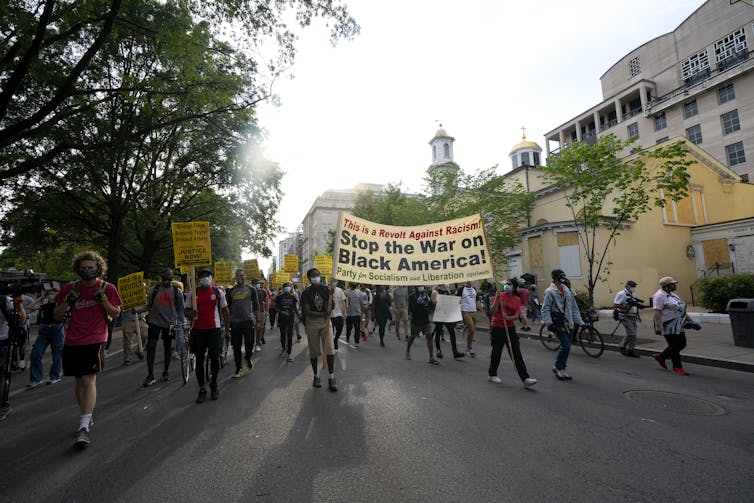
Black Lives Matters protesters in Washington D.C. AAP/Sipa USA/CNP

However, it would be a mistake to think this is because of different ethnic groups per se. It is more to do with how inequality and poverty exacerbate perceived racial and cultural fissures. The US reflects this problem, where the experience of many black Americans is telling: they feel “criminalised at birth”, and when this perception reaches a critical mass among a large enough population, states fail.


Read more: As Minneapolis burns, Trump's presidency is sinking deeper into crisis. And yet, he may still be re-elected


The global conflict zones that political scientists largely focus on are where groups are fighting for basic resources. These include water, mineral, and other basic economic rights.

So, areas that are deeply impoverished, such as Flint, Michigan, or almost any other recent area of profound socio-economic distress, are highly analogous to failed countries. They have also been some of the biggest challenges to the “united” part of the United States.

Signs of increased economic inequality

Yet, the economic indicators are not only dire for minority groups. America’s economy has grown at a good clip for decades, but the wealth has been taken up almost entirely by the wealthiest. For example, CEOs’ pay went from 20 times the average workers’ salary in 1965 to 278 times their salary in 2018.

In real terms, only college graduates have seen their pay increase as a group since 1979, and this occurs while 21% of American children live in poverty. Moreover, health outcomes for Americans are very poor compared to other OECD countries, despite having the highest per capita healthcare costs in the world.

Disproportionately, this is a problem affecting black Americans. This might go some way to explaining recent riots, but is far from a complete picture. All poor Americans are getting relatively poorer, which may also explain why poor white Americans seem increasingly likely to fight against the perceived injustices of other ethnic groups. They do this by pitting themselves against similarly politically and economically disenfranchised groups, rather than the power system that keeps them dispossessed.

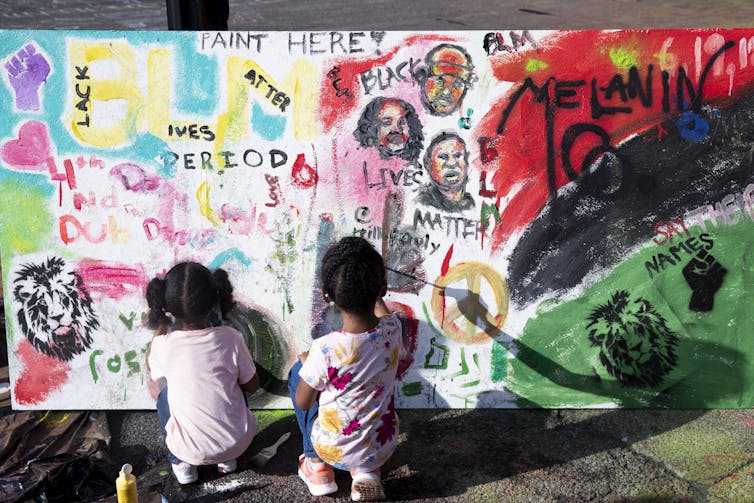
Two children paint a mural at Black Lives Plaza, Washington D.C. AAP/EPA/Michael Reynolds

Adding to this, a major historical study by Thomas Piketty showed the disconnect between the poorest and wealthiest Americans is getting exponentially worse, the middle class is shrinking, and the wealth of the top 1% is taking up an increasing share of the pie.

Is there a democratic deficit?

This wealth disconnect is increasingly represented as a deficit in democracy. As one study showed, America’s democracy is being seriously undermined.

In fact, “undermined” is putting it mildly: after a rigorous analysis of voting from 1982 to 2002, Gilens and Page showed the preferences of the top 10% routinely trumped those of average voters.

It would be a mistake to underestimate the importance of these findings. As analyses of the 2016 general election showed, the US states that flipped from Democrat to Republican (supposedly part of Hillary Clinton’s “firewall”) were almost exclusively part of the so called “rust belt”. Once part of America’s all-powerful manufacturing base, they are now people who feel forgotten, and increasingly angry.

The black and white, racial narrative of America’s woes misses an important, but even more consequential point: while there is no doubt black Americans are disproportionately suffering, an increasing majority is losing out, regardless of race.

American hope

The American revolution centred on the very sensible idea there should be no taxation without representation. Yet, there is now significant evidence that a majority of citizens are not being represented.

The US has one advantage: for all of its flaws, it remains an at least semi-functional democracy. This may well mean blame for state failure can exist with individuals or parties, rather than the entire system.

However, the democratic institutions of the United States continue to break down, and successive governments have proved unable to respond and listen to their citizens. Bizarrely, by the most important indicators available to political scientists, the United States is failing.

Even among its most ardent critics, few would consider America’s failure to be anything other than a catastrophe. The domestic deterioration of the world’s biggest nuclear and military superpower would prove unprecedented and frightening beyond rational analysis — rhetoric suggesting this is merely the new “fall of Rome” is almost glib.

The challenge now is whether the world’s oldest continuous democracy can live up to its own ideals.

Lettori fissi