Adam Smith (1723-1790) and Karl Marx (1818-1883)
were extremely influential economic philosophers. Both remain secular
patron saints today, Smith for capitalists, and Marx for communists.
(Some critics jest that atheistic communists believe "there is no God,
and Marx was his true prophet.")
Smith and Marx had much to say but have been ill-served by uncritical followers. Marx complained, quoting Heinrich Heine, that "I have sown dragons' teeth and harvested fleas."
The most unfortunate thing about them today is that they deflect
attention from an American whose ideas deserve serious attention.
Henry George (1839-1897) was well known in his day. His 1879 book "Progress and Poverty"
was widely read. He ran for mayor of New York City in 1886, finishing
second while future president Theodore Roosevelt came in third. When
George died, crowds turned out to mourn.
People debated whether his was the largest funeral in New York history
or just the biggest since Abraham Lincoln's. Yet today he is virtually
unknown.
"Progress and Poverty"starts with the apparently
paradoxical fact that countries enjoying the most material progress also
have the most intolerable poverty, "[T]here are in the heart of our
civilization large classes with whom the veriest savage could not afford
to exchange."
According to George the "cause of inequality in the distribution of
wealth is inequality in the ownership of land." By "land" he did not
mean just mean the earth's surface. He used the term to refer to "all
natural materials, forces, and opportunities . . . everything that is
freely supplied by nature." In today's world, George's "land" would
include things like the immensely valuable electromagnetic spectrum
through which TV and cellphone signals travel.
In less developed, thinly populated societies, land was abundant. No
able worker was denied access to the resources needed to produce
anything. Progress destroys this happy circumstance while increasing
labor specialization increases interdependency. Thus, "The efficiency of
the whole body of laborers is increased at the expense of the
independence of the constituents. . . . [By contrast] The aggregate
produce of the labor of a savage tribe is small, but each member is
capable of an independent life."
George concluded that both capitalists and workers would benefit if
we could abolish the inevitably unequal private ownership of land. He
proposed a society where value added to natural resources by labor would
be distributed as wages, while the value contributed by natural
resource scarcity would be "distributed as public benefits to all its
members."
Knowing that exertion or talents will not be equal, George didn't
call for equal wages. He also rejected proposals for equal division of
the land, which would reduce total production in a world where large
scale enterprises were increasingly efficient. Nor did he seek to
abolish private property in the means of production, which would also
reduce production of the social "pie" to be divided up.
Rather than confiscating land from current owners, George proposed
instead a high enough property tax on land — but not on improvements —
to capture all of the value contributed to production by natural
resource scarcities. Since he felt that the captured "rents" could
finance all government operations, he advocated abolishing all other
taxes. George thus became known as advocating a "single tax" on land.
George's distinction between value produced by labor and value
("rents") deriving from natural resource scarcity was reasonable.
Natural resources are like manna from heaven. No one has a greater claim
on them than anyone else, since they are not created by human labor.
So why didn't George's ideas catch on? Nicolaus Copernicus(1473-1543) was a genius whose sun-centered replacement for Ptolemy's (100-168 AD) earth-centered solar system worked poorly until Johannes Kepler
(1571-1630) tidied him up by replacing his circular planetary orbits
with ellipses. Perhaps Henry George needed a Kepler to point out his
unnecessary assumption that total rents would exactly equal governmental
costs and that the benefit of these rents should be enjoyed
collectively.
A better approach, consistent with George's basic analysis, would be to finance government with taxes on anything except
land. Land rents captured by government would not go into the
government treasury. They would be placed in a trust fund, as I suggest
in "The Metaconstitutional Manifesto: A Bourgoeis Vision of the Classless Society."
Trust fund money would be distributed equally — substantially
reducing economic inequality — to all individual members of the public
as an Alaska-like social dividend, rather than flowing to people
collectively as services.
With economic inequality an increasing problem in the United States
(and elsewhere), it is a pity that Henry George is not getting more
attention today. His ideas were not only ahead of his time, they are
still ahead of our time.
Paul F. deLespinasse is Professor Emeritus of Political
Science and Computer Science at Adrian College. He received his Ph.D.
from Johns Hopkins University in 1966, and has been a National Merit
Scholar, an NDEA Fellow, a Woodrow Wilson Fellow, and a Fellow in Law
and Political Science at the Harvard Law School. His college textbook,
"Thinking About Politics: American Government in Associational
Perspective," was published 1981 and his most recent book is "The Case
of the Racist Choir Conductor: Struggling With America's Original Sin."
His columns have appeared in newspapers in Michigan, Oregon, and a
number of other states. To read more of his reports — Click Here Now.
Democratizing Economic Power to Break the Cycle of American Inequality
The sharp and growing imbalance between the wealthy and the
rest of Americans dramatically alters how public policy itself is
formulated—and what those policies ultimately look like.
The US democracy crisis is not only a matter of voting; it is also a deeply economic crisis. The sharp and growing imbalance
between the wealthy and the rest of Americans dramatically alters how
public policy itself is formulated—and what those policies ultimately
look like. American politicians and policymakers are consistently more
responsive to the preferences of the wealthy, which drives public
policies that further concentrate wealth and power for the most
resourced constituencies and corporations. The result is a vicious cycle
where economic inequality breeds political inequality, which in turn
exacerbates economic inequality. That cycle can only be broken if we
understand how these inequalities work and feed each other.
These articles, funded by the Ford Foundation as part of the
Realizing Democracy project, speak to an increasingly shared
understanding among policymakers, civil society leaders, and scholars
that democracy reform today must address underlying systemic roots of
exclusion and inequality. The ideas reflect the views of the authors
solely.
We are mired in a rampant and historic crisis of economic inequality,
as more and more wealth is concentrated at the top. We can measure this
in a number of different ways. Take wages: since the 1980s, American
productivity (measured as how much workers produce per hour) has
increased, but wages have been stagnant.
Or economic security: even though we have seen headline indicators of
aggregate economic strength, for many Americans, economic conditions
remain precarious and far from secure
(which is defined as having an income that is enough to meet basic
expenses, including modest asset accumulation). Or consider business
concentration: corporations have become larger, more powerful, and more profitable
within their market sectors, which has led to higher prices, fewer new
and innovative businesses, lower wages, and less worker autonomy.
These various measures of economic inequality suggest that the fundamental problem is not the lack of worker skills,
which would imply that more and better education is the central answer.
Nor is the problem simply a matter of annual income, though income
inequality is a serious issue. No, the core economic problem is one of
power, with wealth and influence concentrated at the top of American
society and business.
This is the economic crux of our democracy crisis: Very few people
and firms have outsized political influence. This leads to
inequality-increasing policies that favor the wealthy. In other words,
democracy in the United States closely approaches what political
scientist Jeffrey A. Winters calls “civil oligarchy”—rule
by the wealthy few wherein the role of the state is to enforce property
claims on behalf of the ruling class, and where the greatest threat to
that class is taxation or some other form of income redistribution. And,
of course, American civil oligarchy is heavily skewed by patterns of
durable racial and gender inequalities.
Realizing a truly inclusive democracy requires tackling this parallel
problem of economic power. Economic policy has to be understood as
involving more than the conventional list of kitchen table issues like
wages, benefits, household debt, and safety net policies (Social
Security, Medicare, unemployment). Economic policy also goes beyond
technical, macroeconomic concerns of GDP growth and stability (meaning
lack of financial crises). While these issues are important, they must
be understood as part of a larger conversation about the governance of
our economy. What matters is not just the quantity and distribution of
resources and opportunities; it also matters a great deal who has the
power to shape our economic life and how they exercise that power.
Three Challenges
We call for democratizing economic power. This means policymakers
today must tackle three key challenges. First, the extreme concentration
of economic control in the hands of a small number of corporate and
financial firms must be dismantled and rebalanced. Second, the
countervailing power of both government and civil society, particularly
workers, must be expanded to ensure that economic decisions reflect the
full range of interests and constituencies. Third,
communities—especially those most affected—must have more direct
influence in the business of economic decision making, whether it is
within the firm, on the local zoning board, or in the administration of
national policymaking at the federal level. The principles of belonging
and inclusion must be at the forefront of this effort, especially in a
multiracial America.
Our hypothesis is that rebalancing power in this way will drive more
growth and lessen the cumulative economic inequalities (of income,
wealth, security, and access) of the last 40 years. Policymakers must do
so in ways that actually make the US economy more democratic, which
means creating more inclusive decision making at various levels of
policy.
The Neoliberal Stranglehold
For much of the late 20th century, economic policymaking and public
political discourse operated from the presumption that markets would
bring more growth, better distribution, and less systematic racial and
gender exclusion. It’s the result of explicit narrative strategies to
make these ideas seem like common sense, and it started as an
intellectual idea, developed mostly by Milton Friedman, Friedrich Hayek,
and others who formed the backbone of the Mont Pelerin Society and,
ultimately, the Chicago School of Economics.
But as neoliberalism evolved, it became more than just a preference
for market systems to solve both economic and social problems. It also
involved a deep distrust of, and deliberate resistance to, the public in
two ways. First was opposition to the government providing public
goods. Neoliberals, at minimum, portrayed government as prone to
capture, inefficiency, and failure. Maximally, neoliberals equated “the
state” with Soviet-style communist central planning. All of this led to
the “smaller government, less regulation, lower taxes” mantra that
became central to American politics by the 1980s, even as conservatives
embarked on a project not to liberate markets, but to use the state to
encase them.
The second opposition to the idea of the public involved an attempt
to resist the popular exercise of voice and decision making exemplified
in the civil rights and women’s rights movements of the 1960s and ’70s.
Economic experts, businessmen, and politicians especially objected to
the state when its power was used to expand civil rights regimes. As
historian N.B.D. Connolly
reminds us, neoliberalism of the ’70s and ’80s was “a story about
backlash and the panic-selling of state functions—literal ‘white flight’
from liberalism.”
Neoliberalism, then, may have started primarily as economics, but it
became politics: the use of power to make sure that some had access and
others didn’t. By the 1980s, American democracy was structured around a
political alliance of free-market thinkers, big-business interests
hostile to the New Deal settlement, social conservatives, antifeminists,
and anticivil rights groups. Not everyone with these views signed on to
everything that their political bedfellows believed, but this
configuration of interests proved to be a powerful foundation for the
conservative dominance of politics and public policy for the last half
century.
The neoliberal ideological undercurrent has helped drive, legitimize,
and validate a policy agenda that has not delivered the equitable
growth it once promised. Instead, it has further concentrated economic
wealth and power and further weakened democratic reforms. “Right to
work” laws in the states have proliferated, as have a slew of judicial
opinions that have severely undermined the ability of workers to
organize. The antigovernment and antitax revolution of the Reagan era
led to a persisting proliferation of “balanced budget” requirements at
the state and local levels, and sporadic spasms of concern about the
federal deficit. The result was less economic security and less voice
for working people, and proposals to cut public provision of health care
or other income supports were validated by the argument that people
need to “stand on their own two feet.” But such fiscal prudence is
curiously absent in the face of conservative dismantling of the
government’s tax base.
We also see these presumptions in shaping liberal policy vision.
Consider how even with unified control of the federal government, the
Obama administration stopped short of the kind of economic stimulus that
was needed to arrest the slide into the Great Recession of 2008. Or the
predilection of many liberal reformers to prefer incremental
improvements in the safety net through hidden transfers like tax credits
rather than through more politically sustainable and
inequality-reducing commitments to public provision and public options.
The result of these conservative policy ideas—and these self-limited
liberal reforms—has been to facilitate the economic inequality and
control that now shapes the vast majority of Americans’ lives.
De-Rigging the Economy
By contrast, building a more inclusive economy and democracy requires policies that address three critical front lines:
Create a new policy agenda to shift economic power. This
new agenda must dismantle the concentration of corporate power and its
control over the economy itself. We should look at new antitrust
efforts, from stronger enforcement to new standards of effective competition (taking into account harms to workers, suppliers, and market competition generally, rather than focusing on price alone).
Build up the countervailing power of government and civil society. The decline of labor unions
is a key reason why wages have stayed stagnant and the electoral
returns have shifted in favor of conservatives. Furthermore, the
dismantling of government regulatory regimes has further concentrated
wealth and power in the corporate sector. The gutting of federal budgets
and tax receipts has similarly fueled the hollowing out of the modern
safety net. An inclusive economy requires robust government and robust
worker organizing to push for and defend these policies in the political
arena.
Craft institutional designs that democratize economic governance more broadly.
These must lie outside the episodic moments of elections and focus on
the day-to-day of economic policymaking. To better distribute wealth and
opportunity requires the workers and communities most affected to have a
voice in the governance of these economic institutions. New forms of
worker voice and more democratic forms of governing corporations,
shifting firms from acting like quasi-authoritarian “private
governments” to workplaces that treat stakeholders equitably, can help
ensure an equitable flow of value.
The crises of democracy and inequality are deeply interrelated.
Concentration of political power helps ensure that public policies
continue to serve the interests of the wealthy and well-resourced.
Meanwhile, concentration of economic power helps megacorporations and
wealthy interests dominate, while also ensuring a concentration of
political influence that blunts policies that could undermine this
vicious cycle. Realizing democracy requires democratizing economic power
across the areas of corporate power, public power, and inclusive
economic governance.
But while the crisis of economic and political inequality is severe,
we are also in a moment of remarkable innovation and mobilization in
public policy and civil society. These developments, if pursued to
reality, can help break the vicious cycle of self-reinforcing inequality
and replace it with a more virtuous cycle of self-reinforcing
democracy.
This article appeared in the Winter 2020 issue of the magazine with the headline: “Democratize the Economy”
According to a new OECD working paper,
Britain is one of the wealthiest countries in the world. Net wealth is
estimated to stand at around $500,000 per household — more than double
the equivalent figure in Germany, and triple that in the Netherlands.
Only Luxembourg and the USA are wealthier among OECD countries.
On
one level, this isn’t too surprising — Britain has long been a wealthy
country. But in recent decades Britain’s economic performance has been
poor. Decades of economic mismanagement have left the UK lagging far
behind other advanced economies. British workers are now 29% less productive
than workers in France, and 35% less than in Germany. How can this
discrepancy between high levels of wealth and low levels of productivity
be explained?
The
process of how wealth is accumulated has been subject of much debate
throughout history. If you pick up an economics textbook today, you’ll
probably encounter a narrative similar to the following: wealth is
created when entrepreneurs combine the factors of production — land,
labour and capital — to create something more valuable than the raw
inputs. Some of this surplus may be saved, increasing the stock of
wealth, while the rest is reinvested in the production process to create
more wealth.
How
the fruits of wealth creation should be divided between capital, land
and labour has been subject of considerable debate throughout history.
In 1817, the economist David Ricardo described this as “the principal problem in political economy”.
Nowadays,
however, this debate attracts much less attention. That’s because
modern economic theory has developed an answer to this problem, called
‘marginal productivity theory’. This theory, developed at the end of the
19th century by the American economist John Bates Clark, states that
each factor of production is rewarded in line with its contribution to
production. Marginal productivity theory describes a world where, so
long as there is sufficient competition and free markets, all will
receive their just rewards in relation to their true contribution to
society. There is, in Milton Friedman’s famous terms, “no such thing as a free lunch”.
The
aim was to develop a theory of distribution that was based on
scientific ‘natural laws’, free from political or ethical
considerations. As Bates Clark wrote in his seminal book, ‘The
Distribution of Wealth’:
“[i]t
is the purpose of this work to show that the distribution of income to
society is controlled by a natural law, and that this law, if it worked
without friction, would give to every agent of production the amount of
wealth which that agent creates”.
Seen
in this light, wealth accumulation is a positive sum game — higher
levels of wealth reflect superior productive capacity, and people
generally get what they deserve. There is some truth to this, but it is
only a very small part of the picture. When it comes to how wealth is
created and distributed, many other forces are at work.
Wealth, property and plunder
The
measure of wealth used by the OECD is ‘mean net wealth per household’.
This is the value of all of the assets in a country, minus all debts.
Assets can be physical, such as buildings and machinery, financial, such
as shares and bonds, or intangible, such as intellectual property
rights.
But
something can only become an asset once it has become property —
something that can be alienated, priced, bought and sold. What is
considered as property has varied across different jurisdictions and
time periods, and is intimately bound up with the evolution of power and
class relations.
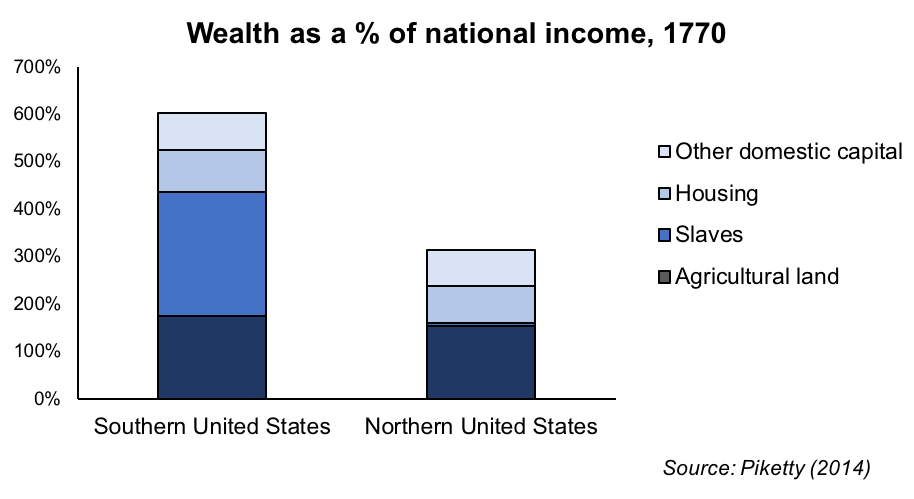
For
example, in 1770 wealth in the southern United States amounted to 600%
of national income — more than double the equivalent figure in the
northern United States. This stark difference in wealth can summed up by
one word: slavery.
For
white slave owners in the South, black slaves were physical property —
commodities to be owned and traded. And just like any other type of
asset, slaves had a market price. As the below chart shows, the
appalling scale of slavery meant that enslaved people were the largest
source of private wealth in the southern United States in 1770.
When
the United States finally abolished slavery in 1865, people who had
formerly been slaves ceased to be counted as private property. As a
result, slaveowners lost what had previously been their prized
possessions, and overnight over half of the wealth in the southern US
essentially vanished. All of a sudden, the southern states were no
longer “wealthier” than their northern neighbours.
But
did the southern states really become any less wealthy in any
meaningful sense? Obviously not — the amount of labour, capital and
natural resources remained the same. What changed was the rights of
certain individuals to exercise an exclusive claim over these resources.
But
the wealth that had been generated by slave labour did not disappear,
and it wasn’t only the USA that benefitted from this. Many of Britain’s
major cities and ports were built with money that originated in the
slave trade. Several major banks, including Barclays and HSBC,
can trace their origins to the financing of the slave trade, or the
plundering of other countries’ resources. Many of Britain’s great
properties, which today make up a significant proportion of household
wealth, were built on the back of slave wealth. Even today, many
millionaires can trace some of their wealth to the slave trade.
The
lesson here is that aggregate wealth is not simply a reflection of the
process of accumulation, as theory tends to imply. It is also a
reflection of the boundaries of what can and cannot be alienated,
priced, bought and sold, and the power dynamics that underpin them. This
is not just a historical matter.
Today
some goods and services are provided by private firms on a commodified
basis, whereas others are provided socially as a collective good. This
can often vary significantly between countries. Where a service is
provided by private firms (for example, healthcare in the USA),
shareholder claims over profits are reflected in the firm’s value — and
these claims can be bought and sold, for example on the stock market.
These claims are also recorded as financial wealth in the national
accounts.
However,
where a service is provided socially as a collective good (such as the
NHS in the UK), there are no claims over profits to be owned and traded
among investors. Instead, the claims over these sectors are socialised.
Profits are foregone in favour of free, universal access. Because these
benefits are non-monetary and accrue to everyone, they are not reflected
in any asset prices and are not recorded as “wealth” in the national
accounts.
A
similar effect is observed with pension provision: while private
pensions (funded through capital markets) are included as a component of
financial wealth in the OECD’s figures, public pensions (funded from
general taxation) are excluded. As a result, a country that provides
generous universal public pensions will look less wealthy than a country
that rely solely on private pensions, all else being equal. The way
that we measure national wealth is therefore skewed towards
commodification and privatisation, and against socialisation and
universal provision.
Capital gains, labour losses
The
amount of wealth does not just depend on the number of assets that are
accumulated — it also depends on the value of these assets. The value of
assets can go up and down over time, otherwise known as capital gains
and losses. The price of an asset such as a share in a company or a
physical property reflects the discounted value of the expected future
returns. If the expected future return on an asset is high, then it will
trade at a higher price today. If the expected future return on an
asset falls for whatever reason, then its price will also fall.
Marginal
productivity theory states that each factor of production will be
rewarded in line with its true contribution to production. But although
presented as an objective theory of distribution, marginal productivity
theory has a strong normative element. It says nothing about the rules
and laws that govern the ownership and use of the factors of production,
which are essentially political variables. For example, rules that
favour capitalists and landlords over workers and tenants, such as
repressive trade union legislation and weak tenants’ rights, increase
returns on capital and land. All else being equal, this will translate
into higher stock and property prices, which will increased measured
wealth. In contrast, rules that favour workers and tenants, such as
minimum wage laws and rent controls, reduce returns on capital and land.
This in turn will translate into lower stock and property prices, and
lower paper wealth.
Importantly,
in both scenarios the productive capacity of the economy is unchanged.
The fact that wealth would be higher in the former case, and lower in
the latter case, is a result of an asymmetry between how the claims of
capitalists and landlords are recorded, and how the claims of workers
and tenants are recorded. While future returns to capital and land get
capitalised into stock and property prices, future returns to labour —
wages — do not get capitalised into asset prices. This is because unlike
physical and financial assets, people do not have an “asset price”.
They cannot become property. As a result, it is possible for measured
wealth to increase simply because the balance of power shifts in favour
of capitalists and landowners, allowing them to claim a larger slice of
the pie at the expense of workers and tenants.
To
the early classical economists, this kind of wealth — attained by
simply extracting value created by others – was deemed to be unearned,
and referred to it as ‘economic rent’. However, ever since neoclassical
economics replaced classical economics as the dominant school of
thinking in the late 19th century, economic rent has been increasingly
marginalised from economic discourse. To the extent that it is
acknowledged, it is usually viewed as being peripheral to the story of
wealth accumulation, resulting from ‘market frictions’, such as
monopsony and asymmetric information, which give rise to certain
instances of ‘market power’. For the most part, economists have tended
to focus on the acts of saving and investment which drive the real
production process. But on closer inspection, it is clear that economic
rent is far from peripheral. Indeed, in many countries it has been the
main story of changing wealth patterns.
To
see why, let’s return to the OECD wealth statistics. Recall that net
wealth per household in Britain is more than double what it is in
Germany, even though Germany is far more productive than the UK. This
can partly be explained by comparing the power dynamics associated with
each factor of production.
Let’s
start with land: Germany has among the strongest tenant protection laws
in Europe, and many German cities also impose rent controls. This,
along with a banking sector that favours real economy lending
over property lending, means that Germany has not experienced the
rampant house price inflation that the UK has. Remarkably, the house price-to-income ratio
is lower in Germany today than it was in 1995, while in the UK it has
nearly tripled over the same time period. The fact that houses are not
lucrative financial assets, and renting is more secure and affordable,
means that the majority of people choose to rent rather than own a home
in Germany — and therefore do not own any property wealth.
In Britain, the story couldn’t be more different. Over the past five decades Britain has become a property owners’ paradise,
as successive governments have sought to encourage people onto the
property ladder. Taxes on land and property have been removed, and
subsidies for homeownership introduced. The deregulation of the mortgage
credit market in the 1980s meant that banks quickly became hooked on
mortgage lending — unleashing a flood of new credit into the housing
market. Rent controls were abolished, and the private rental market was
deregulated. Today tenant protection is weaker
than almost anywhere else in Europe. Meanwhile, the London property
market has served as a laundromat for the world’s dirty money. As Donald
Toon, head of the National Crime Agency, has described: “Prices are being artificially driven up by overseas criminals who want to sequester their assets here in the UK”.
The
result has been an unprecedented house price boom. Since 1995,
skyrocketing house prices have increased value of Britain’s housing
stock by over £5 trillion — accounting for three quarters of all
household wealth accumulated over the same period. While this has been
great news for property owners, it has been disastrous for tenants. As
I’ve written elsewhere,
the driving force behind rising house prices has been rapidly
escalating land prices, and we have known since the days of Adam Smith
and David Ricardo that land is not a source of wealth, but of economic
rent. The trillions of pounds of wealth amassed through the British
housing market has mostly been gained at the expense of current and
future generations who don’t own property, who will see more of their
incomes eaten up by higher rents and larger mortgage payments.
So
while German property owners have not benefited from skyrocketing house
prices in the way that they have in Britain, the flipside is that
German renters only spend 25% of their incomes on rent on average,
while British renters spend 40%. The former is captured in the OECD’s
measure of wealth, while the discounted value of the latter is not.
Now
let’s look at capital. In the UK and the US, the goal of the firm has
traditionally been to maximise shareholder value. In Germany however,
firms are generally expected to have regard for a wider range of
stakeholders, including workers. This has led to a different culture of
corporate governance, and different power dynamics between capital and
labour.
Large companies in Germany must have worker representatives of boards (referred to as ‘codetermination’),
and they are also required to allow ‘works councils’ to represent
workers in day-to-day disputes over pay and conditions. The evidence
indicates that this system has led to higher wages, less short-termism,
greater productivity, even higher levels of income equality. The quid
pro quo is that it also tends to result in lower capital returns for shareholders,
as workers are able to claim more of the surplus. This in turn means
that German firms tend to be valued less than their British counterparts
on the stock market, which contributes to lower levels of financial
wealth.
None
of this means that Germany is poorer than Britain. Instead, it just
reflects the fact that German capitalists and landowners have less
bargaining power than they do in the UK, while workers and tenants have
more power. While lower shareholder returns and house prices are
reflected in the OECD’s measure of wealth, better pay and conditions and
lower rents are not.
Conclusion
All
statistics tell a story, but stories can be told from different
perspectives. Embedded in the definitions of all economic statistics are
value judgements about what is desirable and what is undesirable, which
in turn shape the way we think about the economy. At the moment, the
way we measure the wealth of nations mainly reflects the fortunes of
capitalists and landowners rather than workers and tenants. Britain
looks wealthier than Germany on paper, but this does not reflect the
lived reality for most people. While it’s important not to overstate the
extent to which statistics can influence the real world, this is
important for at least three reasons.
Firstly,
it illustrates how seemingly objective metrics often have ideological
assumptions baked into them. While there is already a well-established
literature on alternatives to GDP, many economic metrics are used in
economic analysis and policy appraisal without any critical appraisal of
their underlying ideological assumptions. This needs to change.
Second,
it highlights how paper wealth has in many places become decoupled from
productive capacity, and how conflating the two can be highly
misleading. This is particularly the case where zero sum rentier
activity is widespread, as in the case of Britain. Such discrepancies
raise the question of whether the way that we currently measure wealth
is really the most sensible.
But
most importantly, it illustrates that the distribution of wealth has
little to do with contribution or productivity, and everything to do
with politics and power. As J.W. Mason states: “It’s bargaining power, it’s politics, all the way down.”
For
economists who see their discipline as a ‘value free’ science which is
separate from politics, this is uncomfortable territory. But if the aim
is to understand the economy as it really exists, then analysing power
beyond the narrow concept of ‘market power’ is essential. Among other
things, this means grappling with the power dynamics that underpin
ownership and property relations, as well as those that that drive
inequalities between different social groups and identities.
It’s been 200 years since David Ricardo described the “principal problem” of political economy. Perhaps it’s time to revisit it.
This article was originally published at openDemocracy.
Income inequality has captured America’s economic debate.
President
Donald Trump, elected with the votes of discontented blue-collar
workers, slaps tariffs on allies and adversaries alike in the name of
restoring yesterday’s middle-class manufacturing jobs. His 2020
Democratic challengers demand an array of federal initiatives, including
higher minimum wages, tax hikes on the rich and reshuffling the balance
of power between business and labor.
Indeed,
the rising gap between the rich and everyone else has fueled unrest
across the world, from Europe’s ongoing Brexit crisis to this year’s
elections in India. A sharp reduction in extreme poverty globally has
not diminished the sense of loss among middle- and working-class
citizens of countries with advanced economies.
ADVERTISING
Why has this happened? And why has it grown so pronounced in the United States?
Here are five causes identified by scholars of the subject:
Technology has altered the nature of work
The
digital revolution creates enormous wealth for those with the skills
and preparation to take advantage, but it eliminates what economists
call “middle-skill” jobs. Computer software and industrial machines now
fill roles — from clerical tasks to routine manufacturing — that once
produced middle-class incomes for workers without college degrees.
“That
has increased the value of abstract problem solving, interpersonal
communication, organization skills — things that highly educated workers
tend to be very capable of,” said MIT professor David Autor. “It has
simultaneously devalued a lot of cognitively repetitive tasks in offices
(and) on production lines. That has contributed to downward pressure
and wage pressure and economic insecurity for the less educated.”
Globalization
Competition
from rising economies like China’s, combined with reduced trade
barriers, have further reduced prospects for American workers without
advanced skills. That has produced devastating consequences for workers
in sectors such as textiles, furniture and leather goods.
“The
biggest economic story of the last 50 years has been China going from a
poor and backward country, in perpetual political and economic crisis,
to a frontier manufacturer with pretty well educated, highly available
skilled labor using modern technology,” said Autor. “That’s primarily a
function of internal developments in China — the decision to allow free
mobility of labor, to adopt Western technology and foreign direct
investment, and to start trading throughout the world.
“That
had a big effect on the United States even in the 1990s prior to
China’s joining the World Trade Organization,” he added. “But when China
joined in 2001 that further opened the floodgates, and had a dramatic
accelerant effect on the rate at which competition entered the U.S.
market for manufactured goods.”
The rise of superstars
Breakthrough firms such as Apple and Amazon
can attract revenue across the world on a scale far larger than in
previous generations. That produces immense jackpots for those companies
and the executives who lead them, turning the pay gap between top
executives and the workers they employ into a chasm.
It has also widened the gap between the metropolises those firms call home and less-populous small-towns and rural areas.
“There
is increasingly divergence and economic growth and economic outcomes
across places in the U.S.,” said University of Maryland economist
Melissa Kearney. “Along with these superstar workers, and these
superstar firms, we now have superstar cities in our increasingly
winner-take-all economy.”
The decline of organized labor
The
share of workers represented by labor unions has dropped by half, to
just over 10%, over the last four decades. That has shrunk their power
to bargain for higher wages and benefits.
Inaction by Congress has
shrunk the buying power of the lowest-paid workers. Because the $7.25
per hour minimum wage has not been increased to keep pace with
inflation, its value has fallen 16% over the past half-century.
Changing, and breaking, the rules
Rising
wealth confers political power, and it has allowed economic winners to
further reward themselves through government policies. The 2017 GOP tax
cut delivers a disproportionate share of its benefits to the most
affluent Americans.
The same goes for policies at private
institutions. Admissions procedures at top colleges favor the children
of donors and past graduates. As the recent scandal ensnaring prominent
entertainers and athletic coaches demonstrates, those with money can
also buy illicit advantages.
The market incentives income
inequality creates — for hard work and risk-taking — helps make
America’s economy dynamic. But they also impose costs.
We
need some inequality. The problem is when that dynamism gives rise to
dynasticism. Kids of affluent parents, even if they’re of mediocre
talent, go to the best schools and talented kids from less affluent
families don’t.
David Autor
MIT professor
“We
need some inequality,” said Autor. “The problem is when that dynamism
gives rise to dynasticism. Kids of affluent parents, even if they’re of
mediocre talent, go to the best schools and talented kids from less
affluent families don’t. It’s not just a loss for them. That means our
society will be less productive.”
It also keeps Americans unhappy.
Despite solid top-line economic growth, the 2020 presidential election
promises to be just as contentious as recent national campaigns that
have repeatedly flipped the party in control of the White House or
Congress.
“People are increasingly likely to report that they
believe the system is rigged against them,” said Kearney. “This is
damaging for the functioning of our democracy, but I actually think also
for the functioning of our economy.
“We’re going to see people in
increasing numbers dropping out of our mainstream drive for economic
success. It’s leading to large, loud political cries for completely
upending our capitalist system.”
Ci vogliono decine DI MIGLIAIA DI giudici ma non COME quelli DEL 'consiglio DI stato' e decine DI miliardi DI investimenti nella Giustizia gia' era cosi' prima DEL 1871 nulla e' cambiato vanno aboliti i TAR fondate corti costituzionali 'cantonali' fondati tribunali DEL lavoro indipendenti abolite LE commissioni tributarie fondati tribunali FINANZIARI indipendenti e MIGLIAIA DI ALTRE cose.
Dario Giorgini
Troppo tardi per 30 anni hanno fatto tutto quello che volevano, allevano polli di loro gradimento, il risultato è evidente,delegare e bene ma verificare e meglio.
Giuseppino Cunticello
Bisogna educare 2-3 generazioni di giudici sin dall'asilo, poi eleggerli direttamente a tribunali di primo grado, poi consentire le carriere ai gradi superiori della magistratura solo per referendum, poi specializzare molto di piu' il sistema giudiziario, renderlo pienamente responsabile ai bisogni del Cittadino, nel giro di 7-10 generazioni comincera' a funzionare come di dovere in uno stato di diritto costituzionale e democratico
Giuseppino Cunticello
Tutta la pattumiera va svuotata, a cominciare dalla cupola, dalla corte costituzionale e dal consiglio di stato. Queste sono cose che puo' E DEVE fare l'Assemblea Costituente Permanente del Popolo Italiano.
Claudio Cominetti
I ladri stanno in parlamento, che fa le leggi, e voi ve la prendete con i giudici
Giuseppino Cunticello
La gente che deve andare in parlamento deve essere selezionata in modo analogo attraverso NUOVE LEGGI a riserva di approvazione referendaria gestite DALL'ASSEMBLEA COSTITUENTE PERMANENTE ma di iniziativa popolare E NON DAL PARLAMENTO, tutto cio' che ha a che fare con elezioni va TOLTO dalla competenza legislativa ordinaria e attribuito a quella costituente, insieme ad altre competenze, quale i compensi dei pubblici ufficiali, le leggi sulle loro pensioni ecc. I PARLAMENTARI NON POSSONO DECIDERE IN FATTO PROPRIO, DEVE FINIRE PER SEMPRE QUESTA STORIA. LA SOVRANITA' PARLAMENTARE NON PUO' ESSERE PIU' GRANDE DI QUELLA DEL POPOLO. Inoltre vanno aggiunti altri principi di selezione politica quali la rotazione e la sorte, che sono esiste nelle repubbliche italiane medioevali, rinascimentali e premoderne per secoli. Erano istituzioni valide e vanno riprese ed adattate alle esigenze attuali. CI SARANNO PARLAMENTI DI STATI FEDERALI, NON PIU' UN SOLO PARLAMENTO E CI SARANNO ASSEMBLEE COSTITUENTI PERMANENTI CANTONALI, NON SOLO QUELLA NAZIONALE. Le LEGGI IMPORTANTI LE DEVE FARE IL POPOLO/I POPOLI, gli esecutivi devono amministrare e basta, non devono poter prendere parte all'iniziativa legislativa. Il sistema giudiziario deve produrre processi e sentenze giuste, non abusare dei propri poteri per fare politica con altri mezzi. DEVE ESSERE UNA RIFORMA DELLA COSTITUZIONE MATERIALE, NON SOLO DI QUELLA FORMALE.
Paolo Varriale
E chi sarebbero questi incapaci.
Giuseppino Cunticello
Quelli che hanno gestito l'Italia dal 1946 ad oggi, tutti i pubblici ufficiali, chiunque abbia ricoperto cariche esecutive, legislative o giudiziarie e tutti i membri dei partiti e dei movimenti politici, senza eccezioni e senza ulteriori tentennamenti. TUTTI IN PENSIONE AD HAMMAMET. PER COLPA DI QUALCUNO NON SI DA' CREDITO PIU' A NESSUNO, E' PERFETTAMENTE DEMOCRATICO. Il problema da risolvere non e' quali culi scegliere per stare seduti sulle poltrone da assegnare, ma insegnare al popolo italiano a governare se' stesso. Non e' capace? DEVE IMPARARE DE SE'. Il popolo deve imparare a dibattere i fatti, le idee, non le persone, destra/sinistra fine a se' stesse e via dicendo. Sono vicoli ciechi.
In his first interview with an American media outlet since 2018,
Russian President Vladimir Putin has brushed off his US counterpart Joe
Biden’s “killer” accusation and called it posturing by an establishment
career politician.
Speaking with NBC News’ Keir Simmons in Moscow, ahead of next Wednesday's summit with Biden, Putin called the “killer” comment an expression of a type of “Hollywood macho” behavior.
"Over
my tenure, I've gotten used to attacks from all kinds of angles and
from all kinds of areas under all kinds of pretext, and reasons, and of
different caliber and fierceness and none of it surprises me," Putin said in a segment NBC aired on Friday evening.
So,
as far as harsh rhetoric [goes], I think that this is an expression of
overall US culture… There are some underlying deep things in Hollywood.
Macho. Which can be treated as cinematic art, but that is part of US
political culture where it’s considered normal. By the way, not here, it
is not considered normal here.
It was ABC news presenter and former Democrat aide George Stephanopoulos who called Putin a “killer” during an interview in mid-March, asking Biden if he would agree.
"Mmm hmm, I do,"
Biden replied. The 78-year-old then told a story about an alleged
confrontation with the “soulless” Putin in 2011, which did not
correspond with official records of the meeting. The US President has
also been accused of falsely claiming to have met ex-Soviet leader
Leonid Brezhnev on a previous trip to Moscow, in 1979.
When Simmons accused Putin of having critics killed, the Russian president called the question “verbal indigestion” and denied having anything to do with the deaths.
Putin
pointed out that relations between Washington and Moscow are at their
lowest point in years. Neither the White House nor the Kremlin have
expressed high hopes that next week's summit will change this state of
affairs.
The Russian president described former US leader Donald Trump as a “colorful individual” who did not come from the establishment and “big time politics,” which is a fact whether people liked it or not. The current occupant of the White House is “radically different,” he said.
“President Biden is a career man. He has spent virtually his entire adulthood in politics,” Putin told NBC. “That's
a different kind of person, and it is my great hope that yes, there are
some advantages, some disadvantages, but there will not be any
impulse-based movements, on behalf of the sitting US president.”
The full interview is scheduled to air on Monday and will be the
Russian president’s first interview with a US outlet since July 2018,
when he sat down with Chris Wallace of Fox News during a summit with
then-president Donald Trump in Helsinki, Finland. The last time NBC got
an exclusive with Putin was in March that year, when he was interviewed by former Fox presenter Megyn Kelly.
Putin
and Biden are scheduled to meet at the Villa LaGrange on the shores of
Lake Geneva. The 18th-century estate is symmetrical, so both delegations
can be given the same number of rooms, protocol officials told
reporters. The villa also underwent some renovations ahead of the
summit.
Security has been stepped up as well. Up to 3,500 police
will be deployed to boost security at the villa, the airport, diplomatic
missions and the hotels used by Russian and American personnel. Geneva
airspace will be restricted between June 15-17. The city’s lakefront
will also be locked down and secured with barricades and barbed wire,
with no pedestrians, vehicles or boats allowed in the area.
Ahead of the G7 summit, British PM Boris Johnson has drawn
ridicule for an article in which he seemingly invokes wartime bonhomie
to state his vision for a post-Covid world built on “openness, freedom,
democracy and free trade.”
Among the priorities Johnson lists in the article, published on Thursday, is a pledge to “vaccinate the world” by the end of 2022, reduce carbon emissions, fight loss of biodiversity and fund the education of 40 million girls by 2025.
In
addition, Johnson and US President Joe Biden will draw up a successor
to the ‘Atlantic Charter’ – a 1941 agreement between Winston Churchill
and Franklin Roosevelt to redraw the world after World War II – that “underscores” the trans-Atlantic commitment to NATO, “dispel any sense of gloom” and protect “allies on Europe’s eastern flank.”
However, the focus will be on the “framing of a new global treaty on pandemic preparedness so the world is never caught out in the same way again,” promises Johnson, who pledged to donate “millions” of Covid-19 vaccines from “surplus UK stocks.”
The bulk of that commitment is expected to come from the
Oxford-developed AstraZeneca vaccine, which is yet to win approval from
US regulators despite large-scale trials. In addition, the European
Union temporarily suspended its use in March while some countries have
stopped using it entirely – owing to the shot’s suspected links to the
incidence of rare, but deadly, blood clots.
Johnson notes with pride that thanks to a “deal done between the British government, Oxford scientists and AstraZeneca,” the vaccine accounts for “95%” of the total stock distributed by COVAX, a global vaccine alliance that provides the shots “at cost” to low- and middle-income countries.
“This
is the moment for the world’s greatest and most technologically
advanced democracies to shoulder their responsibilities and to vaccinate
the world, because no one can be properly protected until everyone has
been protected,” Johnson states.
Noting that the county of Cornwall, where the summit is hosted, had “administered more vaccinations than 22 African countries combined,” Steve Cockburn, head of economic and social justice at Amnesty International, countered that there would be “no
end in sight until rich countries stop hoarding vaccines, stop
supporting pharma monopolies, and start facing up to their international
obligations.”
A
number of social media users queried the efficacy of the AstraZeneca
vaccine against emerging strains, in particular the reported ‘Delta’
variant, of the virus and warned that Britain is “being judged” due to Johnson’s decisions.
Another Twitter user likened Johnson’s vaccine pledge to “leftovers”
in comparison to the announced US purchase of 500 million Pfizer
vaccine doses to be distributed to 92 lower-income countries through
COVAX.
Other users criticised Johnson for indulging in an “Empire 2.0 fantasy” and neglecting “treaty commitments” after his contention that Britain was the “buckle that fastens, the hyphen that joins everything together” in terms of the “breadth of our capabilities and friendships.”
“It
is somewhat ironic that Boris Johnson is discussing a new ‘Atlantic
Charter’ intended to defend democratic values with Joe Biden today when
most of what Boris Johnson does is intended to undermine democracy and
the rule of law in the UK,”tweeted Richard Murphy, a co-founder of the Green New Deal eco-sustainability group.
A significant number of users also called out Johnson’s “hypocrisy” to “pontificate” about climate change while flying to Cornwall instead of using other modes of transportation.



.1559746302687.png?w=900&h=506)



 Post
Post

