9/11 Truth: War on Terror or “War on Democracy”? The Physical Intimidation of Legislatures


Note to readers: please click the share buttons above
Timely and incisive analysis, this is the text of a talk given by Prof. Graeme MacQueen at McMaster University, Hamilton, Ontario, on Nov. 18, 2015.
***
Good evening. I have two sets of introductory comments.
First, my aim tonight is not to prove each of my assertions with a wealth of evidence but to survey four cases briefly in order to reveal a pattern. If you feel I may be on to something it will be up to you to look at these cases in more detail.
Secondly, as a Canadian addressing other Canadians, I want to note that I am aware of the taboos this talk is violating. I will be making claims, and pointing out patterns, that are unwelcome in mainstream society today in Canada. The taboos are held in place with heavy silence and with ridicule, and they are, in my opinion, crucial to the maintenance of the “War on Terror”.
The taboos are strong in the media, the universities, and in all sectors of government. Since my theme today has to do with legislatures, and since we have just experienced a federal election in Canada, I will give two recent examples from the political arena.
Although the two examples concern the Liberal Party, I am not implying this party is alone in its observance of this taboo. As far as I can discover the taboo is found in all of Canada’s major political parties.
While the election campaign was in full swing there was much searching through the records of all candidates (their social media records, for example) by opposing parties for material that could be used to discredit them. It turned out that two Liberal candidates had at one point in the past expressed skepticism about the official account of 9/11. The discovery of this material immediately created a crisis. Both candidates quickly made formal public statements:
(a) “I want to be extremely clear. I do not question any aspects of what occurred during the tragic events on September 11th, 2001. Let there be no doubt about it.”
Maria Manna, Liberal candidate in British Columbia
(b) “Let’s be crystal clear: I have never and do not question the events which took place on Sept. 11, 2001.”
David Graham, Liberal candidate in Quebec
These are peculiar statements. They do not seem to have been written independently and they verge on the incomprehensible. What, after all, does it mean to say you do not question an event? The verb “question” would normally mean in such a context “to doubt.” But how can we doubt an event?
An event is what it is. Perhaps the writer of these statements is using the verb to mean, “to have questions about.” But surely the candidates are not bragging that they have no questions about the events of that day? Over one-third of Canadians and Americans, as revealed by numerous polls, have serious questions about the events of the day. Why would their representatives have no questions? How could it be a virtue to have no questions? Have the candidates studied these events deeply and resolved all questions? Even the National Institute of Standards and Technology, which produced the most detailed official account of the destruction of the World Trade Center, has admitted that it has been left with questions about these collapses. Perhaps Ms. Manna and Mr. Graham should explain to NIST how they have resolved all the confusions?
Or do these candidates mean they do not have any doubts about the official account of the events of 9/11? This would be a different statement altogether. And in this case, which account are they actually referring to? The Canadian government has no independent account of what happened on that day. A citizen’s petition for an independent investigation was rejected with contempt by Steven Blaney, the Minister of Public Safety under the Conservative government. So, is it the U.S. government’s account that the candidates are affirming? This account, to the extent that there is a single account, is the ultimate responsibility of the Federal Bureau of Investigation, which was charged with investigating the crime. But do Ms. Manna and Mr. Graham even know what the FBI’s position is? Do they know, for example, that the FBI never even charged Osama bin Laden with the crimes of 9/11 because they had insufficient evidence? Do they know that the 9/11 Commission, tasked with writing a public report on the events of 9/11, made extensive use of the weakest of claims—claims made under torture?
Frankly, I do not think these candidates’ assertions have anything to do with evidence or reason. I believe they are best understood as loyalty oaths. I think they mean something like this:
“As far as this founding event in the War on Terror is concerned, we promise to accept as true, without investigation or critical inquiry, whatever Canadian authorities accept as true. If Canadian authorities, without conducting an investigation, have faith in statements made under torture and in unsupported claims made by a foreign intelligence agency, then we will share that faith.”
These loyalty oaths suggest that anyone who raises questions about the claims made by this foreign intelligence agency, and supported by acts that violate international law, will be excluded from the Canadian Parliament. Such people will not be permitted to represent the Canadian people or to help steer this country into the future. What a staggering notion.
The loyalty oaths I have been discussing serve well to introduce today’s talk because my theme is the bullying of legislatures in North America. But I wish to go beyond the sort of bullying indicated in loyalty oaths. I want to look at an even more gross form of bullying, the use of physical threat.
My basic claim is simple: physical intimidation of elected representatives, as suggested in the four instances I will discuss, is a core feature of the War on Terror. And this is a direct attack on representative democracy.
Intimidating the U.S. Congress in the fall of 2001
A. The 9/11 Events:
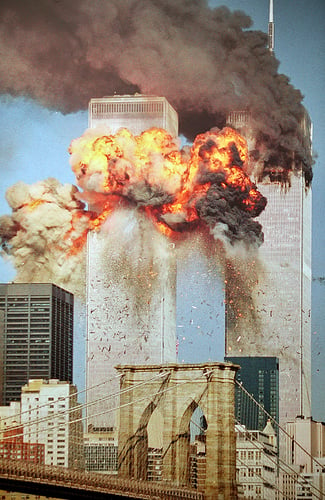
I begin with the attacks of September 11, 2001, crucial to the War on Terror.
Most of you remember these events and are aware of how shocking they were to the general population in North America. But perhaps you do not all recall the nature of the shock delivered to Congress.
Democrat Tom Daschle, who was Senate Majority Leader on September 11, 2001, recalls being at the Capitol with other members of Congress when the assaults on the Twin Towers took place. He watched them on television like most Americans, as stunned and puzzled as anyone. But his television viewing was interrupted when a guard ran into the room and announced that there was a plane headed toward the Capitol and that an immediate evacuation of the building was necessary. This was, says Daschle, the first time in history the entire U.S. Capitol had been evacuated. There appears to have been no clear protocol. Daschle says it was a scene of “total chaos.” Elected representatives, both senators and members of the House, fled in confusion. Many had difficulty getting reliable information about what was happening and did not know what to do or where to go. This was a frightened and intimidated legislature.
Later in the day, when things in Washington had settled down somewhat, many of those who had fled reassembled on the steps of the Capitol building. A few brief speeches were made, after which, as we can see and hear in precious video footage, members of Congress broke into a singing of God Bless America, followed by emotional embraces.

Senate Majority Leader Tom Daschle, Democrat, at the podium on the steps of the Capitol, Sept. 11, 2001, just before the singing of God Bless America. He is saying: “We, Republicans and Democrats, House and Senate, stand strongly united behind the President and will work together to ensure that the full resources of the government are brought to bear.”
A powerful feeling of unity is evident in the record of this event. Tom Daschle said that he had never in his life experienced the sense of unity he felt on September 11, 2001. Like others on the steps of the Capitol that evening, he seems to have been almost euphoric. We were, he says, one family.
I draw your attention to the emergence of a pattern that is common in societies experiencing danger and that characterizes affected populations in the War on Terror.
First, there is the sense of threat. The population then goes through a phase of intense, felt unity.
Party loyalties and ideological divides are cast aside. There are solemn declarations, there is singing, there is the calling down of blessings on the nation, there is hugging and there are tears.
I am not mocking members of Congress, or any other group that unites under threat. This seems to be an aspect of our nature as human beings. But bear in mind that while these social adjustments may help a society gear up for a response to an attack, they can also leave a population vulnerable to manipulation. At such moments dissent is discouraged and critical thinking is in short supply. Passion and calls for loyalty are the order of the day.
The consequences can be very serious.

Bush (Republican, President) embracing Daschle (Democrat, Senate Majority Leader).
The photograph of George W. Bush and Tom Daschle, top Republican and top Democrat, embracing shortly after 9/11, tells the story. The act is a symbolic statement of unity, but like many symbolic statements it tells us a tale with very practical implications.
The U.S. Constitution gives to Congress the power to declare war. Aware of the desirability of involving Congress, the White House immediately took advantage of the shock delivered by 9/11 and asked Congress for a bill explicitly allowing the President to use armed force in response to the attacks. Tom Daschle was one of the few people who could have stopped such a bill. The Democrats had a majority in Senate and he, as Senate Majority Leader, could have urged them to vote as a bloc against the bill. But the hug indicates, the sense of being one family, the feeling of unity, was strong. Not only did Daschle not rise to the occasion and oppose such a bill, he immediately offered to put it forward, thus guaranteeing its acceptance.
This extremely dangerous legislation, “Authorization for Use of Military Force, 2001” was proposed to and passed by both House and Senate on September 14, 2001. There was only one vote against the bill—by Barbara Lee, later Chair of the Congressional Black Caucus. The bill provided cover for the immediate invasion and occupation of Afghanistan and simultaneous preparations for the invasion of Iraq. It also handed to Bush the power to decide who was responsible for the 9/11 attacks.
Remember: people who want war may purposely create a sense of threat and a feeling of unity. And they will typically do so in order to achieve a particular reaction. This is the triad I am drawing your attention to: Threat, Unity, Reaction.
The reaction may express itself outwardly in foreign policy or inwardly in domestic policy. Frequently, the outward and inward moves are simultaneous. Outwardly, the enraged nation throws itself on the nation or group it decides was responsible for the attack. Inwardly, the population agrees that this is a time for unity, not a time for debate and dissent but for gathering as one people, with the surrender of individual freedoms and civil rights as needed to mobilize for violence.
We do not need to speculate about whether this condition was achieved in the American people on 9/11. A poll was initiated on that very day, in the evening of 9/11. (Washington Post-ABC). According to those who conducted the poll, nearly nine in ten Americans supported military action against whoever was responsible for the attacks and two out of three Americans were willing to surrender civil liberties to fight terrorism.
Now, you may be thinking, what’s the big deal? The threat-unity-response triad makes sense: an attacked group unites and, when united, acts to deal with a serious threat. The triad is compatible with the official story of 9/11 and does not by itself mean that dissenters are right and that the day’s events were an inside operation.
You would be right in thinking that I have said nothing to this point that indicates the official story of 9/11 is false. My preliminary aim has been simply to point to the triad, which becomes visible again and again in the War on Terror—and to emphasize how populations and their elected representatives may, at such times, be vulnerable to manipulation.
Now, if we wish to go further and ask if 9/11 was a fraud we will need to look at the evidence. This is not difficult: fourteen years of research by a wide variety of people has given us plenty of evidence. In today’s talk, however, I am discussing four events, and I have little time to discuss details of 9/11. So let me restrict myself to a few brief comments.
Many of you will know, if you have looked into this issue even superficially, that the destruction of the World Trade Center, and especially of three buildings (WTC 1, 2 and 7), is regarded by many of us as providing the strongest evidence against the official account. I realize that many people “tune out” when building collapses are discussed (inner voice: “What do I know about buildings? My God, I hope they aren’t going to ask me to remember my high school physics!”). But there are very good reasons to pay attention to the destruction of these buildings.
Covert operations are typically characterized not only by lying, but by the laying down of false trails and the creation of pseudo-mysteries and diversion. So complex and contradictory is the evidence encountered that it is very often difficult to prove an event was based on deception even when we feel sure this is the case. When we do get such proof it makes sense to try to persuade people to look at it. The destruction of the WTC buildings is one such instance. In my view the official explanations of their destruction have been proven to be false. If you wish to read an admirable summary of the evidence against the official account of the WTC destruction, I refer you to a recent publication that can be obtained from the website of Architects & Engineers for 9/11 Truth. It is entitled, Beyond Misinformation: What Science Says About the Destruction of World Trade Center Buildings 1, 2, and 7.
As this publication makes clear, the official account of the destruction of these buildings is based on repeated violations of the laws of physics and of basic principles of scientific investigation and thought. In contrast, the hypothesis that the three buildings were brought down by planted explosives and other agents of destruction is robustly supported. Evidence against the official account and in favor of the dissident account is copious, varied, and mutually corroborating.
Image on the right: The North Tower being demolished on 9/11.

But if these three buildings were brought down not by plane strikes but by controlled demolition, through preparations made well before the attacks, this means that the entire official narrative is false and the founding event in the War on Terror is a fraud. Moreover, since discovering that the official account is false is not actually difficult, we must assume that the U.S. government agencies that promote the fraudulent event, including the FBI, are aware of the fraud and have been engaged in a major cover-up. They are, at the very least, accessories after the fact.
Let me sum up my observations and claims to this point:
- Observation: there is a taboo in place in Canada (as in the U.S.) that punishes people, including members of Parliament, who raise questions about the FBI account of 9/11.
- Observation: a familiar pattern of human history becomes clear to those who study the 9/11 event: threat leads to feelings of unity, and feelings of unity facilitate and shape the reaction: (a) the sacrifice civil rights at home and (b) a willingness to use force against a perceived enemy.
- Observation: In the case of the 9/11 event in the U.S. the reaction phase encouraged (a) a willingness at home to surrender traditional rights and freedoms and (b) a willingness to use military force abroad.
- Claim: the 9/11 attacks were not carried out by Islamic extremists but were managed from within the U.S. to manipulate the population and to intimidate the U.S. Congress into supporting the reaction desired by the perpetrators.
B. The 2001 Anthrax attacks:
Very shortly after the 9/11 attacks there was a second set of attacks in the U.S. Envelopes containing deadly anthrax spores were sent through the mail.
This set of attacks appeared at the time to be the second punch in a one-two punch attack. After all, the attacks began a mere week after 9/11 and the perpetrators clearly wanted to be seen as the same Muslim extremists who had carried out the first attack.
Here, for example, is the letter sent to Senator Tom Daschle:
Note the date, 9/11, at the top. Note the attempt to look like a Muslim extremist. Most of the U.S. population assumed this was, indeed, a second blow by the same Muslim extremists alleged to have carried out the 9/11 attacks. We know this from a poll carried out in mid-October, 2001.

What were the effects of the anthrax attacks and who was the perpetrator?
The main effect was to keep up the momentum established by the 9/11 attacks. The external aspect of the reaction to 9/11 was directed toward those thought responsible: this reaction supported the invasion and occupation of Afghanistan. The first bombs were dropped on Afghanistan on October 7, 2001, two days after the first death in the U.S. from anthrax. The anthrax attacks kept al-Qaeda and Afghanistan in the crosshairs.
And as October of 2001 progressed another possible perpetrator appeared on the scene. According to this hypothesis al-Qaeda was providing the foot-soldiers—the people who wrote the letters and mailed them—but the sophisticated anthrax spores had to have been produced by a state, which was collaborating with al-Qaeda in this deadly attack.
The enemy state was said to be Iraq.
The Iraq hypothesis flourished briefly in October and November of 2001 in partnership with the al-Qaeda hypothesis. During that period, as the invasion of Afghanistan proceeded, support was given to preparations for the invasion of Iraq.
But I spoke earlier of a pattern, and the pattern includes not only attack on enemy states but also sacrifice of civil rights at home. Here is where the anthrax attacks scored their biggest victory. Attorney General John Ashcroft had introduced what would later be called the Patriot Act shortly after 9/11 and had made it clear to Congress that he wanted it passed immediately. But there was resistance. Both the population at large and Congress began to recover from the 9/11 attacks, and as they did so their willingness to sacrifice civil rights began to diminish. The anthrax attacks saved the day for Ashcroft by ensuring that both population and Congress remained sufficiently intimidated to accept the Patriot act. The act was passed on October 26, 2001. The connection between its passage and the anthrax attacks is very clear.
There were two powerful Democratic senators whose actions were slowing down passage of the Patriot Act. One was Tom Daschle, whom I have mentioned previously. The second was Patrick Leahy, Chair of the Senate Judiciary Committee. Anthrax letters were sent out to Daschle and Leahy immediately after they resisted a deadline for passage of the bill proposed by Vice-President Dick Cheney.
How odd that al-Qaeda and Iraq would have had a special hatred of Democratic senators who slowed down the Patriot Act!
But, of course, the anthrax letters were not sent by al-Qaeda and Iraq. According to what we have since learned, no Muslim had anything whatsoever to do with the attacks.
If you want to know more about this topic, please read my book, The 2001 Anthrax Deception. Since the publication of that book there have been further developments, including the emergence of a highly placed FBI whistle-blower, that have supported the book’s claims.
What do we know about the perpetrators? Studies of the physical characteristics of the anthrax spores quickly ruled out al-Qaeda and Iraq as sources of these spores and showed that the anthrax came from a highly secure laboratory within the U.S. military-industrial complex. This is not controversial, having been acknowledged by the FBI, the White House and the Department of Homeland Security.
So the perpetrators were not Muslim extremists but they pretended to be, and whoever they were they had access to the heart of the U.S. intelligence and military community. It is, therefore, clear that the anthrax attacks were an “inside job” and a “false flag operation.”
The true perpetrators are still at large, the FBI having led the public on a multi-year wild goose chase.
As far as the intimidation of Congress is concerned, the process stared with 9/11 but was continued by means of the anthrax attacks. Concrete barricades and yellow crime scene tape marked off the Capitol. Congress members were told by the FBI not to wear their Congressional pins publicly or to use their Congressional license plates. They were told they must hide their identities as elected representatives.
When Tom Daschle’s office received an anthrax letter in mid-October the stuff was so sophisticated it contaminated the whole building. The Hart Senate building was closed down for several months while it was cleaned. Some senators remained without computer access and proper office space as the Patriot Act was being pushed through. The anthrax attacks ensured that the passage of the Patriot Act took place in an atmosphere of urgent and ongoing threat to Congress.
Now, note that the lies pushed in October-November of 2001 to frame Afghanistan and Iraq for the anthrax attacks (Iraq as sponsor, al-Qaeda as client) belonged to the same repository of lies that was used over a period of years to justify the 2003 attack on Iraq. The two main deceptions were (a) that Iraq had “weapons of mass destruction” and (b) that Iraq was a sponsor of al-Qaeda.
The Centre for Public Integrity in the U.S. did a study a few years ago of these two sets of false statements. The study found that during the two years following 9/11 top Bush officials made 935 false statements on these two topics.
When Colin Powell gave his deceptive performance before the UN Security Council just before the 2003 invasion of Iraq, holding up his little vial of simulated anthrax, he was still making these two sets of false statements and he was still warning the world that Iraq might attack the U.S. with anthrax.
Intimidating Canadian legislatures, 2013-14
I now turn to a different country and to a time nearer the present. I have two incidents in Canada to discuss, the first situated in 2013 and the second in 2014.
A. The Provincial Legislature of British Columbia:
In 2013 Canadians learned that the Royal Canadian Mounted Police had arrested two Muslims for attempting to set off three bombs on the grounds of the British Columbia legislature on Canada Day, July 1.
Image on the right: The “pressure cooker bombs,” 2013.

This event seemed to have confirmed dramatically the fears on which the War on Terror feeds: Islamic terrorism, as a threat to democracy both symbolic and real, is alive and well in North America.
But let us look more closely at the perpetrators.
The couple arrested, John Nuttall and Amanda Korody, had allegedly self-converted to Islam in 2011. According to Ian Mulgrew, journalist for the Vancouver Sun who attended the lengthy trial, “These new Muslim converts ‘discovered’ Islam in a Lower Mainland camouflage store while on a walkabout in an alcoholic haze.” Nuttall and Korody were not members of a Muslim community; in fact, we have been told that when they began talking about the need for jihad members of the B.C. Muslim community promptly reported them to police.
Mulgrew has described Nuttall and Korody as “impoverished, troubled drug addicts.”
Image below: John Nuttall and Amanda Korody.

After they were brought to the attention of police Nuttall and Korody “were befriended by an [RCMP] officer pretending to be an Arab businessman with extremist connections. Over the following months, he encouraged their Islamic militance and introduced them to other Mounties acting as jihadis.” Mulgrew refers to this exercise as a “stage-managed operation.” More than 240 members of the RCMP were involved in this exercise.
“Over the following months, the [RCMP] corporal [posing as their Muslim friend] encouraged their extremism, bought Nuttall a suit…paid him for meaningless jobs, gave him money for groceries, all the while pressing him to formulate a viable terrorist plot.”
On the audiotapes of police interactions with Nuttall, the RCMP mole can at one point be heard berating Nuttall for his “poorly researched plan to hijack a Via Rail passenger train in Victoria that no longer exists.” (The remarks are by Canadian Press journalist Geordon Omand.)
The evidence consistently suggests that Nuttall had been indulging in fantasies. His plans were not rooted in the real world. What was the RCMP response on learning this? On the undercover audiotapes the police mole, after criticizing him for his poor research, can be heard saying to Nuttall: “I’m here to make what you have in your head come true.”
In other words, people cannot be arrested in Canada for having violent fantasies, but the RCMP is permitted to turn these fantasies into reality so that an arrest can be made and the victim fed to the ever-hungry War on Terror.
Each of us may have our moment of special anger as we read the records of this case. My moment came when I read about Nuttall having an awakening of conscience in the weeks before the planting of the bombs.
“Until a couple of days ago, I didn’t clue in that people were going to die. I’ve never killed anybody. I’m not a murderer.”
At another point Nuttall says clearly that he needs spiritual counseling.
“I want to know in my heart that I did the right thing—I need some spiritual guidance.”
The RCMP mole, anxious to discourage these signs of an awakening of conscience, replies: “What’s this spiritual guidance going to give you?”
Nuttall says: “This is about my soul were talking about, my wife’s soul.”
“All of us,” intones the costumed RCMP officer, “we have our own destiny…Allah chooses it for us, we don’t choose it for ourselves.”
Here is the essence of entrapment. A citizen shows clear signs of being ready to back away from a not yet committed crime but the police, instead of encouraging this tendency, work to beguile, seduce, and trap the citizen into the commission of this crime.
But there was more. A frightening little videotape was found in which Nuttall and Korody, with faces hidden, exhorted people to carry out jihad and expressed inclinations toward martyrdom.
Image on the right: Frame from Nuttall-Korody jihad and martyrdom video.

But who urged the couple to make the video? Who helped at every stage in its creation? Who filmed it? Who even supplied the black banner used as a backdrop? Why, the RCMP. The film was an RCMP production.
Neither the entrapment of this couple, nor even the assistance in making a martyrdom video, involves creativity on the part of the RCMP. Canada’s federal police have for some years been aping the FBI, which has a long record of such operations and has made them central to the War on Terror. Those of you who wish to look into this should read Trevor Aaronson’s book, The Terror Factory: Inside the FBI’s Manufactured War on Terrorism. If you do not have time to read the book, please watch Aaronson’s TED talk on the internet.
In the end, RCMP operatives convinced Nuttall to concentrate on a practical weapon, something he might actually be able to manage. They suggested he build pressure-cooker bombs and gave him advice on how to do it. They assured him they would supply the required explosive substance—to which he had no access.
Then they drove Nuttall around Victoria and found him a nice place to put the bombs—behind the bushes on the grounds of the B.C. legislature.
This case is so outrageous that even mainstream media have carried angry criticism of the RCMP. Journalist Ian Mulgrew has said: “this operation is redolent of a make-work project by the Mounties and the federal justice department to bolster the rhetoric of the prime minister.”
Consider Mulgrew’s statement. Let us give credit where credit is due: he is a mainstream Canadian journalist with the courage to say that the RCMP’s actions in this operation are not real policing at all (he calls them “pretend policing”) but a political act constructed to support the Conservative government’s involvement in the War on Terror. Everything I have seen about the case supports this claim.
The fact is that in Canada today, as in the U.S., federal police and intelligence agencies have politicized both policing and the courts. They have corrupted both sets of institutions. In doing so they are driven by, and in turn are supporting, an aggressive global conflict framework, the War on Terror, that is based on lies and deception.
And let me remind you of one aspect of the 2013 stage production that is often neglected. It involved the Canadian federal police encouraging a threat to a Canadian legislature.
B. The Parliament of Canada:
And now we arrive at the fourth and last case from the annals of the War on Terror to be reviewed today. This is the invasion of the Centre Block of the Parliament Buildings in Ottawa on October 22, 2014.
Senator Céline Hervieux-Payette has recalled her experience in her Senate office:
At 2:30 p.m., to cries of “Police,” my assistant opens the office’s main door. He comes face to face with soldiers aiming their machine guns at him and ordering him to put his hands in the air. One by one, our doors are opened and the soldiers point their guns at my other assistants who exit their offices, hands in the air, as if they were criminals… The door we go through is destroyed; glass has exploded all over the floor. The door across the hallway has also been knocked in. Glass litters the hallway. There are more than 50 people crammed into four offices, everyone talking to one another…
I sit near the open window. I’m breathing but stunned: parliamentarians are under the command of the military. Parliament is in the hands of the armed forces.
The persons holding the automatic weapons were almost certainly federal police officers, not members of the armed forces, but for our purposes today the distinction may not be important. Men in camouflage clothing with heavy boots, helmets, and automatic weapons would have been hard for most Canadians to identify. Let us simply say that security forces took control of Parliament. The image fits the theme of this talk very well.
But you are thinking: naturally they took control—an armed gunman was running down the hall shooting!
Yes, but let us look a bit more closely at the affair.
I want to begin by saying I do not pretend to have sorted out the facts of this attack. I am not in a position to say with confidence that the RCMP were complicit. But, in a report I have written on this incident, The October 22, 2014, Ottawa Shooting: Why Canadians Need a Public Inquiry, I do claim that (a) there are very serious unanswered questions about this series of incidents (I list 32 questions), (b) the RCMP have given both misleading and false information to the public and (c) in any serious inquiry the possibility of RCMP complicity would have to be considered.
The RCMP are, of course, the ones in charge of the investigation of the October 22, 2014 events. But this simply illustrates the dilemma faced by citizens in North America. The agencies charged with investigating acts of alleged Islamic terrorism have a proven record of incitement, entrapment and framing. They would, for this reason, be treated as suspects within an uncorrupted system of policing and litigation.
When we look for recognition of this obvious truth in mainstream North America media today we will seldom find it. I saw not a single person interviewed on television or radio, or quoted in mainstream newspapers, in Canada in the days after the October 22, 2014 attacks, who was willing to raise this as a serious possibility.
Drawing on the 2013 Canada Day case, we might ask our question this way: Could the 2014 impoverished drug addict from Vancouver (Zehaf-Bibeau) have been assisted by the RCMP the way the 2013 impoverished drug addict from Vancouver (Nuttall) was assisted? Could the two acts of intimidation of the people’s elected representatives have belonged to the same pattern of police behavior?
Before entering into the critical questioning of the mainstream account of October 22, I draw attention to the triad we have seen before: Threat, Unity, Reaction.
Let us begin with threat. After allegedly shooting Corporal Cirillo at the War Memorial the suspect, Michael Zehaf-Bibeau, made it to the Centre Block of Parliament. The Conservative caucus, including Mr. Harper, was assembled behind a door on one side of the central Hall of Honour, while the New Democratic Party was assembled behind a door on the other side. To the astonishment and horror of the MPs, a barrage of shooting broke out in the Hall.
Globe and Mail reporter Josh Wingrove caught the gunfire (second volley) on his Blackberry, and the showing of this video footage gave the public a dramatic sense of what MPs, hunkered down behind poorly barricaded doors off the main hall, heard at that time.

Oct. 22, 2014 (from Wingrove video): just before the 2nd volley of shots in Centre Block.
Volley one, which had occurred prior to the volley caught on this video, had roughly the same number of shots as volley two.
So MPs certainly felt threatened. The danger was emphasized by the CBC, which said on October 22 that the perpetrator may have fired 30 shots in the Hall of Honour. John Baird, then the Minister of Foreign Affairs, said on Anderson Cooper’s TV show on October 23 that if Sergeant-at-Arms Kevin Vickers had not killed Zehaf-Bibeau a dozen people might have been killed.
It turned out these statements were based on fantasy. The evidence we now have suggests that the suspect, Zehaf-Bibeau, ran into Centre Block with two bullets in his rifle. His firearm was a lever-action hunting rifle—a model first produced in 1894. Zehaf-Bibeau’s goals at that point are not clear, but he fired his two bullets, hitting no one (security guard Samearn Son appears to have been hit in the leg by a ricochet) and at one point he declined to shoot a security guard he was facing at point blank range. In the space between volleys he seems to have loaded one more bullet in his rifle, which he fired—again hitting no one—just before dying in a hail of bullets less than two minutes after entering the building. He did not, therefore, shoot 30 times; he shot three times. And he was in no position to kill a dozen people. Of the roughly 59 shots heard by MPs, 56 were fired by police with semi-automatic 9mm handguns.
While it is important to sort out these facts, it remains true that the feeling of threat experienced by MPs was intense. They heard a huge barrage of shots, could not see what was going on, and felt at risk.
How about the next member of our triad, unity?
We have a remarkable piece of footage from the next day, October 23, fully as striking as the singing of God Bless America on the steps of the Capitol. Kevin Vickers, apparently one of the two men who killed Zehaf-Bibeau, was Sergeant-at-Arms and regularly carried the mace into Parliament. (The mace represents the authority of the Speaker and the right of the House, transmitted to it by the crown, to pass laws.) When Mr. Vickers entered Parliament with the mace on October 23 he was given a prolonged standing ovation by the House, with members of all political parties enthusiastically participating.
In addition to this particular symbolic statement of unity we saw in Canada the embraces familiar to us from the U.S. incidents of the fall of 2001. The Canadian Prime Minister signaled his trans-party solidarity with Mr. Trudeau of the Liberal Party and Mr. Mulcair of the NDP with hugs.

Post-event hugs, October 2014: Harper and Mulcair, Harper and Trudeau.
So we had threat and we had unity. The third element is reaction, which possesses two components. Internally, citizens and their representatives are all supposed to pull together, sacrificing civil rights or having them sacrificed on their behalf. Externally, they are to fling themselves at the enemy—whoever has been assigned that role.
In Prime Minister Harper’s speech on October 22 he made clear, albeit in genteel and delicate language, that he intended to move ahead on both fronts: to give more power to national security agencies at home while joining with allies in military action abroad.
This week’s events are a grim reminder that Canada is not immune to the types of terrorist attacks we have seen elsewhere around the world…this will lead us to strengthen our resolve and redouble our efforts and those of our national security agencies to take all necessary steps to identify and counter threats and keep Canada safe here at home, just as it will lead us to strengthen our resolve and redouble our efforts to work with our allies around the world and fight against the terrorist organizations who brutalize those in other countries with the hope of bringing their savagery to our shores. They will have no safe haven.
The forms this reaction took are well known. Internally we had the passage of a series of bills, including the famous Bill C-51. Externally, we found the victim of the War Memorial shooting, Corporal Cirillo, quickly exploited in Iraq.
So we have the triad found in the War on Terror in its autumn, 2001 manifestation. The presence of death in the October 22 events has guaranteed that the pattern will be deeply inscribed in people’s consciousness. The absence of killing in the B.C. bombers incident is, I am convinced, one of the reasons the incident has had relatively little impact in Canada. In fact, the lengthy court case associated with this incident—still not resolved as this talk is being given—has embarrassed the RCMP at the same time the lack of casualties has left the Canadian population uninterested. The operation cannot be called a success.
Would it not be tempting for police, after such a failure, to mount an operation in which there are deaths to draw people’s attention and where the perpetrator or patsy is killed in the operation so that there will never be a court case?
I am aware that I have to this point offered no evidence that the October 22, 2014 incident was planned or carried out with police complicity. Let me now, therefore, look at selected aspects of the RCMP’s performance and foreknowledge. In my view these are sufficiently peculiar, even if they were the only anomalies encountered, to justify a public inquiry. For other problematic issues in the case my report may be consulted.
I begin with a question: Where did the most blatant security failure occur, which allowed the suspect to make it into a building of Parliament after shooting Mr. Cirillo at the War Memorial? The answer is that the main security failure occurred between the time he emerged from his car in front of the bollards near East Block until the time he entered the doors of Centre Block. This zone was the responsibility of the RCMP. As he stepped onto Parliament Hill he was no longer the responsibility of the Ottawa police, and as he entered Centre Block he became the responsibility of House of Commons security. In between the RCMP was responsible.
Now, during that brief period when he was the responsibility of the RCMP he ran from the bollards along the grass in front of the East Block, his keffiya over the lower part of his face, his long hair flowing, and his Winchester rifle in his hands. He hijacked a black ministerial car in front of East Block. The driver got out and ran away at top speed. The suspect then got into the black car with his rifle and drove straight to Centre Block. On his way he passed two white RCMP vehicles. Neither moved to intercept him, although either one could have done so. Neither seems to have made a serious effort to catch him or intercept him on the rest of his journey to Centre Block, although they followed him to his destination.

Black hijacked car (circled), heading in direction of top of frame, has just driven past two white RCMP vehicles.
I am not interested in blaming the officers in these two cars. The more important issue is the fact that the RCMP has such a thin and permeable line of security, not to mention a communications system that performed very badly. Two cars between the suspect and Parliament, each with one officer, neither of whom seemed to expect anything and neither of whom appeared to have heard the 911 calls from the War Memorial? Neither of whom appears to have been able to warn the House of Commons security, who were, therefore, caught off guard when Zehaf-Bibeau burst through the door?
We now know, thanks to a CBC access to information request, that the RCMP were short by at least 29 persons in their Parliament Hill security at that time. We also know that the extra patrols in the vicinity that the RCMP had mounted in mid-October due to various incidents had been halted two days before the October 22 incident.
Am I being a Monday morning quarterback? Will you object that it is all very well to bemoan this reduction of security in retrospect but that the RCMP could not possibly have known of the danger at the time? Well, I certainly would have thought that the killing of a soldier at Saint-Jean-sur-Richelieu two days earlier by an apparent “terrorist” would have led to some tightening of security. But, beyond that, there were plenty of signs of danger.
We are now touching on one of the most explosive aspects of the October 22, 2014 case, namely advance warnings. If we turn to the RCMP and ask what was the stated and official position we find it set out very clearly. Commissioner Paulson said without hesitation that there had been “no advance warning.” Is this true? Consider the following list:
(1) October 8, 2014
Warning: potential “knife and gun” attacks inside Canada.
Source: NBC News, crediting US intelligence sources, in turn crediting Canadian authorities. The warning was quickly denied by Canadian authorities.
(2) October 17:
Warning: “heightened state of alert”
Source: Integrated Terrorism Assessment Centre (ITAC), which is housed at the Canadian Security Intelligence Service (CSIS) but has several partner organizations, including the RCMP.
(3) October 17:
Warning: “violent act of terrorism”
Source: Privy Council Office (PCO), which advises the Prime Minister.
(4) October 18:
Warning: ISIS considering attacks on uniformed law enforcement persons in Canada
Source: Criminal Intelligence Integrated Unit of the RCMP
(5) October 21:
Warning: [We do not know what is in this report, which the RCMP has refused to release, but it was apparently based on more than the lethal October 20 event in Quebec.]
Source: National Intelligence Coordination Centre, RCMP
(6) September to October, 2014, beginning about a month before the October 22 events
Warning: There was a war-gaming of “an attack in Quebec followed by an attack in another city” (CBC journalist Adrienne Arsenault called it the “precise scenario” that unfolded in October).
Source: Adrienne Arsenault, speaking on The National, CBC television, October 22, 2014. According to her the participants in the war game included CSIS, the RCMP, and the National Security Task Force.
We find, in short, that there were repeated warnings beginning at least a month before October 22 and growing more intense in the five days prior to the attacks. Such warnings are not at all normal in Canada. ITAC’s last similar warning had been issued about four years previously. As to the precision in timing of the warnings, Craig James, an official at the B.C. legislature, said that his office had been told “there may be a problem this week.” How extraordinary. There was, indeed, a problem “this week:” there was a lethal attack on the Monday (October 20) followed by a lethal attack on the Wednesday (October 22).
But the words of Craig James raise another issue: it is not merely the timing that is peculiar but also the institutions warned. With warnings going out to legislatures in Canada, how could the most important legislature at all have been left with no warning? As journalist Michael Smyth of The Province put it: “our provincial politicians [in B.C.] and legislative security staff were well-briefed by the feds here, but the RCMP in Ottawa got taken by surprise? What is wrong with this picture?”
What is more, consider the peculiarity in the October NBC warning. “Knife and gun” attacks inside Canada? Such attacks are very uncommon. Yet both on October 20 and October 22 large knives were found at the crime scene. Is this a coincidence?
Finally, we have the war-games exercise, which was found to be oddly prophetic when an attack in the province of Quebec (October 20) was followed by an attack in a second city (Ottawa, Ontario). It is true that part of the war-game scenario mentioned by Arsenault (a third incident with returnees from Syria) did not manifest itself, but there were certainly efforts, which involved RCMP lies, to tie both October suspects to Syria.
So, what are we to think of Mr. Paulson’s statement about “no advance warning?” Mr. Paulson was lying. Why? There are two main possibilities.
First, he may have been lying to disguise gross RCMP incompetence. To suggest this is to stay within the bounds of acceptable discourse, although even in this case there should be calls for Mr. Paulson’s resignation.
But how does the incompetence theory fit with the fact that the although the PCO document of October 17 explicitly called for maintaining patrols, the RCMP, after the issuing of the PCO document, actually halted a series of patrols they had been making in the vicinity of Parliament Hill? And why would the RCMP, after receiving a series of clear warnings, allow themselves to remain short-staffed on the scene to the tune of at least 29 officers? Moreover, since the PCO warning explicitly called for maintaining excellent communications, how is it that the RCMP neither received nor passed on, in a timely way, effective warnings that would have prevented the suspect’s assault on Centre Block?
The unspeakable possibility—the possibility that is outside the bounds of respectability and will not be mentioned by mainstream media and political representatives–is that Mr. Paulson denied receiving warnings of the attacks because the RCMP were complicit in the attacks.
It is not wise to pretend we know the truth about an incident when we do not. I do not pretend, in this talk or in my written report, to know with certainty whether the Royal Canadian Mounted Police was complicit in the October 22, 2014 attacks in Ottawa. But I do know that, given its history of complicity in establishing “terrorist” threats, as well as the serious anomalies and unanswered questions that stare us in the face when we investigate the October 22 events, the RCMP must be regarded as suspects.
Conclusions:
Let me end this talk by reiterating five points.
- There is a pattern, common enough in war and found in the War on Terror: Threat, followed by Unity, followed by Reaction, which has an internal and external dimension.
Whatever the value of this pattern to human survival at various times in our history, it can leave populations open to deception and manipulation.
- In the War on Terror deception and manipulation are exactly what we find. There is strong evidence that legislatures of the U.S. and Canada have been subjected to physical intimidation that has facilitated both the internal projects (repressive legislation) and the external projects (invasions and occupation) of the leaders of the War on Terror.
- A strong social taboo has been constructed that has hampered awareness of this deception and manipulation. The taboo extends through the population but is especially strong in legislatures, including the Parliament of Canada.
- This taboo ensures that our Canadian Parliament, like the U.S. Congress, is unfit to protect citizens from the deceptions and violence of the War on Terror and is even unable to protect itself.
- Of the four cases dealt with today, I regard complicity in the physical intimidation of legislatures by state agencies as established in three cases. In the fourth case, the events of October 22, 2014 in Canada, state-sponsored intimidation had not been established, but is a possibility that must be explored through investigation and research—formal and public if possible, but otherwise by members of civil society using all their intelligence and determination.
*
The text was edited by MacQueen for publication in Truth and Shadows. In addition to being a retired professor of Religious Studies and founder of McMaster’s Peace Studies program, MacQueen is the author of The 2001 Anthrax Deception: The Case For a Domestic Conspiracy.
This article was originally published on Truth and Shadows.
Sources
Since this was a public talk rather than an article it included no notes. I directed the audience to websites where they could find more information.
9/11:
Websites important for understanding the destruction of the World Trade Center:
Architects and Engineers for 9/11 Truth:
(The booklet, Beyond Misinformation: What Science Says About the Destruction of World Trade Center Buildings 1, 2, and 7 (Architects & Engineers for 9/11 Truth, 2015) can be purchased below:)
http://www.beyondmisinformation.org/#beyond-misinformation
Consensus 9/11: The 9/11 Best Evidence Panel:
The Journal of 9/11 Studies:
http://www.journalof911studies.com/
Anthrax:
There are several good books, but my own explores the relationship of the anthrax attacks to the 9/11 attacks more closely than other books: The 2001 Anthrax Deception: The Case For a Domestic Conspiracy (Clarity Press, 2014). This book also explores the intimidation of Congress by both sets of attacks.
http://www.claritypress.com/MacQueen.html
The two Canadian cases:
Information about the Nuttall-Korody case was obtained mainly from a series of articles by Vancouver Sun journalist Ian Mulgrew, who attended the couple’s trial and regularly posted articles about it.
Information about the events of October 22, 2014 can be found in my report, The October 22, 2014, Ottawa Shootings: Why Canadians Need a Public Inquiry (fall, 2015). The bibliography in that report includes both primary and secondary sources for those wishing to learn more. The report can be downloaded here:
http://democracyprobe.ca/wp-content/uploads/2015/10/09021508.pdf
A slightly revised version is available here:
http://www.amazon.com/dp/B01C6DZU6W
All images in this article are from the author unless otherwise stated.




 Post
Post

