Debunked COVID-19 conspiracy theory weaves a UNC medical researcher into the tale


Debunked COVID-19 conspiracy theory weaves a UNC medical researcher into the tale

Duration 1:40
Watch as reported cases of coronavirus spread county-by-county across NC
Beginning on March 3, 2020, with the first reported case of COVID-19 in Wake County, the coronavirus has spread across North Carolina. Here's a look at the cumulative number of cases by day as reported by NC DHHS.

The messages started coming a little more than a month ago, first on social media and eventually by email.

By March, Kari Debbink, a professor at Bowie State University who holds a doctorate from UNC-Chapel Hill, had received her first death threat.

The reason: She was being accused of helping create the novel coronavirus, which has caused the COVID-19 pandemic that has shut down much of the world, in a lab in North Carolina.

“To me it is just unbelievable that I would end up in a position to have someone think I could start a global pandemic,” she said in a phone interview with The News & Observer. “I reported it to the police … and they were just like, ‘What is going on?’”

As COVID-19 spread at the start of the year, so did rumors and speculation about its origin. Some said it was a biological weapon developed by the Chinese, or that it escaped from a laboratory accidentally or even that the disease was amplified by 5G technology.

Labor Day Sale

Unlimited digital access - $3 for 3 months

CLAIM OFFER

One unfounded theory that many internet users have latched onto and that has been amplified by right wing news channels, like One America News, has placed its sights on North Carolina. It claims — falsely — that COVID-19 was created at UNC-Chapel Hill, specifically in the lab of Ralph Baric, where Debbink once worked.

Baric is one of the world’s preeminent researchers of coronaviruses — having studied the family of viruses known for their crown-like shape for 30 years. His lab on the UNC campus was one of the first places in the U.S. to receive a sample of the novel coronavirus earlier this year to begin conducting tests.

And while experts and researchers in the field who have examined the genomic structure of COVID-19 have overwhelmingly concluded that the virus originated in wildlife, the UNC rumor has continued to spread on social media and message boards.

Stated simply, scientists have reported that the makeup of the virus points to it being the result of natural evolution rather than bio-engineering.

ralph-baric-2015-738x714.jpg
Dr. Ralph Baric, of UNC’s Gillings School of Global Public Health, was one of the first people in the U.S. to receive a sample of the coronavirus. UNC-Chapel Hill
Today’s top headlines

Sign up for the Afternoon Update and get the day’s biggest stories in your inbox.

This site is protected by reCAPTCHA and the Google Privacy Policy and Terms of Service apply.

UNC declined to comment for this story, and Baric was not available for an interview. Baric’s lab is putting a potential COVID-19 treatment through human trials.

Debbink worked in Baric’s lab while pursuing her doctorate at UNC, which is how she came to be a target online. She believes Baric has been tied up in conspiracy theories because of a lack of scientific knowledge among the general public.

“Not everybody is able to read a scientific paper and understand it,” she said. “It is very easy for someone to watch a video that makes [false information] seem like a totally legitimate idea.”

It’s unnerving, she added, to see people make threats over something they likely don’t understand.

Previous study of one coronavirus strain

Baric’s name appears to have been swept up into theories around the new coronavirus because of a 2015 paper he co-authored with more than a dozen other scientists, including one associated with the Wuhan Institute of Virology, a lab located near the epicenter of the COVID-19 outbreak.

That paper showed coronaviruses in bats were capable of directly infecting humans rather than evolving in another animal first. Bats have been shown to be responsible for other coronaviruses in the past, like SARS and MERS, though the virus passed through a different animal host before infecting humans in those cases.

To prove this, the scientists created a a hybrid version of a bat coronavirus and used it to infect mice whose modified genomes mimicked human lung receptors. Creating an infectious virus for experiments — also known as “gain-of-function research” — had become a topic of debate around the time of the 2015 study.

Some fellow scientists, Nature reported, questioned whether the insights from gain-of-function research were worth the risks, however slim they might be. Baric told Nature that without the research that particular coronavirus strain — which is different from the one causing COVID-19 — would not be viewed as a threat that requires more attention.

IMG-2839.jpg
Professors at UNC-Chapel Hill’s Gillings School of Global Public Health are at the forefront of research into to the coronavrius. Submitted

In 2014, the U.S. government decided it would stop funding gain-of-function research, though Baric’s study was underway and was grandfathered in. The National Institutes of Health deemed the study not risky enough to fall under the moratorium on funding, Baric told Nature in 2015.

The lingering literature around the debate appears to have drawn attention to Baric’s work. An editor’s note attached to the top of Nature’s article about the debate now reads: “We are aware that this story is being used as the basis for unverified theories that the novel coronavirus causing COVID-19 was engineered. There is no evidence that this is true.”

Debbink, who helped author Baric’s 2015 paper, said everyone involved with that research has been targeted online by harassers who are accusing them of creating a biological weapon.

Expert research shows the virus didn’t come from a lab

But since COVID-19, just one of several known coronavirus strains in the world, has had a chance to be studied, scientists have been resolute in saying there’s no proof of it being engineered by humans. On the contrary it appears to be quite natural in origin, likely coming from bats, they say.

A recent article in the journal of Emerging Microbes & Infections aimed squarely at false claims about Baric’s 2015 paper.

The authors of the study found no connection between Baric’s research and the new pandemic — because the hybrid Baric used and the virus that causes COVID-19 are completely different strains.

“This claim lacks any scientific basis and must be discounted...,” the authors wrote. “[T]here is no credible evidence to support [it].”

Susan Weiss, a professor at the University of Pennsylvania Medical School and an author of the article, said she didn’t have time to talk to an N&O reporter about the false theories but added, “The conspiracy theory is ridiculous.”

In February, The Lancet, a peer-reviewed medical journal, published a statement “strongly condemn[ing] conspiracy theories suggesting that COVID-19 does not have a natural origin.”

The group of scientists who published the statement cited nine different genomic analyses that all pointed overwhelmingly toward a natural origin of the virus.

“Conspiracy theories do nothing but create fear, rumors, and prejudice that jeopardize our global collaboration in the fight against this virus,” the scientists in The Lancet wrote.

Debbink said she doesn’t expect researchers to slow down their work because of the conspiracy theories, but she is worried about the long-term consequences of them.

“I think conspiracy theories are very harmful to the public discourse,” she said, “... less so because of people like me getting death threats ... but because they degrade the public trust in science and confuse people.”

This story was produced with financial support from a coalition of partners led by Innovate Raleigh as part of an independent journalism fellowship program. The N&O maintains full editorial control of the work. Learn more; go to bit.ly/newsinnovate

Zachery Eanes is the Innovate Raleigh reporter for The News & Observer and The Herald-Sun. He covers technology, startups and main street businesses, biotechnology, and education issues related to those areas.

Read more here: https://www.newsobserver.com/news/local/article241996426.html#storylink=cpy

Peter Daszak


Peter Daszak

From Wikipedia, the free encyclopedia
Jump to navigation Jump to search
Peter Daszak
Peter Daszak 2017 01.jpg
Daszak speaking in 2017
NationalityBritish
EducationUniversity of East London (Ph.D.) Bangor University (B.Sc.)
OccupationZoologist

Peter Daszak is a British zoologist, consultant and public expert on disease ecology, in particular on zoonosis. He is the president of EcoHealth Alliance, a nonprofit non-governmental organization that supports various programs on global health and pandemic prevention.[1] He is also a member of the Center for Infection and Immunity at the Columbia University Mailman School of Public Health.[1] Daszak was involved in investigations into the initial outbreak which eventually developed into the COVID-19 pandemic[2] and became a member of the World Health Organization team sent to investigate the origin of COVID-19 in China.

Education

Daszak earned a B.Sc. in zoology in 1987, at Bangor University and a Ph.D. in parasitic infectious diseases in 1994 at University of East London.[1]

Career

Daszak worked at the School of Life Sciences, Kingston University, in Surrey, England in the 1990s. In the late 1990s Daszak moved to the United States and was affiliated with the Institute of Ecology at the University of Georgia and the National Center for Infectious Diseases, Centers for Disease Control and Prevention, in Atlanta, Georgia. Around 2001 he became executive director at a collaborative think-tank in New York City, the Consortium for Conservation Medicine.[3] He has adjunct positions at two universities in the U.K. and three universities in the U.S., including the Columbia University Mailman School of Public Health.[1]

He was one of the early adopters of conservation medicine.[4] The Society for Conservation Biology symposium in 2000, had focused on the "complex problem of emerging diseases".[4] He said in 2001 that there were "almost no examples of emerging wildlife diseases not driven by human environmental change...[a]nd few human emerging diseases don't include some domestic animal or wildlife component." His research has focused on investigating and predicting the impacts of new diseases on wildlife, livestock, and human populations, and he has been involved in research studies on epidemics such as the Nipah virus infection, the Australian Hendra outbreaks, the 2002–2004 SARS outbreak, Avian influenza, and the West Nile virus.[5]

Starting in 2014, Daszak was Principal Investigator of a six-year NIH project which was awarded to the EcoHealth Alliance and which focused on the emergence of novel zoonotic coronaviruses with a bat origin.[6] Among the aims of the project was to characterize the diversity and distribution of Severe acute respiratory syndrome–related coronavirus (SARSr-CoV) in bats, viruses with a significant risk of spillover, in southern China, based on data from spike protein sequences, infectious clone technology, infection experiments (both in vitro and in vivo), as well as analysis of receptor binding.[7] The six 1-year projects received $3.75 million in funding from the National Institute of Allergy and Infectious Diseases (NIAID), part of the U.S. National Institutes of Health agency.[6]

Daszak has served on committees of the International Union for Conservation of Nature, World Health Organization (WHO), National Academy of Sciences, and United States Department of the Interior.[1] He is a member of the National Academy of Medicine and Chair of the National Academies of Sciences, Engineering, and Medicine (NASEM)'s Forum on Microbial Threats and sits on the supervisory board of the One Health Commission Council of Advisors.[8]

During times of large virus outbreaks Daszak has been invited to speak as an expert on epidemics involving diseases moving across the species barrier from animals to humans.[8][9][10] At the time of the Ebola outbreak in West Africa in 2014, Daszak said "Our research shows that new approaches to reducing emerging pandemic threats at the source would be more cost-effective than trying to mobilize a global response after a disease has emerged".[11]

In October 2019, when the U.S. federal government "quietly" ended the ten-year old program called PREDICT,[12] operated by United States Agency for International Development (USAID)'s emerging threats division,[13] Daszak said that, compared to the $5 billion the U.S. spent fighting Ebola in West Africa, PREDICT—which cost $250 million—was much less expensive. Daszak further stated, "PREDICT was an approach to heading off pandemics, instead of sitting there waiting for them to emerge, and then mobilizing."[13]

As of 2020 Daszak has been designated a Highly Cited Researcher by Web of Science.[14] In addition to citations in academic publications, his work has been covered in leading English-language newspapers,[15][16] television and radio broadcasts, documentary films,[17] and podcasts.[18]

As of 2021, Daszak is the president of the New York-headquartered NGO EcoHealth Alliance.[19] His research focuses on global emergent diseases such as Severe Acute Respiratory Syndrome (SARS), Nipah virus, Middle East Respiratory Syndrome (MERS), Rift Valley fever, Ebola virus, and COVID-19.[1][20][21] The organization has administered more than $100 million in U.S. federal grants to fund overseas laboratory experiments.[22][23]

COVID-19 pandemic

After the outbreak of the COVID-19 pandemic, Daszak noted in New York Times that he and other disease ecologists had warned the WHO in 2018 that the next pandemic "would be caused by an unknown, novel pathogen that hadn't yet entered the human population", probably in a region with significant human-animal interaction.[15] The group had named this hypothetical pathogen "Disease X"; it was included it on a list of eight diseases which they recommended should be given highest priority in regard to research and development efforts, such as finding better diagnostic methods and developing vaccines.[24] He said, "As the world stands today on the edge of the pandemic precipice, it's worth taking a moment to consider whether Covid-19 is the disease our group was warning about."[15]

Prior to the pandemic, Daszak and EcoHealth Alliance were the only U.S.-based organization researching coronavirus evolution and transmission in China,[25] where they partnered with the Wuhan Institute of Virology, among others. On 1 April 2020, following the beginning of the COVID-19 pandemic in the United States, the USAID granted $2.26 million to the EcoHealth program for a six-month emergency extension of the program whose funding has expired in September 2019.[26][27] The University of California announced that the extension would support "detection of SARS-CoV-2 cases in Africa, Asia and the Middle East to inform the public health response" as well as investigation of "the animal source or sources of SARS-CoV-2 using data and samples collected over the past 10 years in Asia and Southeast Asia."[27]

An open letter co-authored by Daszak, signed by 27 scientists and published in The Lancet on 19 February 2020, stated: "We stand together to strongly condemn conspiracy theories suggesting that COVID-19 does not have a natural origin...and overwhelmingly conclude that this coronavirus originated in wildlife." It further warned that blaming Chinese researchers for the virus' origin jeopardised the fight against the disease.[28] The letter has been criticized by Jamie Metzl for "scientific propaganda and thuggery", and by Katherine Eban of Vanity Fair as having had a "chilling effect" on scientific research and the scientific community by implying that scientists who "bring up the lab-leak theory... are doing the work of conspiracy theorists".[29][30][31] According to emails obtained by FOIA, Daszak was the primary organizer of the letter, and had communicated with colleagues while drafting and signing the letter to "conceal his role and creat[e] the impression of scientific unanimity."[31] It also caused controversy since Daszak did not disclose that his EcoHealth Alliance group had an existing relationship with the Wuhan Institute of Virology, with some alleging that this was an apparent conflict of interest.[32] In June 2021, The Lancet published an addendum in which the April 2020 letter's authors were asked to update their competing interest disclosures. As the only author to do so, Daszak listed his cooperation with researchers in China.[33]

EcoHealth Alliance's project funding was "abruptly terminated" on 24 April 2020, by the National Institutes of Health. The move met with criticism,[20][34][35] including by a group of 77 Nobel Prize laureates who wrote to NIH Director Francis Collins that they "are gravely concerned"[36] by the decision and called the funding cut "counterintuitive, given the urgent need to better understand the virus that causes COVID-19 and identify drugs that will save lives."[37] A 8 May 2020 article in the journal Science stated that the unusual 24 April decision to cut EcoHealth's funding had occurred shortly after "President Donald Trump alleged – without providing evidence – that the pandemic virus had escaped from a Chinese laboratory supported by the NIH grant, and vowed to end the funding."[38]

In May 2020, Daszak "said there was 'zero evidence' that the virus" was created in the Wuhan Institute of Virology during an appearance on "60 Minutes."[39]

In 2020 Daszak was named by the World Health Organization as the sole U.S.-based representative on a team sent to investigate the origins of the COVID-19 pandemic,[40] a team that also included Marion Koopmans, Hung Nguyen, and Fabian Leendertz.[40] Daszak had previously collaborated for many years with Shi Zhengli, the director of the Wuhan Institute of Virology,[41] on efforts to trace SARSr-CoV viruses to bats after the 2002–2004 SARS outbreak. In June 2021, Daszak recused himself from The Lancet's inquiry commission focused on COVID-19 origins, after concerns were raised over his links to the Wuhan Institute of Virology.[42]

Awards and honors

In October 2018, Daszak was elected to the National Academy of Medicine.[43]

References


  1. "EcoHealth Alliance's Dr. Peter Daszak Elected to National Academy of Medicine". EcoHealth Alliance. 15 October 2018. Retrieved 10 May 2020.

External links

  • "Peter Daszak, PhD". Columbia University Mailman School of Public Health. Archived from the original on 30 May 2021. Retrieved 26 May 2021.

  • Quinn, Jimmy (25 May 2021). "The Growing Scrutiny of Peter Daszak's Chinese Research Collaboration". National Review.

  • "Peter Daszak". TEDMED. TED. Retrieved 5 September 2021.

  • Norris, Scott (1 January 2001). "A New Voice in ConservationConservation medicine seeks to bring ecologists, veterinarians, and doctors together around a simple unifying concept: health". BioScience. 51 (1): 7–12. doi:10.1641/0006-3568(2001)051[0007:ANVIC]2.0.CO;2. ISSN 0006-3568.

  • "Peter Daszak". TEDMED. Retrieved 20 April 2020.

  • "Project no. 2R01AI110964-06: Understanding the Risk of Bat Coronavirus Emergence (2019-2021)". NIH RePORTER. Retrieved 17 April 2021.

  • "RePORT ⟩ RePORTER". reporter.nih.gov. Retrieved 26 May 2021.

  • "Dr. Peter Daszak". EcoHealth Alliance. Retrieved 20 April 2020.

  • Gorman, James (28 January 2020). "How do bats live with so many viruses?". The New York Times. Retrieved 20 April 2020.

  • Bruilliard, Karin (3 April 2020). "The next pandemic is already coming, unless humans change how we interact with wildlife, scientists say". Washington Post. Retrieved 20 April 2020.

  • "Ebola, Dengue fever, Lyme disease: The growing economic cost of infectious diseases". National Science Foundation. 16 December 2014. Retrieved 20 April 2020.

  • "Scientists Were Hunting for the Next Ebola, Now the U.S. Has Cut Their Funding". The New York Times.

  • McNeil, Donald G. Jr (25 October 2019). "Scientists Were Hunting for the Next Ebola. Now the U.S. Has Cut Off Their Funding". The New York Times. ISSN 0362-4331. Retrieved 10 May 2020.

  • "Peter Daszak". publons.com.

  • Daszak, Peter (27 February 2020). "Opinion | We Knew Disease X Was Coming. It's Here Now". The New York Times. Retrieved 21 June 2021.

  • Williams, Shawna (24 January 2020). "Where Coronaviruses Come From (Interview)". The Scientist. Retrieved 20 April 2020.

  • "The Next Pandemic". Explained. Season 2. Episode 7. 7 November 2019.

  • "Why Humans Are Responsible for the Coronavirus". Slate. 23 December 2020.

  • "Wildlife Conservation and Pandemic Prevention - EcoHealth Alliance". EcoHealth Alliance. Retrieved 14 October 2016.

  • Subbaraman, Nidhi (21 August 2020). "'Heinous!': Coronavirus researcher shut down for Wuhan-lab link slams new funding restrictions". Nature. doi:10.1038/d41586-020-02473-4. PMID 32826989.

  • "Developing MCMs for Coronaviruses". Rapid Medical Countermeasure Response to Infectious Diseases: Enabling Sustainable Capabilities Through Ongoing Public- and Private-Sector Partnerships: Workshop Summary. National Academy of Sciences. 2016.

  • Ridley, Alina Chan and Matt (15 January 2021). "The World Needs a Real Investigation Into the Origins of Covid-19". Wall Street Journal.

  • Subbaraman, Nidhi (21 August 2020). "'Heinous!': Coronavirus researcher shut down for Wuhan-lab link slams new funding restrictions". Nature. doi:10.1038/d41586-020-02473-4.

  • 2018 Annual review of diseases prioritized under the Research and Development Blueprint (PDF) (Report). February 2018. p. 449.

  • Latinne, Alice; Hu, Ben; Olival, Kevin J.; Zhu, Guangjian; Zhang, Libiao; Li, Hongying; Chmura, Aleksei A.; Field, Hume E.; Zambrana-Torrelio, Carlos; Epstein, Jonathan H.; Li, Bei (25 August 2020). "Origin and cross-species transmission of bat coronaviruses in China". Nature Communications. 11 (1): 4235. Bibcode:2020NatCo..11.4235L. doi:10.1038/s41467-020-17687-3. ISSN 2041-1723. PMC 7447761. PMID 32843626.

  • Baumgaertner, Emily; Rainey (2 April 2020). "Trump administration ended pandemic early-warning program to detect coronaviruses". The LA Times. Retrieved 26 May 2021.

  • Cohen, Zachary (10 April 2020). "Trump administration shuttered pandemic monitoring program, then scrambled to extend it". CNN. Retrieved 26 May 2021.

  • Calisher, Charles; Carroll, Dennis; Colwell, Rita; Corley, Ronald B; Daszak, Peter; Drosten, Christian; Enjuanes, Luis; Farrar, Jeremy; Field, Hume; Golding, Josie; Gorbalenya, Alexander; Haagmans, Bart; Hughes, James M; Karesh, William B; Keusch, Gerald T; Lam, Sai Kit; Lubroth, Juan; Mackenzie, John S; Madoff, Larry; Mazet, Jonna; Palese, Peter; Perlman, Stanley; Poon, Leo; Roizman, Bernard; Saif, Linda; Subbarao, Kanta; Turner, Mike (March 2020). "Statement in support of the scientists, public health professionals, and medical professionals of China combatting COVID-19". The Lancet. 395 (10226): e42–e43. doi:10.1016/S0140-6736(20)30418-9. PMC 7159294. PMID 32087122. S2CID 211201028.

  • Lonas, Lexi (9 June 2021). "WHO adviser accuses COVID-19 lab-leak theory critics of 'thuggery'". TheHill. Retrieved 19 June 2021.

  • "Did COVID-19 Leak From A Lab? A Reporter Investigates — And Finds Roadblocks". NPR.org. Retrieved 19 June 2021.

  • Eban, Katherine. "The Lab-Leak Theory: Inside the Fight to Uncover COVID-19's Origins". Vanity Fair. Retrieved 19 June 2021.

  • "Opinion | Who Are the Covid Investigators?". Wall Street Journal. 15 February 2021. Retrieved 23 June 2021.

  • Editors Of The Lancet (June 2021). "Addendum: competing interests and the origins of SARS-CoV-2". The Lancet. doi:10.1016/S0140-6736(21)01377-5. PMC 8215723. S2CID 235494625.

  • Pelley, Scott (9 May 2020). "Trump administration cuts funding for coronavirus researcher, jeopardizing possible COVID-19 cure". Retrieved 11 May 2020.

  • "Coronavirus: US cuts funding to group studying bat viruses in China". 9 May 2020. Retrieved 10 May 2020.

  • "Nobel laureates and science groups demand NIH review decision to kill coronavirus grant". Science. 21 May 2020.

  • "Letter to Francis Collins Urging to Reconsider Decision to Cut Coronavirus Research Funding" (PDF).

  • Wadman, Meredith; Cohen, Jon (8 May 2020). "NIH move to ax bat coronavirus grant draws fire". Science. 368 (6491): 561–562. Bibcode:2020Sci...368..561W. doi:10.1126/science.368.6491.561. PMID 32381695.

  • Lanum, Nikolas (2 June 2021). "Former State Dept investigator on leaked Fauci emails: 'I don't trust these scientists' about Wuhan lab". FOX News Network, LLC.

  • Mallapaty, Smriti (2 December 2020). "Meet the scientists investigating the origins of the COVID pandemic". Nature. 588 (7837): 208. Bibcode:2020Natur.588..208M. doi:10.1038/d41586-020-03402-1. PMID 33262500.

  • Hernandez, Javier C. (13 January 2021). "Two Members of W.H.O. Team on Trail of Virus Are Denied Entry to China". The New York Times Company.

  • "UK scientist with links to Wuhan lab 'recuses himself' from inquiry into Covid origins". Telegraph UK. 22 June 2021.

  • Australia – On the Brink of Total Fascism


    Australia – On the Brink of Total Fascism

    All Global Research articles can be read in 51 languages by activating the “Translate Website” drop down menu on the top banner of our home page (Desktop version).

    Visit and follow us on Instagram at @crg_globalresearch.

    ***

    Right now the Australian people are being cruelly subjugated due to the fake pandemic. The police there have been given extraordinary powers beyond what would be considered rational. These measures can be implemented without police officers having to reveal their identity.

    When the police are given total freedom to impose injustices on a compliant population for a pandemic that never was it reeks of totalitarianism, and is the modern-day equivalent of Franco’s Spain, Mussolini’s Italy, Stalin’s Russia and Hitler’s Germany. Powers the Australian police have been given include:

    • forcible entry into buildings
    • preventing people from moving about
    • quarantining people
    • making people take tests and undergo medical treatment
    • compelling people to give information

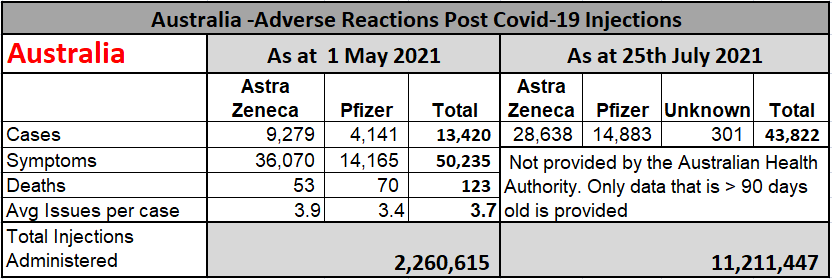
    While the Australian government releases death statistics (allegedly from Covid) on a day-to-day basis it only releases vaccine-related deaths that are at least 90 days old. Thus we know that from the 6 days 18-23 August there were 17 so-called Covid deaths, those dying after having tested positive for Covid-19. It could be that every one of those 17 deaths were vaccine victims.

    The latest figures we have show that there were 123 deaths by 1 May from the two vaccines. The Covid deaths as of 23 August stood at 984. We know that by 31 August 2020 there were 682 deaths claimed to be Covid-19 deaths. We also know that people vaccinated develop Covid from the spike protein. So every vaccine associated death is likely to be a Covid-19 statistic. The vaccines are killing people and this is being covered up with at least a 3 month lag in the release of figures.

    Is it any wonder that the lorry-drivers have decided to do the job idle politicians, frightened medics and lawyers choose to ignore? On 31 August the truck drivers will bring Australia to a standstill until the government caves in. Clearly they do not want to be the victims of untested, unsafe vaccines. It is not just the lorry drivers. Militia groups are beginning to form ready to back up the lorry drivers. This blog has heard of two such groups on the ground in Australia.

    And there are whispers of not just private militia organisations from veteran Australians but groups ready to support them from around the world. Their battle is everyone’s battle. Their war is our war. Join them. Give them your support.

    *

    Note to readers: Please click the share buttons above or below. Follow us on Instagram, @crg_globalresearch. Forward this article to your email lists. Crosspost on your blog site, internet forums. etc.

    This article was originally published on the author’s blog site, All the Goss.

    Featured image is from All the Goss

    Lettori fissi